
You have an API, a handful of related substances, and a deadline. Which column you hang on the instrument sets the ceiling on everything downstream: resolution, run time, robustness, and how often you will be back here. Most method development time is lost scouting the wrong phase chemistry, not tuning the gradient.
Below: an HPLC column selection chart for eight common stationary phases, the column format choices (particle size, length, inner diameter), a decision tree for column selection based on the nature of the molecule, what a scouting gradient should test, and where a computed suggestion helps. It uses real results from CovaSyn's method analysis, including where those results are thin.
Selectivity beats efficiency, almost always
Resolution is driven by three terms: efficiency (N), retention (k), and selectivity (alpha). Doubling plate count buys you a factor of about 1.4 in resolution. Moving alpha from 1.02 to 1.05 buys you far more, for free.
Column selection is therefore a selectivity decision, not an efficiency decision. Sub-2 µm particles and long columns give you N. Only the stationary phase chemistry, mobile phase pH, and organic modifier give you alpha. If a critical pair co-elutes on C18, a longer C18 rarely fixes it. A different interaction mechanism usually does. So scout phases that are chemically *different* from each other, not three C18s from three vendors.
HPLC column selection chart: eight stationary phases compared
The chart below covers the phases that solve most small-molecule separations in pharmaceutical analysis. Read it by mechanism, not by name: two columns are only worth scouting side by side if their dominant interaction differs.
| Stationary phase | Retention mechanism | Selectivity features | Typical analytes | Watch-outs |
|---|---|---|---|---|
| C18 (ODS) | Hydrophobic partitioning into the alkyl chains | Separates mainly by hydrophobicity, strongest retention of the alkyl phases | Neutral and ion-suppressed small molecules of moderate lipophilicity, the default first pass | Very polar analytes elute near the void; conventional C18 can dewet (phase collapse) in nearly 100 % aqueous mobile phase; residual silanols cause tailing of bases |
| C8 | Hydrophobic, weaker than C18 | Selectivity often close to C18, with shorter retention | Lipophilic compounds that over-retain on C18, late-eluting impurities | Not a truly orthogonal partner to C18 in a scouting set; even less retention for polar analytes |
| Phenyl-hexyl | Hydrophobic plus pi-pi interaction with aromatic rings | Differentiates by aromaticity, conjugation and ring substitution | Aromatic positional isomers, ring-substituted impurities, conjugated systems | Pi-pi selectivity is stronger in methanol than in acetonitrile, whose own pi electrons compete; weaker retention of aliphatic compounds than C18 |
| PFP (pentafluorophenyl) | Hydrophobic, pi-pi with an electron-deficient ring, dipole-dipole, hydrogen bonding, some ion exchange | Shape and positional selectivity, distinctive for halogenated compounds | Halogenated analytes, positional isomers, polar aromatics, basic compounds | Several mechanisms act at once, so retention responds strongly to modifier, pH and buffer; fix them early before comparing columns |
| Cyano (CN) | Weak hydrophobic plus dipole-dipole | Different selectivity for polar functional groups; usable in reversed-phase and normal-phase mode | Moderately polar compounds, an alternative selectivity when alkyl phases fail | Low retention in reversed phase; bonded cyano phases are generally less hydrolytically stable than C8 or C18 |
| Polar-embedded (amide or carbamate group in the alkyl chain) | Hydrophobic plus hydrogen bonding via the embedded group | Elution order of hydrogen-bond donors such as phenols can shift relative to C18; embedded group shields silanols | Polar compounds and bases that need better peak shape, highly aqueous conditions | Selectivity is not a drop-in replacement for C18, so re-check critical pairs after a switch |
| HILIC (bare silica, amide, diol, zwitterionic) | Partitioning into a water-enriched layer on a polar surface, plus hydrogen bonding and electrostatic interaction | Elution order roughly reversed compared with reversed phase; water is the strong solvent | Very polar and charged small molecules: polar bases, amino acids, sugars, polar metabolites | Needs a high-organic mobile phase and a high-organic sample diluent, otherwise peaks distort; equilibration takes longer than in reversed phase |
| Mixed-mode (reversed phase plus anion or cation exchange) | Hydrophobic plus ionic interaction | Retention tunable by pH, ionic strength and organic content | Charged and zwitterionic analytes, API and counter-ion in one run, polar ions without ion-pairing reagents | More method variables to control; chemistries differ widely between suppliers, so transfer to another mixed-mode column is not one-to-one |
A ninth phase worth knowing is biphenyl: a stronger pi-pi phase than phenyl-hexyl, useful for aromatic impurity families that C18 cannot separate.
For a first scout pick one hydrophobic phase, one pi-active phase, one polar-retention phase. Three different mechanisms tell you more in a day than eight columns from the same family.
Particle size, column length and inner diameter
Phase chemistry sets selectivity. The column format sets efficiency, run time, pressure and solvent use. These relationships are general chromatography, independent of supplier.
- Particle size. Smaller particles give higher efficiency per unit length and lose less efficiency at higher flow rates. The price is back pressure, which rises roughly with the inverse square of the particle diameter at constant linear velocity. Fully porous sub-2 µm particles therefore need a UHPLC system rated for the pressure and with low extra-column volume. Superficially porous (core-shell) particles around 2.6 to 2.7 µm reach efficiencies close to sub-2 µm fully porous particles at a lower pressure. Fully porous 3 to 5 µm particles remain the robust standard on conventional HPLC.
- Column length. Plate count scales with length, but resolution scales with the square root of plate count. Doubling the length buys about 1.4 times the resolution and costs twice the run time and twice the pressure. Short columns (50 mm) suit fast scouting and assays; 150 to 250 mm suit complex related-substance profiles.
- Inner diameter. At the same linear velocity, flow scales with the square of the diameter. Moving from 4.6 mm to 2.1 mm ID cuts flow and solvent use by a factor of about 4.8, fits the flow rates electrospray MS handles well, and gives taller peaks for the same injected mass. The narrower column is also more sensitive to extra-column band broadening, so tubing, detector cell and injection volume have to scale down with it. 4.6 mm ID remains the tolerant choice on standard HPLC with UV detection.
- Pore size. Small molecules are well served by pores of roughly 80 to 120 Å. Peptides and proteins need wide pores, typically around 300 Å, to access the bonded surface.
- pH range. Conventional silica-based phases are typically specified for roughly pH 2 to 8. Working at high pH, for example to neutralise a base, requires a column specified for it, such as a hybrid-particle phase.
Selection based on the nature of the molecule
The quickest way to a short list is to read the molecule before you read a catalogue. Work through the tree in this order: polarity first, then ionisation, then structural features, then detection. Thresholds are rough guides for a starting column, not hard limits.
1. Polarity: use logD at your working pH, not only logP. - logD below about 0 (very polar, often charged): HILIC first, amide or zwitterionic. Alternatives: an aqueous-stable C18 or a polar-embedded phase run at high water content, or mixed-mode if the analyte carries a charge. - logD about 0 to 1: polar-embedded or aqueous-stable C18 as the reversed-phase option, PFP as the second mechanism, HILIC as the orthogonal check. - logD about 1 to 4: C18 as the default, with phenyl-hexyl or PFP as the orthogonal scout. - logD above about 4: C18 with a steep, high-organic gradient, or C8 if retention runs too long. 2. Ionisation: place the pH deliberately relative to every pKa. - Set the mobile phase pH at least 2 units away from each relevant pKa, so small pH errors do not move retention. - Acids: low pH suppresses ionisation and increases reversed-phase retention. - Bases: low pH keeps them fully protonated and reproducible, but less retained. High pH, above pKa plus 2, makes them neutral and better retained, and needs a column specified for high pH. - Basic analytes and silanols: ionised residual silanols on the silica surface interact with protonated bases and cause tailing. Low pH, high-purity end-capped silica and polar-embedded phases reduce the effect, as does adequate buffer strength. - Permanently charged species and zwitterions (quaternary amines, sulfonates, amino acids): mixed-mode or HILIC. Classic ion-pairing reagents work on C18 too, but equilibrate slowly and are a poor fit for MS. - API plus counter-ion, or acids and bases in one sample: mixed-mode is often the only phase that retains all of them in one run. 3. Structural features: match the phase to what distinguishes the critical pair. - Aromatic or conjugated analytes that differ in ring substitution: phenyl-hexyl or biphenyl, run with methanol to strengthen pi-pi selectivity. - Halogenated compounds and positional isomers (ortho, meta, para): PFP. - Hydrogen-bond donors such as phenols where C18 gives no separation: a polar-embedded phase or cyano. - Enantiomers: no achiral column separates them; a chiral stationary phase is required. - Peptides and proteins: wide-pore phases; shorter alkyl chains such as C4 or C8 are common for proteins. 4. Detection: let the detector constrain the mobile phase and format. - LC-MS: volatile buffers such as formate, acetate or ammonium bicarbonate; no phosphate, no non-volatile ion-pairing reagents. Trifluoroacetic acid suppresses electrospray signal. A 2.1 mm ID column fits the flow. - Low-wavelength UV: acetonitrile has better UV transparency than methanol.
The same tree as a short list:
| Molecule | First column | Orthogonal second column |
|---|---|---|
| Neutral, moderately lipophilic | C18 | Phenyl-hexyl or PFP |
| Very polar or charged, elutes at the void on C18 | HILIC (amide or zwitterionic) | Polar-embedded or aqueous-stable C18 |
| Basic, tails on C18 | Polar-embedded or high-purity end-capped C18 at low pH | High-pH-stable phase at high pH, or PFP |
| Aromatic positional isomers | Phenyl-hexyl or biphenyl with methanol | PFP |
| Halogenated analytes | PFP | Phenyl-hexyl |
| Charged species plus counter-ion | Mixed-mode | HILIC |
| Enantiomers | Chiral stationary phase | Second chiral phase with a different selector |
Worked example: a polar basic API and its acid impurity
Take atenolol as the API and its carboxylic acid degradant as the related substance. A classic method development trap.
The structure and pKa analysis returned for atenolol:
- MW 266.34, TPSA 84.58 Ų
- logP consensus −0.401 (Crippen 0.452, Moriguchi −1.254)
- Basic pKa 10.5, secondary amine, dominant species at pH 7.4 is the cation
Caveat up front: the pKa estimate flags its own reliability as medium, with an accuracy of roughly plus/minus 1.0 pKa unit. The logP figure is a consensus across several estimation methods. Both are estimates for triage, not measured values.
That profile already states the problem. A logP below zero plus an amine protonated across the whole usable pH range means almost no hydrophobic driving force on a C18.
The method suggestion for atenolol returned verbatim:
- Column: C18 ODS 150 x 4.6 mm
- Mobile phase A: water + 0.1% formic acid
- Mobile phase B: acetonitrile
- Gradient: 0 min 5% B, 2 min 15% B, 12 min 60% B, 15 min 60% B
- Flow: 1.0 mL/min
- Predicted retention time: 2.3 min
The retention time prediction gave 2.3 min for atenolol and 2.6 min for the acid degradant, both on the same C18 under ACN/water.
Two things fall out immediately, and they are the reason a chemist still has to read the result.
The retention factor is too low.
For a 150 x 4.6 mm column at 1.0 mL/min, assuming a total porosity of about 0.65, the void volume is roughly 1.62 mL, so t0 is about 1.62 min. That puts atenolol at k of about 0.42 and the acid at about 0.60. Anything under k = 2 sits where injection solvent strength, diluent mismatch, and unretained matrix all move your peak. Not a robust place for a release method.
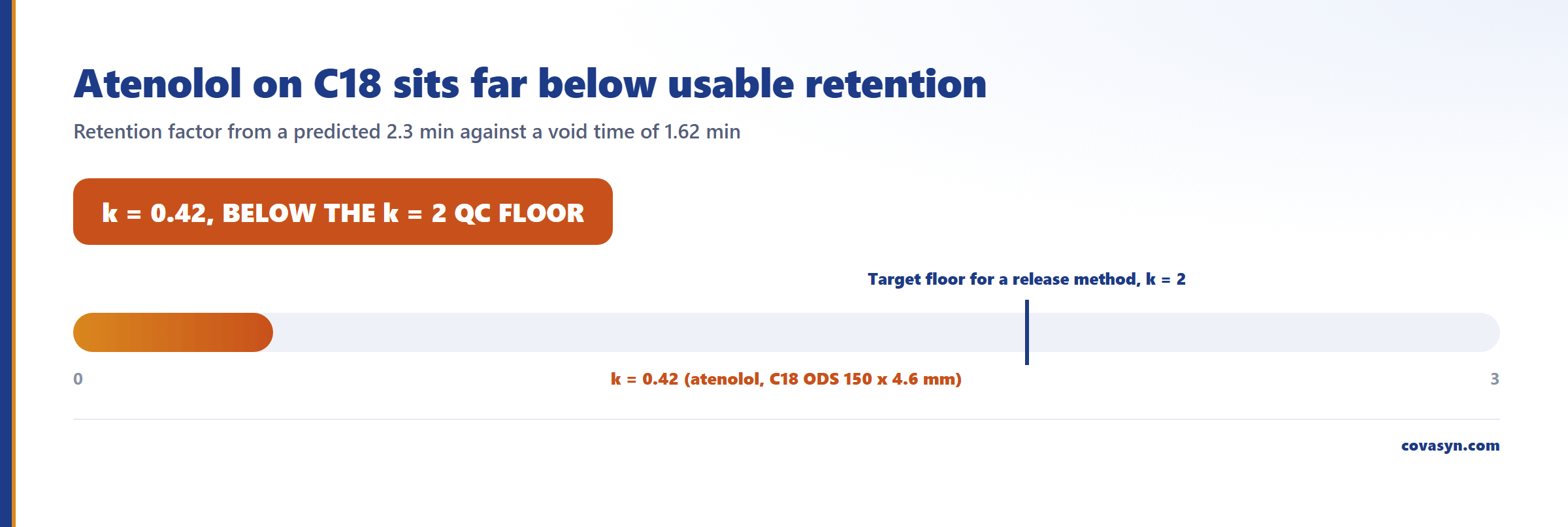
The pair is 0.3 min apart, near the void.
A 0.3 min gap sounds fine until you notice both peaks land in the part of the chromatogram where matrix salts, excipients, and the solvent front live.
The correct read of that output is not "run this method". It is "C18 will not hold this API, go to a polar-retention mechanism": a polar-embedded or AQ-type C18 that survives high aqueous, a HILIC amide phase where the protonated amine is retained rather than repelled, or a PFP where the cation gets some ion-exchange retention from residual silanols at low pH. That judgement is what the prediction should trigger, not replace. It is also exactly where the decision tree above lands for a base with logD below 0: HILIC first, a polar-embedded phase as the reversed-phase alternative.
Contrast: a lipophilic neutral
Run the same analysis on celecoxib and the picture changes. The structure analysis gives MW 381.38, logP 3.514, TPSA 77.98 Ų. The method suggestion returned:
- Column: C18 ODS 150 x 4.6 mm
- A: water + 0.1% TFA, B: acetonitrile
- Gradient: 0 min 20% B, 2 min 30% B, 12 min 80% B, 15 min 80% B
- Flow: 1.0 mL/min
- Predicted retention time: 4.5 min
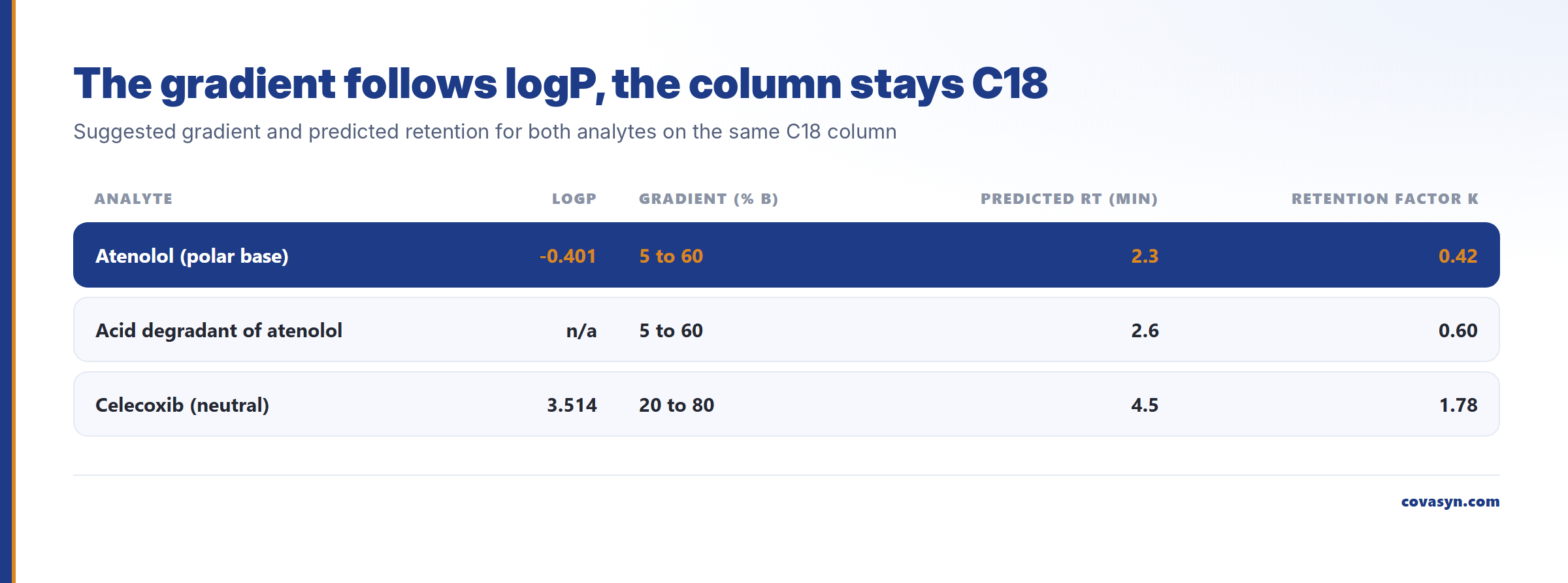
Same t0 assumption gives k of about 1.78. Still low for a stability-indicating method, but a sane starting point, and the proposed window (20 to 80% B rather than 5 to 60% B) is the right shape for a logP 3.5 analyte. That difference between the two suggestions is where the value sits: the organic window and the acid modifier are scaled to the structure, which saves you the first scouting run.
Where a computed column recommendation stays thin
Being direct, because you will notice it in five minutes: both molecules got the same column recommendation, a C18 ODS 150 x 4.6 mm as the general-purpose phase. The same recommendation for a logP −0.4 base that stays protonated at usable pH and for a logP 3.5 neutral sulfonamide is a sensible default, not a differentiated choice. The method suggestion and the retention time prediction are useful for the parts that do vary with structure; override the column field using the column selection chart and the decision tree above.
Second honest observation: the pKa estimate labelled celecoxib's sulfonamide NH2 as a basic primary amine at pKa 10.0. That sulfonamide is in fact weakly acidic. With a rule-based estimate at plus/minus 1.0 pKa unit, this is what that limitation looks like in practice. Check the list of ionizable groups before building a pH strategy on it.
A scouting strategy that actually converges
1. Get pKa and logP first. Structure in, estimates out, one minute. It tells you whether this is a reversed-phase problem or a polar-retention problem before you touch a column. 2. Fix pH deliberately, at least 2 units from every pKa. For a base with pKa 10.5 that means low pH (fully protonated, reproducible) or a high-pH-stable hybrid particle (neutral, retained). The middle is where retention drifts batch to batch. 3. Run a broad linear scout: 5 to 95% B over 20 column volumes. On two or three mechanistically different phases, with both acetonitrile and methanol. A modifier swap routinely changes alpha more than a column swap. 4. Read k for the first and last peak, then convert the scout into a focused gradient so everything lands between k = 2 and k = 10. 5. Only then optimise. Slope, temperature and buffer strength are fine-tuning. If the critical pair is unresolved at the scouting stage, change the mechanism, not the slope.
What this does not tell you
- Predicted retention is not measured retention. The confidence that comes with the prediction is the model's own estimate, not a validated accuracy figure against your instrument, column lot, or dwell volume.
- No peak shape, no plate count, no resolution. Tailing from silanol interaction, the biggest risk for a protonated base on bare-silica C18, is not modelled.
- No degradant discovery. This assumes you already know what you are separating. Forced degradation and mass balance are a separate exercise.
- No system suitability, no validation. Nothing here substitutes for ICH Q2 validation or a real SST. It is triage, to cut the number of scouting runs.
Frequently asked questions
How do I choose an HPLC column?
Start from physicochemistry, not from habit. Get logP or logD and pKa, then match the retention mechanism: C18 for neutrals with logD roughly 1 to 4, polar-embedded or aqueous-stable phases for logD below 1, HILIC for logD below 0 or permanently ionised analytes, phenyl-hexyl or PFP when you need pi or dipole selectivity for aromatic or halogenated isomers, and mixed-mode for charged species with their counter-ions. Then pick the format: 150 x 4.6 mm for conventional HPLC with UV, shorter 2.1 mm columns with smaller particles for UHPLC and LC-MS. Scout three mechanistically different phases, not three C18s.
C18 or phenyl-hexyl: which one should I pick?
Start on C18 when the compounds you need to separate differ mainly in hydrophobicity. Switch to, or scout in parallel, phenyl-hexyl when the critical pair differs in aromaticity, conjugation or the position of a ring substituent, or simply co-elutes on C18. Run phenyl-hexyl with methanol at least once: acetonitrile dampens the pi-pi interaction that gives the phase its distinct selectivity. Expect less retention for aliphatic compounds than on C18.
When should I use HILIC instead of reversed phase?
When your analytes are so polar that they elute at or near the void on reversed phase even at high water content, typically at logD below about 0, and for small charged molecules such as polar bases, amino acids or sugars. HILIC also suits LC-MS, because the high-organic mobile phase helps electrospray desolvation. Plan for its demands: dissolve samples in a high-organic diluent, allow longer equilibration, and remember that water is the strong solvent.
What particle size and column dimensions should I start with?
On a conventional HPLC with UV detection, 150 x 4.6 mm with 3 to 5 µm fully porous or about 2.7 µm superficially porous particles is a tolerant, transferable start. On UHPLC or LC-MS, 50 to 100 x 2.1 mm with sub-2 µm particles is common, provided the system handles the pressure and has low extra-column volume. Settle the phase chemistry first; format changes buy efficiency and speed, not selectivity.
Which column helps against peak tailing of basic compounds?
Tailing of bases mostly comes from interaction with ionised residual silanols. Use a high-purity, end-capped silica or a polar-embedded phase, run at low pH where silanols are largely protonated, and use adequate buffer strength. If the base must be neutral for retention, work at high pH on a column specified for it.
What is a good scouting gradient for HPLC method development?
A broad linear gradient of 5 to 95% organic over about 20 column volumes, at a fixed pH set at least 2 units away from every analyte pKa, run with both acetonitrile and methanol. That single experiment tells you the elution window, whether anything sticks or elutes at the void, and whether modifier choice changes selectivity. Convert the result into a focused gradient targeting k between 2 and 10.
What retention factor should I target in a QC method?
Aim for k between 2 and 10 for all reported peaks. Below k = 2 you sit in the void region where injection solvent strength, sample diluent, and matrix components shift retention, which makes the method fragile in transfer. Above k = 10 you pay in run time and peak dilution without gaining resolution.
Why does my polar basic API elute at the void on C18?
Because there is almost no hydrophobic driving force. A compound with logP near or below zero and an amine that stays protonated across the usable pH range has little to partition into a C18 chain. In our worked example the structure analysis returned logP consensus −0.401 and basic pKa 10.5 for atenolol, and the C18 method predicted a retention factor near 0.4. The fix is a different retention mechanism: HILIC, a polar-embedded phase, or PFP.
Does column selectivity matter more than column efficiency?
Yes, in most real separations. Resolution scales with the square root of plate count but roughly linearly with the selectivity term. Going from a 2.7 µm to a 1.8 µm particle gains you modest resolution. Changing to a phase with a different interaction mechanism, or swapping acetonitrile for methanol, can move a co-eluting pair to baseline separation. Optimise alpha first, N last.
Can software pick the column for me?
It can narrow the field and set a sensible gradient window, and it can do that in seconds from a SMILES string. It cannot predict peak shape, silanol tailing, column lot variability, or your instrument dwell volume. Treat computed retention as a scouting shortcut with a stated confidence, then confirm on the instrument.
Related reading
Evaluation for this topic
We evaluate this for your lab.
- HPLC method development: column, gradient, retention time.