
An extractables study gives you a peak list, often 200 to 600 features. The hard part is not acquiring it. The hard part is deciding which peaks are above the analytical evaluation threshold, which of those you can name, and which named compounds actually carry a toxicological question. This article walks the screening half of that workflow with real results, and is explicit about where the automation stops.
The order the decisions actually happen in
USP <1663> covers the extractables study design (exaggerated conditions, multiple solvents, container closure components). USP <1664> covers leachables, the subset that migrates into the drug product under real storage. In practice you run four steps, in this order:
1. Set the AET. Below it you do not report. Above it you must identify. 2. Match what is matchable. Common polymer additives are a known, finite list. Hit them first. 3. Escalate the rest. Unmatched peaks above AET go to formula determination and MS/MS. 4. Hand structures to toxicology. Only once you have a structure does the safety question become answerable.
Steps 2 and 4 are where a structure-first analysis earns its place. Steps 1 and 3 stay judgement-heavy.
Step 1: the AET is an arithmetic step, not a model
The AET is derived, not predicted. In the common form:
AET = (SCT [µg/day] / daily dose [containers or mL per day]) x (1 / response factor uncertainty)The safety concern threshold is set by the dosage form. PQRI recommended 0.15 µg/day as the SCT for orally inhaled and nasal drug products, and 1.5 µg/day for parenteral and ophthalmic products in its later recommendation. For mutagenic impurities, ICH M7 sets the TTC at 1.5 µg/day for lifetime exposure, with higher acceptable intakes for less-than-lifetime durations. You then apply an uncertainty factor to the estimated AET because you are quantifying unknowns against a surrogate response factor, commonly by dividing by 1.5 to 2.
No software should hand you this number. It depends on your dose, your container count, your dosage form and your RF database. Compute it, document the assumptions, and use it as the cut line for everything below.
Step 2: match the known additive list
In the first pass, CovaSyn's analysis matches the peak list against common additives for the given container type, on protonated monoisotopic mass in a deliberately wide mass window.
Run on a seven-peak list from a polymer container extract, that gave four identifications:
| Peak m/z | Assigned | Formula | Mass error |
|---|---|---|---|
| 229.1223 | Bisphenol A | C15H16O2 | 1.31 ppm |
| 391.2843 | DEHP | C24H38O4 | 0.77 ppm |
| 282.2791 | Oleamide | C18H35NO | 0.35 ppm |
| 338.3417 | Erucamide | C22H43NO | 0.89 ppm |
Three peaks did not match: 647.4587, 1177.7914 and 114.0913. The same match for rubber on a stopper extract assigned m/z 221.190 to BHT at 0.00 ppm error.
Be clear about what this is.
A match against the most frequent additives per container type is not an exhaustive E&L information system. A match on [M+H]+ alone misses additives that ionise better as [M+NH4]+, [M+Na]+ or [M-H]-, even when they are present. Treat a match as a hypothesis to confirm against a reference standard, and treat a non-match as no information at all.
Step 3: unmatched peaks go to formula determination
The 647.4587 peak from the run above is a typical unknown: high intensity, late retention, no match to a known additive. Our formula search at a 5 ppm window returned 45 candidate formulae. The top-ranked one was C42H63O3P, exact mass 646.45148, mass error 0.0926 ppm, RDBE 12. That is consistent with Irgafos 168, a very common phosphite antioxidant.
It is also where the honesty matters. Forty-five formulae fit inside 5 ppm at m/z 647. For a late peak in a polyolefin extract, Irgafos 168 is the obvious candidate, but that does not confirm it: you need the isotope pattern, MS/MS fragments, the oxidised form (phosphate, m/z 663) as a companion peak and a retention time match to the standard. The formula search ranks candidates; it does not close the identification.
Step 4: structures go to toxicological triage
Once you have structures, the question changes to toxicology. What matters is mutagenic potential, a compound-specific daily value and the comparison with the measured amount; endpoints such as hERG or liver injury are only supplementary hints here. Besides the compounds from the peak match, we added caprolactam to the triage, a typical extractable from polyamide parts; it is not identified in the run above. The tox triage rated all five compounds at medium overall risk, with these composite risk scores:
- Caprolactam 0.418 (highest value in the batch)
- DEHP 0.387
- Bisphenol A 0.340
- Oleamide 0.104
- BHT 0.101
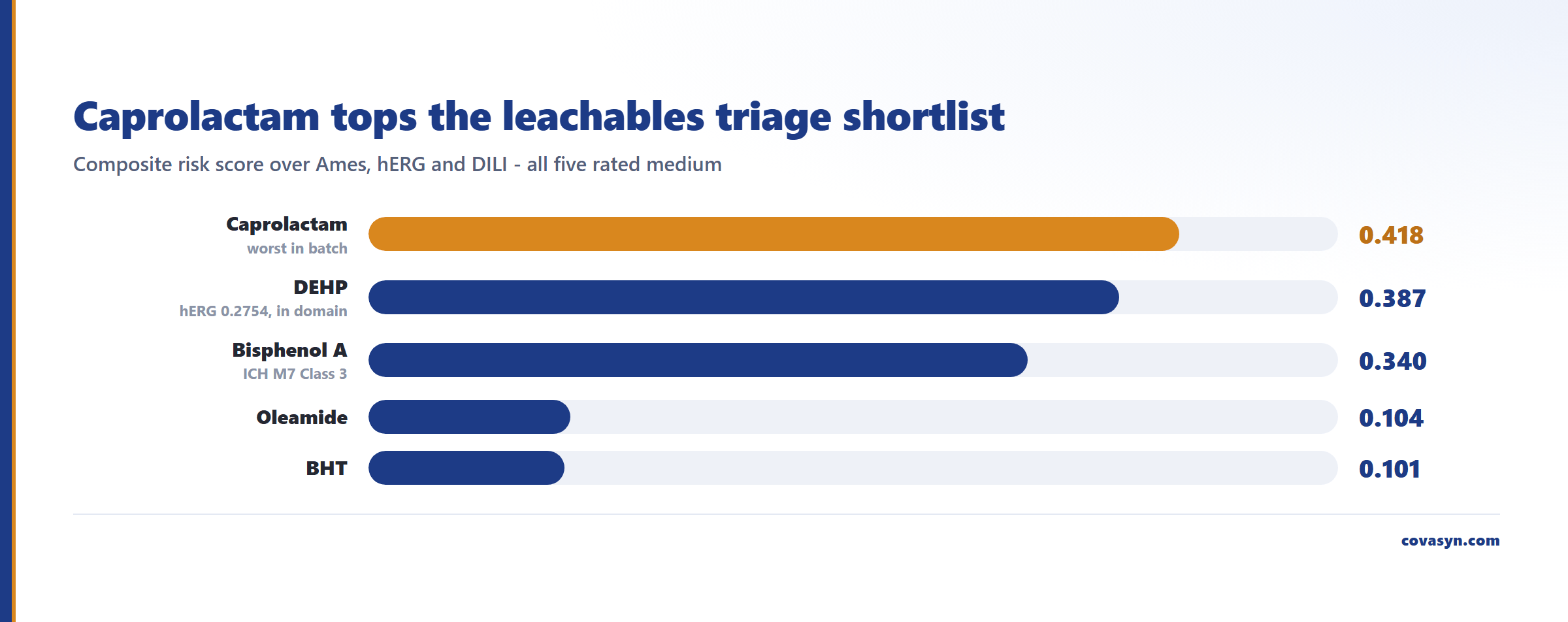
The individual predictions are more informative than the composite. DEHP returned hERG 0.2754 inside the model's applicability domain, plus DILI 0.0436 at confidence 0.9128, also in domain. Those two are usable signals.
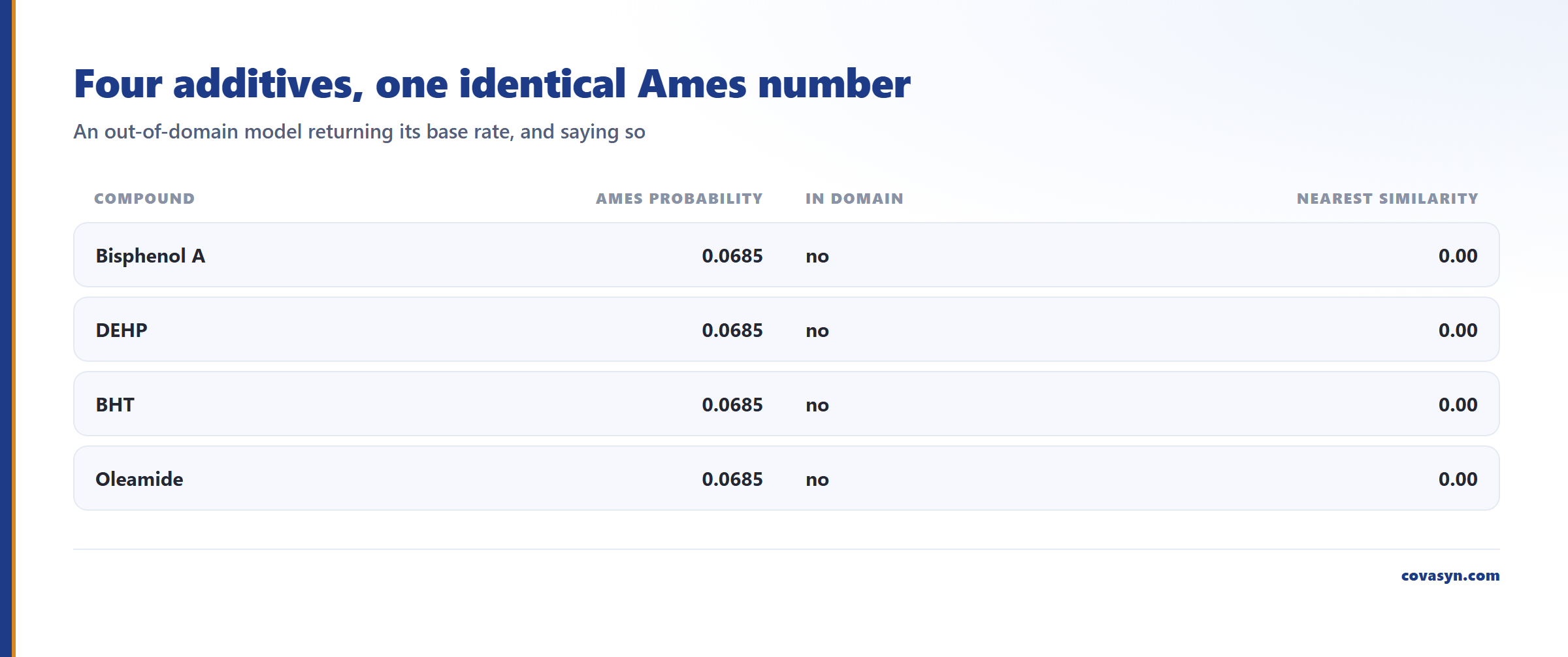
The Ames output on the same batch is not. Bisphenol A, DEHP, BHT and oleamide all returned exactly 0.0685, and every one of those predictions was flagged as outside the applicability domain. That is the model returning its base rate and telling you so. Polymer additives are chemically far from the drug-like Ames training set. Do not read 0.0685 as "not mutagenic." Read it as "this model has nothing to say about this molecule."
For context on where the models are calibrated: our hERG model scores AUROC 0.856 on a held-out, scaffold-split test set (n = 7,500), and the Ames model 0.736 balanced accuracy on a scaffold split (0.848 on a random split, n = 1,089). Good numbers inside the domain; irrelevant outside it, which is exactly what the applicability domain flag is for.
Reading it by ICH M7 principles drives action
Leachables are formally outside ICH M7; PQRI recommendations, USP <1663>/<1664> and the ICH Q3E draft apply. For the mutagenicity question, ICH M7 principles apply by analogy (structural alerts plus statistical model, then a check against existing data):
- Bisphenol A: The quinone methide precursor alert fires (mechanism: oxidation to quinone methide, Michael addition to DNA; weak evidence, Bolton et al. 2000), the statistical model is negative (0.0685, confidence 0.588). Without data this would be class 3 under ICH M7 logic. BPA, however, has negative Ames data; mutagenic potential is ruled out and the assessment runs via a compound-specific daily value.
- Caprolactam: No alerts, statistical score 0.1677, negative, confidence 0.348, and the statistical arm was out of domain. Caprolactam has tested negative in the Ames test; here too the assessment runs via a compound-specific daily value.
The actionable output of the chain is the data check: it converts a peak at m/z 229.1223 into an assessment against a daily value instead of an unnecessary Ames test.
What this workflow does not tell you
- It does not quantify. Every number above is an identification or a hazard score. Concentration against the AET requires your calibration and your response factors.
- It does not confirm identity. An additive match and a top-ranked formula are hypotheses. Regulatory identification needs a reference standard, or at minimum matching MS/MS and retention time.
- It does not do the toxicological risk assessment. A qualified toxicologist reads the ICH M7 class, the PDE derivation and the exposure calculation. The screen narrows the list they read.
- The additive match is not exhaustive. Absence of a hit is not absence of a compound.
- Out-of-domain predictions are labelled and should be ignored, not discounted. Four of five Ames calls in this batch were out of domain.
Frequently asked questions
What is the analytical evaluation threshold (AET) in an E&L study?
The AET is the concentration above which an extractable or leachable must be reported and identified. It is calculated, not predicted: divide the safety concern threshold for the dosage form by the maximum daily dose (containers or mL per day), then apply an uncertainty factor for response factor variability, commonly a division by 1.5 to 2. PQRI recommended an SCT of 0.15 µg/day for orally inhaled and nasal drug products and 1.5 µg/day for parenteral and ophthalmic products.
What is the difference between USP <1663> and USP <1664>?
USP <1663> covers extractables: what comes out of a packaging or manufacturing component under exaggerated conditions such as aggressive solvents, elevated temperature and long contact. USP <1664> covers leachables: what actually migrates into the drug product under normal storage and use. Extractables define the worst-case candidate list. Leachables define what a patient is actually exposed to, and are usually a small subset.
Can software identify an unknown extractable from accurate mass alone?
No. At m/z 647 with a 5 ppm window, our formula search returned 45 candidate formulae. The top hit by mass error was C42H63O3P at 0.09 ppm, consistent with Irgafos 168, the obvious candidate for a late peak in a polyolefin extract. Accurate mass narrows candidates. Confirmation requires the isotope pattern, MS/MS fragmentation, and a retention time match to a reference standard.
How should mutagenicity be assessed for an identified leachable?
Leachables are formally outside ICH M7; its principles apply by analogy: an expert-rule structural alert system plus a statistical QSAR model, followed by a check against existing test data. In our run, bisphenol A fired one alert (quinone methide precursor) with a negative statistical call; without data that would be class 3. Since BPA has negative Ames data, the assessment runs via a compound-specific daily value. Caprolactam returned no alerts and is also Ames negative.
Why do in-silico tox models sometimes return the same value for different compounds?
Because they are out of applicability domain and returning a base rate. Four polymer additives in our batch returned an identical Ames probability of 0.0685, each flagged as outside the applicability domain. Polymer additives sit far from drug-like training data. A model that flags this is behaving correctly; the value should be discarded, not treated as low risk.
Does an automated screen replace a toxicological risk assessment?
No. The screen triages: it names the peaks that are nameable, ranks formulae for the rest, and separates compounds that carry a structural alert from those that do not. A qualified toxicologist still derives the PDE, judges the exposure, and signs the assessment. The value is that they review a prioritised shortlist instead of a raw feature table.
Related reading
Evaluation for this topic
We evaluate this for your lab.
- Mass spectra, formula prediction, impurity profiling.
- ICH M7, Tox21, CYP450, structural alerts, ADMET triage.