

You ran a screening design, found the three factors that matter, and now someone wants a response surface and a design space. The default move is to build a fresh central composite design and run it. That throws away every screening run you already paid for. It also, in most real processes, asks you to run experiments outside your equipment limits.
Augmentation is the alternative: keep the screening runs, add only the runs the quadratic model is actually missing, and fit one model on the combined set.
The worked example
Suzuki-type aryl halide coupling, six factors screened: temperature (60 to 120 °C), catalyst loading (0.5 to 5 mol%), base equivalents (1 to 3), water fraction (0 to 20%), time (2 to 16 h), boronic acid equivalents (1 to 1.5).
Screening design: a 13-run definitive screening design from our design-of-experiments analysis. Thirteen runs, six factors, main effects clear of two-factor interactions, and curvature detectable because the DSD carries three levels per factor. Run 13 is the all-centre run.
Screening flags temperature, catalyst loading and time as active. Base equivalents, water fraction and boronic acid equivalents come back inactive.
Now the question: what does it cost to get a quadratic model on the three survivors?
Option A: augment, 8 new runs
Augment to a central composite design in the three active factors, temperature, catalyst and time, with three centre points and reuse of existing centre runs.
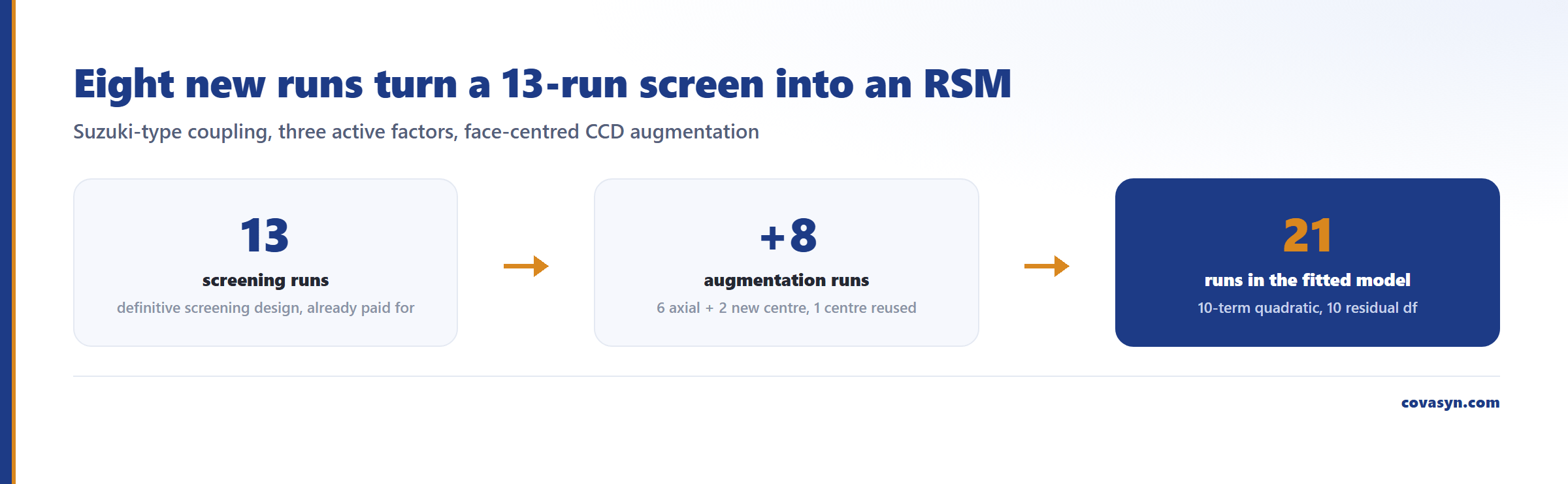
The result: 6 axial runs, 2 new centre runs, one reused centre run, 8 new runs in total, 21 runs together with the existing ones, coded alpha = 1.0.
Six axial runs, two new centre runs, and index 12 (run 13, the all-centre run from the screen) reused as the third centre point. Eight new experiments. Twenty-one runs in the combined model.
The eight new runs, in real units:
| Run | Temperature (°C) | Catalyst (mol%) | Time (h) | Role |
|---|---|---|---|---|
| 14 | 60.0 | 2.75 | 9.0 | axial, low T |
| 15 | 120.0 | 2.75 | 9.0 | axial, high T |
| 16 | 90.0 | 0.5 | 9.0 | axial, low cat |
| 17 | 90.0 | 5.0 | 9.0 | axial, high cat |
| 18 | 90.0 | 2.75 | 2.0 | axial, short |
| 19 | 90.0 | 2.75 | 16.0 | axial, long |
| 20 | 90.0 | 2.75 | 9.0 | centre |
| 21 | 90.0 | 2.75 | 9.0 | centre |
Option B: start over, 17 new runs
For comparison I built a fresh three-factor CCD with three centre points over the same ranges. It comes to 17 runs: 8 factorial, 6 axial, 3 centre, with coded alpha = 2.1213 (rotatable).
That design is statistically prettier. It is also not runnable. The axial points it asks for, in real units:
- Temperature 26.36 °C and 153.64 °C
- Catalyst −2.02 mol% and 7.52 mol%
- Time −5.85 h and 23.85 h
Negative catalyst loading and negative reaction time. That is what a rotatable CCD does when you hand it your operating range as the factorial range: it extrapolates the star points by a factor of 2.12 beyond the cube. In practice you either shrink the factorial box (and lose signal) or clamp alpha to 1.0 and end up with the face-centred design augmentation gives you anyway.
Side by side
| Augment (Option A) | Start over (Option B) | |
|---|---|---|
| New experiments | 8 | 17 |
| Runs in the fitted model | 21 | 17 |
| Residual df (10-term quadratic) | 10 | 6 |
| Axial style | alpha = 1.0, face-centred | alpha = 2.12, rotatable |
| Axial points inside equipment limits | yes | no (negative time and catalyst) |
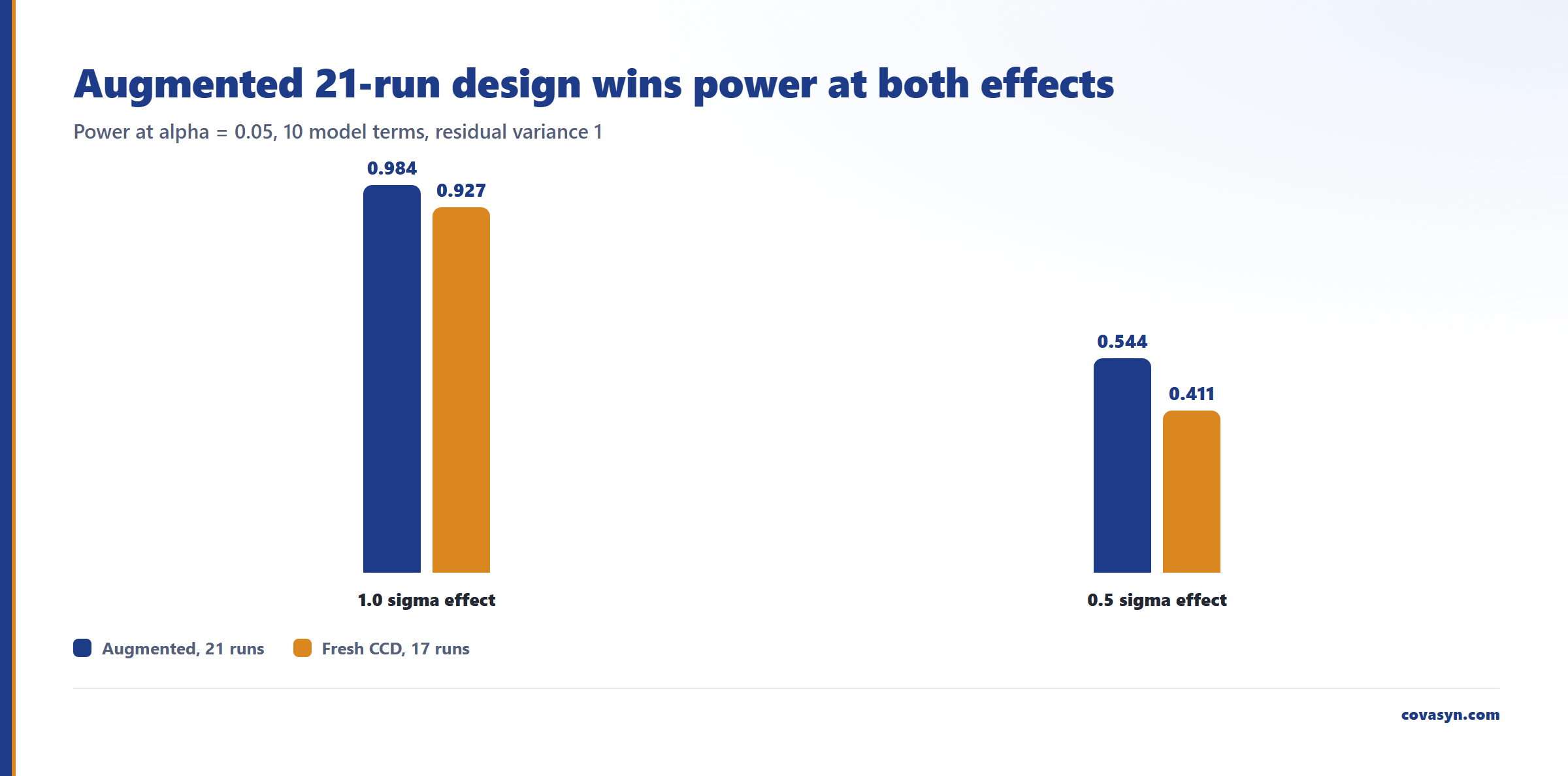
| Power, 1.0 sigma effect | 0.984 | 0.927 |
| Power, 0.5 sigma effect | 0.544 | 0.411 |
Run counts and alpha from the design-of-experiments analysis, power figures from the power analysis at a significance level of 0.05, 10 model terms (intercept, 3 linear, 3 quadratic, 3 two-factor interaction) and residual variance normalised to 1.
Augmenting costs 9 fewer experiments and buys 4 more residual degrees of freedom, because the 13 screening runs come along for free.
Why the reuse is legitimate
This only works if the factors you dropped were genuinely inactive. The 13 screening runs vary base equivalents, water fraction and boronic acid equivalents across their full ranges. The 8 augmentation runs specify only temperature, catalyst and time: you run those at your fixed setpoints for everything else.
So the combined data set is not clean unless one of these is true:
1. Screening showed the dropped factors have effects small relative to noise, and you accept their residual contribution as part of experimental error. This is the normal case and the reason you ran a screen first. 2. You keep the dropped factors in the model as linear covariates, spending 3 more degrees of freedom.
If screening did not clearly rule those factors out, do not pool. Fix them, and run a design in the three factors you care about. Augmentation is a reward for a screen that gave a clean answer, not a way around an ambiguous one.
What you do with the 21 runs
Fit a quadratic model, then derive the optimum for the setpoint and the proven acceptable range. In a separately documented example (an 18-run CCD with simulated yield values, so treat the fit quality as illustrative and the computational behaviour as real), that chain returned R2 = 0.9988 (adjusted 0.9974), an optimum at 91.2 °C / 3.76 mol% / 9.7 h predicting 93.5% yield with a 95% confidence interval of 93.16 to 93.76 and a prediction interval of 92.73 to 94.20, and a design space over 10,000 Monte Carlo samples where only 10.6% of the range passed a 90% yield spec. Check the residual diagnostics before you believe any of it: on that data set they flagged Shapiro-Wilk p = 0.036 and Cook's D = 0.277 at run 9.
Honest limits
- Face-centred is not rotatable. With alpha = 1.0 the prediction variance is not uniform at equal distance from the centre, and the pure quadratic terms are estimated less precisely than in a rotatable design. You are trading statistical elegance for runs you can actually perform.
- The power numbers are run-count based. Power is computed from run count, number of model terms and effect size, not from your specific model matrix. Treat 0.984 and 0.927 as planning figures for comparing design sizes, not as guarantees for a particular coefficient.
- Augmentation adds a time block. The 13 screening runs and the 8 augmentation runs were made on different days, possibly different reagent lots. If you suspect a shift, add a block term and test it. Augmentation does not do this for you.
- Extrapolation stays extrapolation. The face-centred design covers the cube you screened. Any optimum the RSM puts at a corner is a signal to run another campaign, not a setpoint.
- This is decision support. A response surface built from 21 runs guides your next experiments and your control strategy discussion. It is not a validated method and it is not a filing.
Frequently asked questions
How many runs do I need to augment a screening design to an RSM?
For three factors, augmentation gave 8 new runs: 6 axial points plus 2 new centre points, with one existing all-centre screening run reused as the third centre point. Combined with the 13-run definitive screening design, that gives 21 runs for a 10-term quadratic model. A fresh central composite design over the same three factors needs 17 new runs.
Can I reuse screening runs in a response surface model?
Yes, if the factors you dropped were shown to be inactive during screening. The screening runs vary those dropped factors, so their effect ends up in the residual. That is acceptable when screening showed the effects are small relative to noise. If the screen was ambiguous, either keep the dropped factors in the model as covariates or run a clean design in the surviving factors instead.
Why does the augmented CCD use alpha = 1.0 instead of a rotatable alpha?
Because a rotatable alpha extrapolates outside your operating range. For temperature 60 to 120 °C, catalyst 0.5 to 5 mol% and time 2 to 16 h, a rotatable CCD with alpha = 2.12 asks for −2.02 mol% catalyst and −5.85 h reaction time. Alpha = 1.0 puts the axial points on the faces of the cube you already screened, so every run is physically executable.
Is augmenting statistically worse than running a fresh CCD?
Not in this case. The 21-run augmented design leaves 10 residual degrees of freedom against 6 for the 17-run fresh CCD, and the power analysis gives it higher power at both effect sizes tested (0.984 vs 0.927 at 1 sigma). The trade-off is geometry: the augmented design is face-centred, so prediction variance is less uniform than a rotatable design.
What do I check before trusting the augmented model?
Check the residual diagnostics on the fitted model: normality tests, Cook's distance and leverage per run, which is where a bad screening run or a batch shift between the screening and augmentation campaigns will show up. Then check whether the optimum sits inside the cube. An optimum on a boundary means you have not bracketed it.
Does augmentation work for Box-Behnken or fold-over designs too?
Augmentation is not limited to central composite: axial, fold-over and Box-Behnken augmentation are equally possible. Fold-over is the right choice when your screen was a Resolution III fractional factorial and you need to break the alias between main effects and two-factor interactions before you go anywhere near a response surface.
Related reading
Evaluation for this topic
We evaluate this for your lab.
- Design of Experiments, RSM, templates.