
You have six process factors and a budget for maybe fifteen experiments. A two-level fractional factorial fits the budget but tells you nothing about curvature, so if the optimum sits inside your range you will walk straight past it. A full factorial answers everything and costs 67 runs. The definitive screening design (DSD) is the compromise most process chemists should be reaching for, and this article shows a real one, run by run.
Every number below comes from CovaSyn's design-of-experiments analysis, generated on 2026-07-15. Nothing is illustrative.
What a definitive screening design actually is
A DSD is a three-level design with 2m + 1 runs for m continuous factors. For six factors that is 13 runs. Its structure, from Jones and Nachtsheim (2011, Journal of Quality Technology 43(1)), gives it three properties a two-level screen cannot have:
- Each factor is set at its low, centre and high level, so a quadratic (curvature) term is estimable for every factor.
- Main effects are not aliased with two-factor interactions and not aliased with any quadratic term.
- The runs come in mirror-image pairs, plus one all-centre run.
That last point is the easiest way to recognise a DSD by eye. Run 1 and run 7 below are exact fold-overs of each other, run 2 and run 8, and so on. The fold-over pairing is what clears the main effects.
The example: a Suzuki-type coupling, six factors
Factors and ranges of the design:
| Factor | Code | Low | Centre | High |
|---|---|---|---|---|
| Temperature (°C) | Temp | 60 | 80 | 100 |
| Catalyst loading (mol%) | Cat | 0.5 | 1.5 | 2.5 |
| Base (equiv) | Base | 1.0 | 2.0 | 3.0 |
| Water fraction (%) | H2O | 0 | 10 | 20 |
| Time (h) | Time | 2 | 7 | 12 |
| ArB (equiv) | ArB | 1.0 | 1.3 | 1.6 |
The design has 13 runs. Coded matrix:
| Run | Temp | Cat | Base | H2O | Time | ArB |
|---|---|---|---|---|---|---|
| 1 | 0 | +1 | +1 | +1 | +1 | +1 |
| 2 | +1 | 0 | +1 | −1 | −1 | +1 |
| 3 | +1 | +1 | 0 | +1 | −1 | −1 |
| 4 | +1 | −1 | +1 | 0 | +1 | −1 |
| 5 | +1 | −1 | −1 | +1 | 0 | +1 |
| 6 | +1 | +1 | −1 | −1 | +1 | 0 |
| 7 | 0 | −1 | −1 | −1 | −1 | −1 |
| 8 | −1 | 0 | −1 | +1 | +1 | −1 |
| 9 | −1 | −1 | 0 | −1 | +1 | +1 |
| 10 | −1 | +1 | −1 | 0 | −1 | +1 |
| 11 | −1 | +1 | +1 | −1 | 0 | −1 |
| 12 | −1 | −1 | +1 | +1 | −1 | 0 |
| 13 | 0 | 0 | 0 | 0 | 0 | 0 |
Three things to read off it:
1. Every factor has exactly one 0 in the first twelve runs. Run 1 sets Temp to centre, run 2 sets Cat to centre, and so on down the diagonal. That is where the curvature information comes from. 2. Runs 1 to 6 mirror runs 7 to 12. Flip every sign in run 3 and you get run 9. 3. Run 13 is the all-centre point. In real units that is 80 °C, 1.5 mol% catalyst, 2.0 equiv base, 10% water, 7 h, 1.3 equiv ArB. It does double duty: a pure-error anchor and a curvature check.
Why a two-level screen cannot do this
A two-level design only ever visits the corners of the factor space. Every response it sees is fit by a plane. If yield peaks at 85 °C and falls off at both 60 °C and 100 °C, a two-level design records "temperature has no effect" because the two corner means are identical. That is the failure mode a DSD is built to remove.
Here are six candidates for the same six factors, scored and ranked for a screening goal:
| Design | Runs | D-efficiency | Estimated power | Resolution |
|---|---|---|---|---|
| D-optimal | 19 | 0.9898 | 0.9788 | VI |
| Definitive screening | 13 | 0.7986 | 0.8495 | VI |
| Full factorial 2^6 (+ centres) | 67 | 0.9615 | 1.0000 | Full |
| Fractional factorial | 11 | 0.7611 | 0.7016 | III |
| Latin hypercube | 20 | 0.3800 | 0.9847 | VI |
| Plackett-Burman | 8 | 1.0000 | 0.1757 | III |
The DSD gets a 0.8495 estimated power at 13 runs against 1.0 at 67. You give up some power and buy back 54 experiments. The Plackett-Burman line is the honest counterpoint: D-efficiency 1.0 looks perfect, but at 8 runs the estimated power is 0.1757, so it is efficient at estimating almost nothing.
Caveat on that table: our ranking puts D-optimal first, not the DSD. If you can afford 19 runs and you have a specific model in mind, take the D-optimal design. The DSD wins on runs-per-unit-information, which is usually the constraint that actually bites.
Power: check it before you run anything
Power calculation for 13 runs, a 7-term model and α = 0.05:
| True effect size | Power | Noncentrality |
|---|---|---|
| 0.5 sigma | 0.311 | 3.25 |
| 1.0 sigma | 0.819 | 13.00 |
Error degrees of freedom: 5. That is the number that should make you pause. Thirteen runs minus a seven-term model and its intercept leave five df for error, and a half-sigma effect is detected 31% of the time. If your factor ranges are narrow relative to your assay noise, a 13-run DSD will return "nothing significant" and you will have learned very little. Widen the ranges or accept that you are only looking for large effects.
The honest limit: two-factor interactions
This is the part vendors skip. Thirteen runs give 12 degrees of freedom after the intercept. A full quadratic model in six factors has 27 terms (6 main + 15 two-factor interactions + 6 quadratic). You cannot fit 27 terms with 12 df, and no design of 13 runs ever will.
The design comparison reports this directly:
- DSD, 13 runs: 6 linear, 12 interaction and 12 quadratic terms
- Full factorial, 67 runs: 6 linear, 21 interaction and 27 quadratic terms
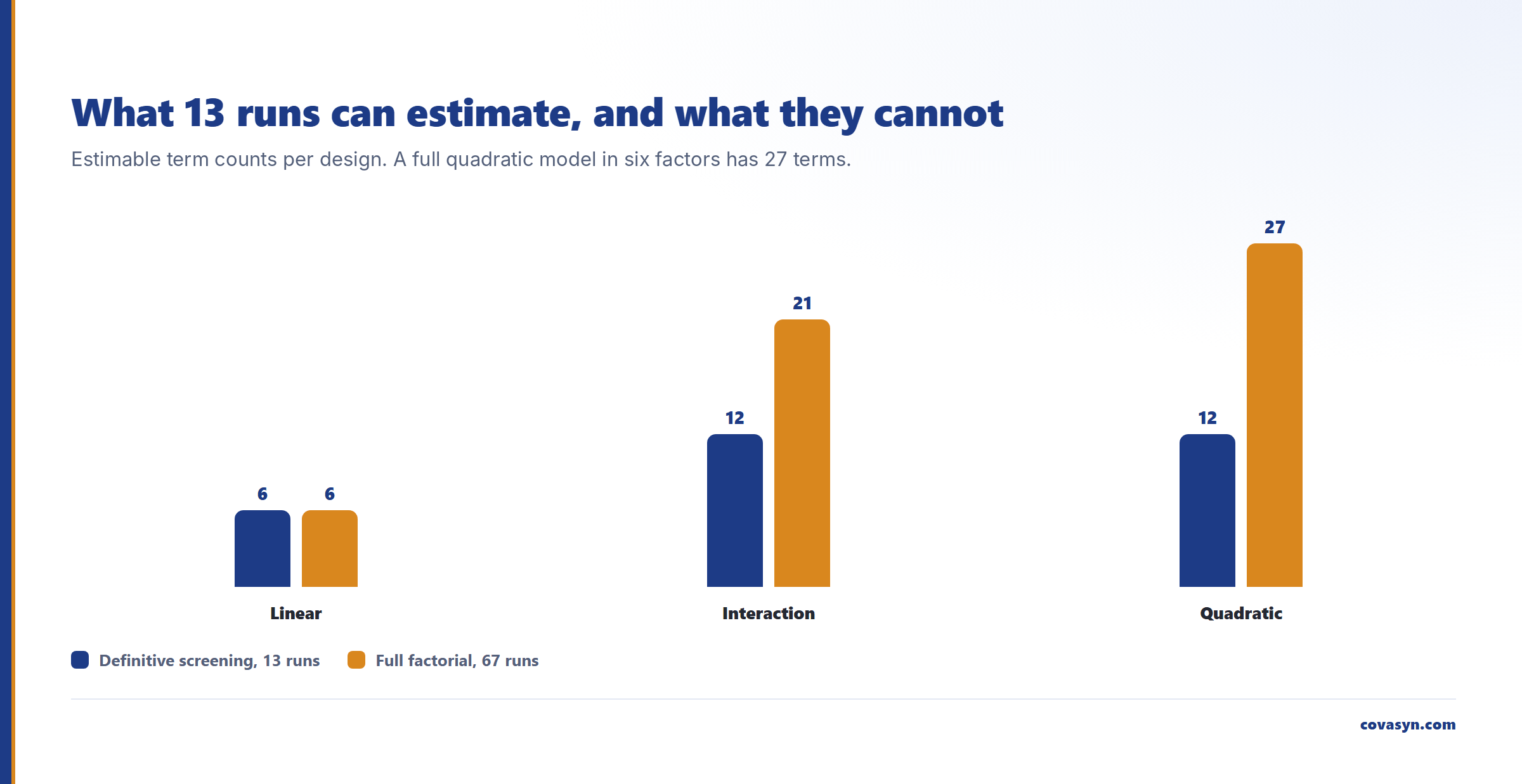
So what the DSD actually delivers is: all six main effects clear of two-factor interactions, all six quadratic terms available, and two-factor interactions that are correlated with each other. You can find that an interaction is present. You often cannot say which pair of factors owns it without more runs. Treat any interaction term from a bare DSD as a hypothesis, not a conclusion.
Two further limits worth naming:
- The "Resolution VI" label in the comparison table is a summary label from our analysis. DSD aliasing does not map onto the classical fractional-factorial resolution scale, so read it as "main effects are clear of two-factor interactions", not as a literal resolution-VI fractional factorial.
- Categorical factors. The
2m + 1construction above is for continuous factors. Categorical factors need the extended DSD construction and change the run count.
Resolving the ambiguity: augment, do not restart
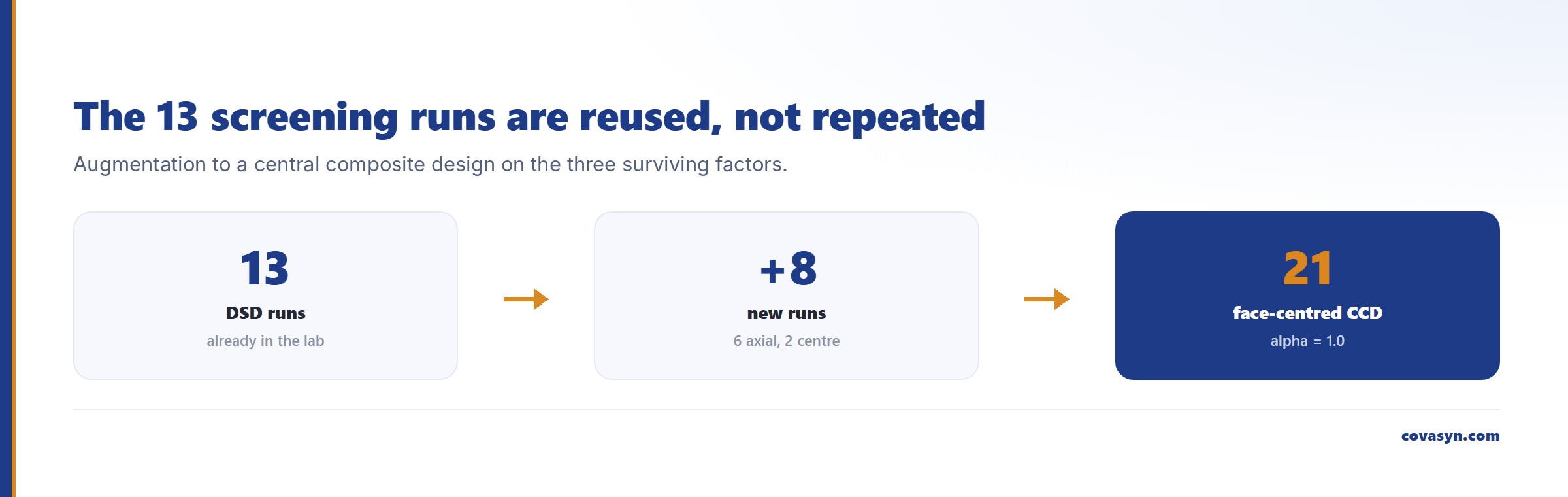
Say the screen flags temperature, catalyst loading and time. Augmenting to a central composite design on those three factors gave:
- 6 axial runs
- 2 new centre runs (the existing centre point, run 13, was reused)
- 8 new runs in total, 21 runs together with the existing ones, α = 1.0
Eight new experiments turn the 13 you already ran into a 21-run face-centred central composite design on the three surviving factors. The original 13 runs stay in the model. Note α = 1.0 means face-centred, so no factor is pushed outside the range you originally declared safe. That matters when a factor range is bounded by equipment or a safety limit.
When to use a DSD, and when not to
Use one when: you have 4 to 12 continuous factors, you suspect the optimum may be inside the range, and you cannot afford a full factorial.
Do not use one when: you have fewer than 4 factors (just run a face-centred CCD), your factors are mostly categorical, you already know which interactions matter and need them cleanly estimated, or your effects are small relative to noise and you cannot widen the ranges.
Frequently asked questions
How many runs is a definitive screening design?
For m continuous factors, a definitive screening design uses 2m + 1 runs: m mirror-image pairs plus one all-centre run. Six factors give 13 runs, eight factors give 17. Some implementations add extra centre points for a better pure-error estimate. The six-factor example in this article has exactly 13 runs.
What is the difference between a definitive screening design and a fractional factorial?
A fractional factorial is two-level, so it fits only planes and cannot detect curvature. A DSD is three-level and estimates a quadratic term for every factor, and its main effects are not aliased with two-factor interactions. For six factors, our design comparison put the 13-run DSD at 0.8495 estimated power against 0.7016 for an 11-run resolution-III fractional factorial.
Can a definitive screening design estimate two-factor interactions?
Only partially. Thirteen runs give 12 degrees of freedom after the intercept, and a full quadratic model in six factors has 27 terms. Two-factor interactions in a DSD are correlated with each other, so you can detect that an interaction exists but often cannot attribute it to a specific factor pair. Confirm with augmentation runs before drawing conclusions.
Why does a DSD include a centre point?
The all-centre run gives you a curvature check and, when replicated, a pure-error estimate that is independent of your model. In the six-factor example, run 13 sits at 80 °C, 1.5 mol% catalyst, 2.0 equiv base, 10% water, 7 h, 1.3 equiv ArB. It is also reused when the design is later augmented to a central composite design, so it is never a wasted run.
Is 13 runs enough to find a real effect?
It depends entirely on effect size relative to noise. The power calculation for 13 runs and a 7-term model at α = 0.05 gives 82% power for a 1-sigma effect but only 31% for a 0.5-sigma effect, with 5 error degrees of freedom. Run the power calculation before the experiments, not after, and widen the factor ranges if the power is low.
How do I go from a DSD to a response surface model?
Augment rather than restart. Augmenting the 13-run DSD on three selected factors to a central composite design gives 8 additional runs (6 axial, 2 new centre, existing centre reused) for a 21-run face-centred CCD with alpha = 1.0. All 13 original runs remain in the fitted model.
Related reading
Evaluation for this topic
We evaluate this for your lab.
- Design of Experiments, RSM, templates.