
Everyone agrees the dichloromethane should go. The argument starts when someone asks what replaces it and nobody can say what the process loses in solubility. So the swap gets deferred to the next campaign, and the next one after that.
This article shows how to turn that argument into a ranked shortlist before anyone books lab time, using predicted solubility across an ICH Q3C classified solvent panel. Every number below comes from CovaSyn's solubility prediction for ibuprofen at 25 °C.
Why chlorinated solvents are hard to displace
Two regulatory frameworks drive the decision, and they do different jobs.
ICH Q3C(R8)
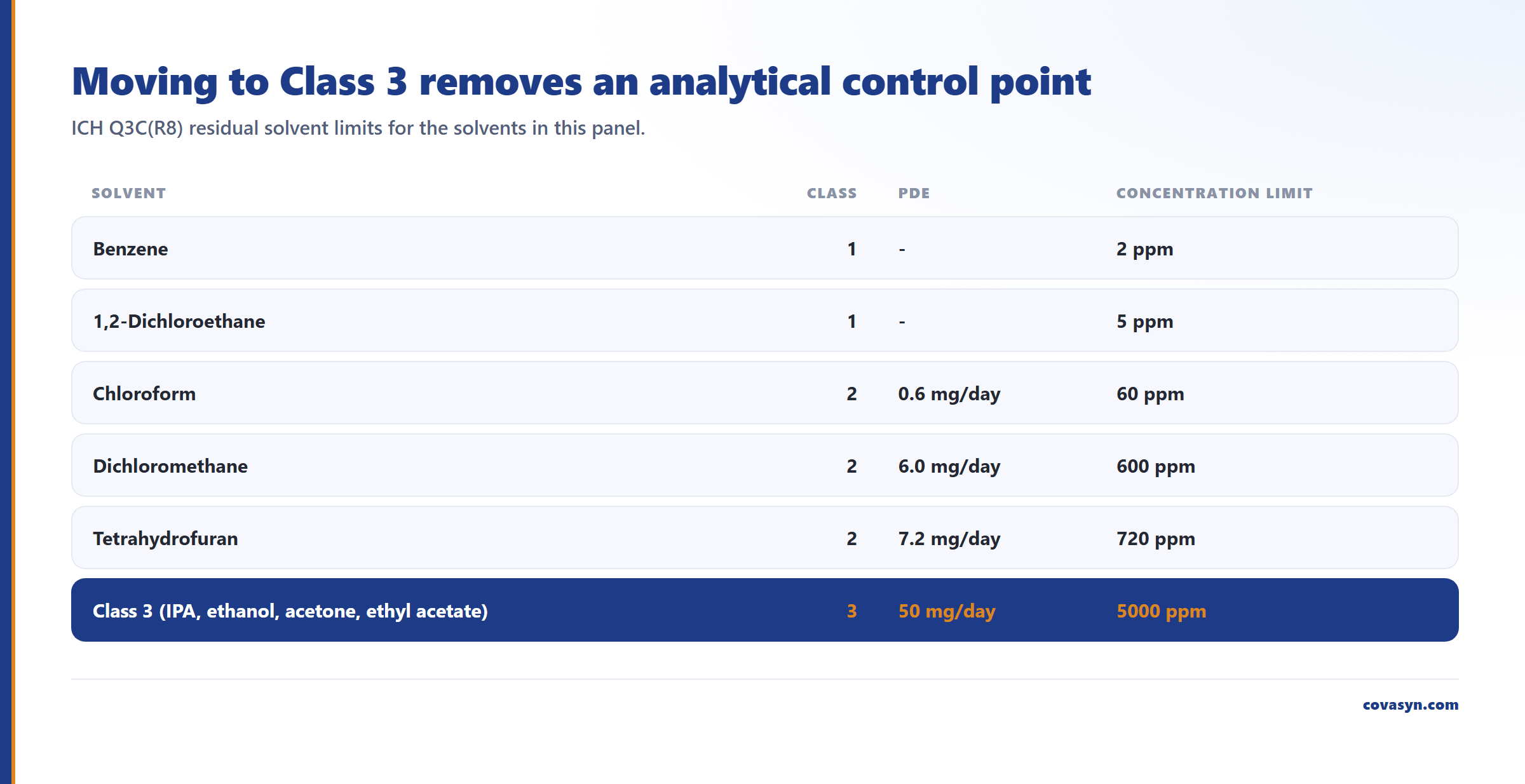
sets the residual limits. Class 1 solvents should be avoided outright: 1,2-dichloroethane carries a 5 ppm concentration limit, benzene 2 ppm, carbon tetrachloride 4 ppm. Class 2 solvents are limited by permitted daily exposure: DCM at 6.0 mg/day (600 ppm), chloroform at 0.6 mg/day (60 ppm), THF at 7.2 mg/day (720 ppm). Class 3 solvents are regarded as low toxic potential and are generally acceptable up to 50 mg/day (5000 ppm) without further justification. That last number is the whole point of the exercise: moving a solvent from Class 2 to Class 3 removes an analytical control point and a specification.
CHEM21
(Prat et al., Green Chem., 2016) is the selection guide most process groups actually use at the bench. It grades solvents Recommended, Problematic, Hazardous and Highly Hazardous on safety, health and environmental axes. Ethanol, IPA, ethyl acetate and acetone sit in the Recommended band. DCM is Hazardous. Chloroform and 1,2-dichloroethane are Highly Hazardous.
Neither framework tells you whether your API will dissolve. That is the gap.
The worked example: what a Class 3 swap actually costs
We predicted the solubility of ibuprofen (SMILES CC(C)Cc1ccc(cc1)C(C)C(=O)O) at 25 °C across the full solvent panel and ranked it twice: once on solubility alone, once with ICH class taken into account. Predicted log S is in mol/L. ICH class, cost per litre and boiling point are listed alongside.
| Solvent | Predicted log S (mol/L) | ICH Q3C class | Model confidence | Cost/L |
|---|---|---|---|---|
| THF | 0.681 | 2 | 0.994 | $0.55 |
| 1,2-Dichloroethane | 0.658 | 1 | 0.984 | $0.50 |
| DMSO | 0.630 | 3 | 0.983 | $0.70 |
| DCM | 0.573 | 2 | 0.985 | $0.50 |
| Cyclohexanone | 0.551 | 3 | 0.992 | $0.65 |
| IPA | 0.502 | 3 | 0.999 | $0.55 |
| Ethanol | 0.476 | 3 | 0.987 | $0.60 |
| MTBE | 0.465 | 3 | 0.999 | $0.60 |
| Acetone | 0.417 | 3 | 0.990 | $0.40 |
| Ethyl acetate | 0.393 | 3 | 0.988 | $0.45 |
| Chloroform | 0.384 | 2 | 0.991 | $0.55 |
| 2-MeTHF | 0.378 | 3 | 0.987 | $1.20 |
| Water | −3.945 | 3 | 0.982 | $0.01 |
Read the gaps, not the absolute values.
- DCM to IPA costs 0.071 log units. That is roughly 15 percent less solubility. For a dissolution or extraction step with any headroom at all, that is a volume adjustment, not a redesign.
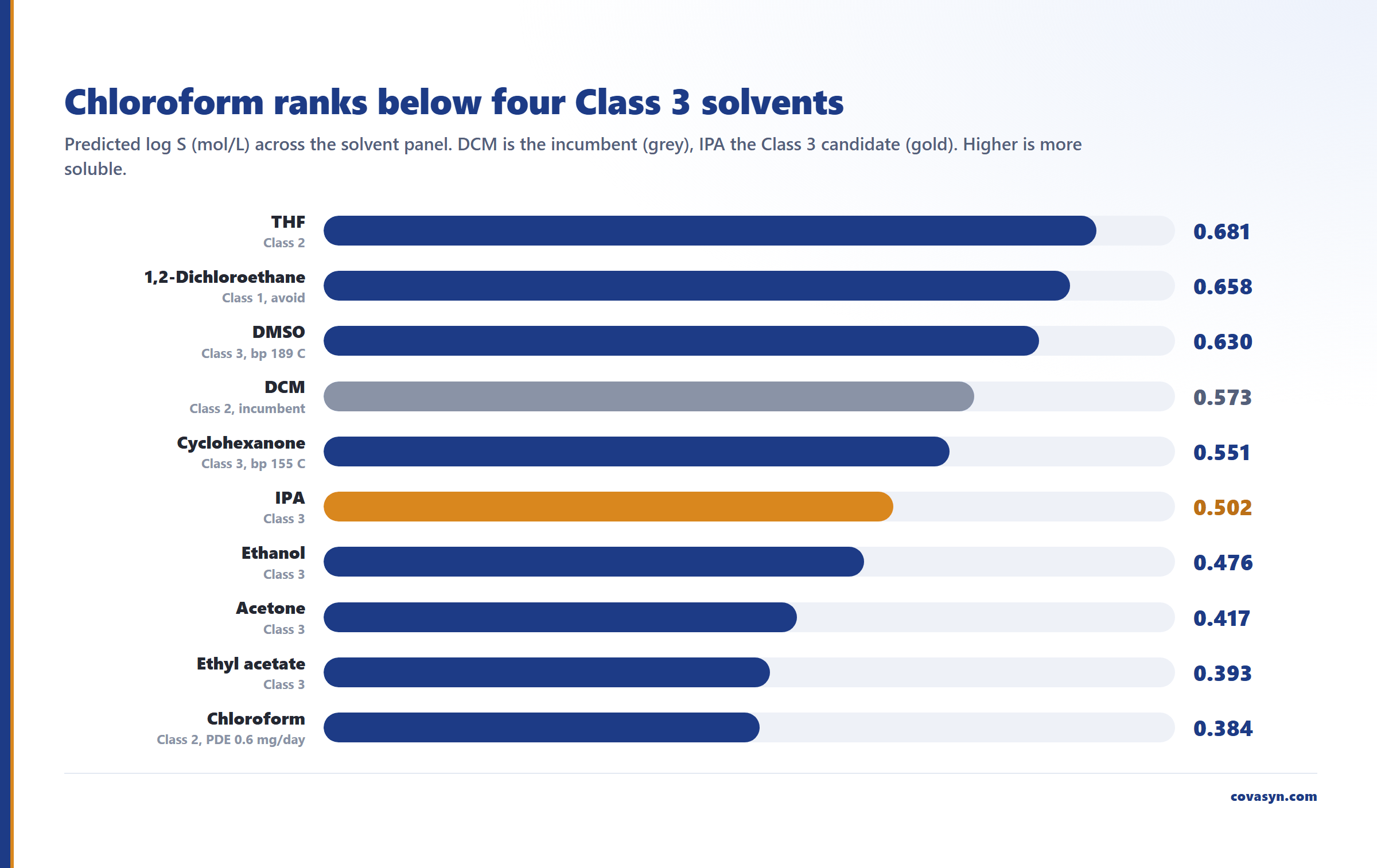
- Chloroform is not worth defending. Predicted log S 0.384 is *below* IPA (0.502) and below ethanol, acetone and ethyl acetate. IPA is about 1.3x better on this API. A Class 2 solvent with a 0.6 mg/day PDE is being used here for no solubility benefit at all.
- 1,2-DCE is the real trade. At 0.658 it is 0.156 log units above IPA, about 1.4x. That is a genuine loss, and it is the case where you would go looking for a mixed-solvent system rather than a straight one-for-one swap.
- Two Class 3 solvents bracket DCM. DMSO (0.630) and cyclohexanone (0.551) sit either side of DCM's 0.573. Both dissolve the API. Both have boiling points of 189 °C and 155 °C, so neither is a sensible isolation solvent. Solubility ranking is a filter, not the decision.
What the green scoring actually does
The green ranking does not use a different solubility model. It favours Class 3 solvents through a rule applied on top of the solubility score, which reshuffles the ranking:
| Solvent | Score, solubility only | Score, with ICH class | Class |
|---|---|---|---|
| IPA | 0.602 | 1.102 | 3 |
| Ethanol | 0.574 | 1.074 | 3 |
| Acetone | 0.516 | 1.016 | 3 |
| Ethyl acetate | 0.491 | 0.991 | 3 |
| THF | 0.780 | 0.780 | 2 |
| DCM | 0.671 | 0.671 | 2 |
IPA moves up the ranking to first once the ICH class is priced in. That is the transparent, boring mechanism behind the recommendation, and you should know it is a rule and not a model. The useful output is not the score. It is the ordered shortlist with the predicted solubility penalty attached to each candidate, so the discussion becomes "we lose 15 percent, here is the volume" instead of "it probably won't work".
How to run a solvent swap triage
1. Get the predicted panel for your API, ranked once on solubility alone and once with ICH class. 2. Cut everything Class 1 and everything Class 2 you cannot justify. 3. Filter the Class 3 survivors on process fit, not solubility: boiling point for distillation and drying, water miscibility if you plan an antisolvent crystallisation, peroxide formation risk for the ethers, cost at scale. 4. Take the top three to four survivors to shake-flask. Confirm the predictions. 5. Only then design the crystallisation. A prediction for antisolvent and cooling crystallisation will tell you whether the new solvent even supports an isolation route. In the documented ibuprofen case, water-antisolvent addition recovered 99.96 percent from ethanol while cooling crystallisation from ethanol recovered 0.0 percent. A solvent can be a perfectly good dissolution solvent and a useless crystallisation solvent.
Honest limits
The solubility prediction was evaluated on a held-out, scaffold-split test set: R² 0.92, RMSE 0.64 log units, about 78 percent of predictions within 0.5 log, on roughly 5,315 novel-scaffold rows. For aqueous test data the scorecard reads RMSE 0.689, MAE 0.402, R² 0.914, 76.4 percent within 0.5 log. Units are log S in mol/L.
Now put that next to the worked example. The model's RMSE (0.64 log) is nearly ten times the DCM-to-IPA gap (0.071 log). So:
- Do not read fine rank order as truth. The separation between IPA, ethanol, acetone and ethyl acetate here is well inside model error. Treat the top band as an unordered shortlist of four, not a winner and three runners-up.
- Large gaps are the reliable signal. Water at −3.945 versus IPA at 0.502 is four orders of magnitude and is not in question. Chloroform sitting below four Class 3 solvents is a big enough gap to act on. A 0.03 log difference is not.
- Errors partially cancel within one API. Comparing solvents for the same molecule is more robust than comparing absolute solubilities across molecules, but this is a tendency, not a guarantee, and it is not something we have quantified for your compound.
- Check the applicability domain flag. Every prediction carries a 95 percent interval and an applicability domain flag. Novel or large scaffolds get wider intervals. Ibuprofen is an easy case; a 900 Da conjugate is not.
- Polymorph, impurity rejection and reaction kinetics are out of scope. A solvent change can shift the crystal form, the impurity purge and the reaction rate. None of that is in a solubility model.
- This is triage, not a filing. It ranks experiments. Q3C justification needs measured residual solvent data and validated methods.
Frequently asked questions
What is the best green replacement for dichloromethane in pharma?
There is no single answer, because it depends on the API. For ibuprofen at 25 °C, our solubility prediction puts IPA at predicted log S 0.502 against DCM at 0.573, a loss of about 15 percent solubility for a move from ICH Q3C Class 2 to Class 3. Ethanol, acetone and ethyl acetate follow closely. Run the panel on your own molecule and confirm the top candidates by shake-flask.
What is the difference between ICH Q3C Class 1, 2 and 3 solvents?
Class 1 solvents are known or suspected human carcinogens and should be avoided, with concentration limits such as 5 ppm for 1,2-dichloroethane and 2 ppm for benzene. Class 2 solvents are limited by permitted daily exposure, for example DCM at 6.0 mg/day and chloroform at 0.6 mg/day. Class 3 solvents have low toxic potential and are generally acceptable up to 50 mg/day, or 5000 ppm, without further justification.
Does CHEM21 replace ICH Q3C?
No. They answer different questions. ICH Q3C sets the residual solvent limits a regulator will hold you to. CHEM21 (Prat et al., Green Chem., 2016) is a selection guide that grades solvents Recommended, Problematic, Hazardous or Highly Hazardous on combined safety, health and environmental criteria. Use CHEM21 to choose candidates early and ICH Q3C to define the specification and analytical control.
How accurate is CovaSyn's solubility prediction?
On a held-out, scaffold-split test set, the prediction reaches R² 0.92 and RMSE 0.64 log units, with about 78 percent of predictions within 0.5 log across roughly 5,315 novel-scaffold rows. That error is larger than the differences between closely ranked Class 3 solvents, so the model is reliable for shortlisting and for large gaps, and not for declaring a single winner. Every prediction carries a 95 percent interval and an applicability domain flag.
Can I use predicted solubility in a regulatory submission?
No. Treat it as decision support for experiment planning. A Q3C position, a design space or a control strategy needs measured data from validated methods. What the prediction changes is which experiments you run and in what order, which is usually where the time goes.
Why does chloroform rank below ethanol for this API?
Because chlorinated does not mean universally better at dissolving. For ibuprofen, our prediction returns log S 0.384 for chloroform against 0.476 for ethanol and 0.502 for IPA, a gap large enough to act on. That is worth checking on any legacy process: a Class 2 solvent may be carrying a control burden for a solubility advantage that never existed.
Related reading
Evaluation for this topic
We evaluate this for your lab.
- Solubility, pH, crystallization, antisolvent.