
Your reaction is done and the API is dissolved in ethanol. Now you have to get it out as a filterable solid, and there are two obvious routes: cool the batch, or add an antisolvent. Pick the wrong one and you spend a week in the lab discovering that nothing crystallizes. The decision is not a matter of taste: it is arithmetic on the solubility curve, and you can do that arithmetic before you charge anything.
Both routes do the same thing: generate supersaturation
Crystallization needs the solution to hold more solute than it can dissolve at equilibrium. That excess is supersaturation, and it is the only driving force there is. The routes differ only in how they create it.
Cooling
moves the equilibrium. You dissolve at high temperature where solubility is high, then reduce temperature so solubility falls below the concentration you are carrying. The lever is the slope of the solubility curve, which is governed by the enthalpy of dissolution.
Antisolvent addition
moves the solvent. You keep temperature constant and add a miscible liquid in which the solute is poorly soluble. The mixed solvent has a lower solvent power than the original, so the equilibrium solubility collapses under the concentration you are carrying.
pH shift
is the third route for ionizable compounds, and it belongs in the same discussion: you convert a soluble salt to a poorly soluble neutral form. It is often the cheapest route of all when the molecule has a usable pKa.
Two numbers decide everything: the concentration you are carrying (charge divided by volume) and the equilibrium solubility at the endpoint. If the first is not comfortably above the second, no amount of process engineering will produce a solid.
When cooling simply cannot work
Cooling fails in a specific, predictable way: when the compound is so soluble in the chosen solvent that even at the coldest practical temperature, the equilibrium solubility is still above your working concentration. The solution never becomes supersaturated. It just gets cold.
This is not exotic. It is the normal situation for lipophilic acids in alcohols, for many APIs in DMSO or DMF, and for anything you dissolved in a solvent chosen for the reaction rather than for the isolation.
A shallow solubility-temperature slope makes it worse. If the dissolution enthalpy is small, cooling 60 K buys you very little change in solubility, and the whole cooling range is spent inside the undersaturated region.
Worked example: ibuprofen out of ethanol
Standard basis: 10 g of API in 100 mL of solvent, so a working concentration of 100 g/L. Ibuprofen (SMILES CC(C)Cc1ccc(cc1)C(C)C(=O)O), 25 °C unless stated.
Route A: cooling crystallization from ethanol
CovaSyn's solubility prediction gives a cooling profile for ibuprofen in ethanol from 353.15 K down to 278.15 K:
| Temperature | Equilibrium solubility (computed) |
|---|---|
| 353.15 K (80 °C) | 2412.4 g/L |
| 298.8 K (25.7 °C) | 725.5 g/L |
| 278.15 K (5 °C) | 459.1 g/L |
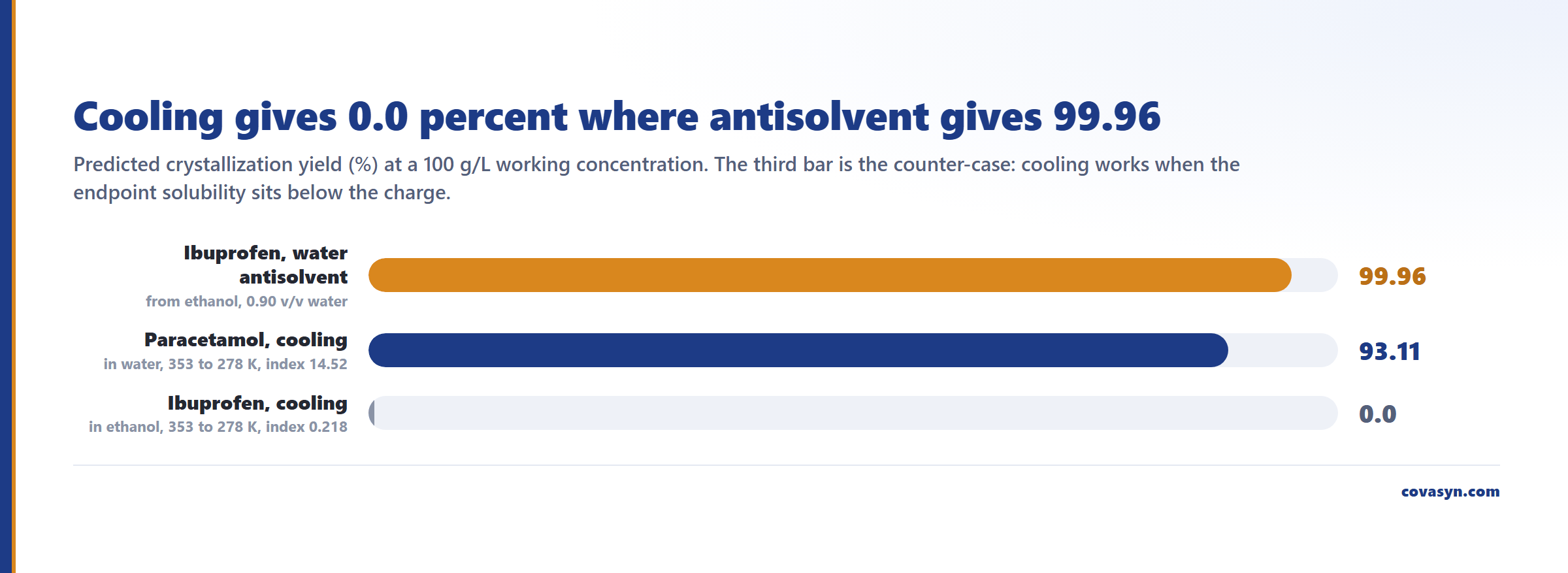
Computed yield: 0.0 g, 0.0%. Computed supersaturation index: 0.218.
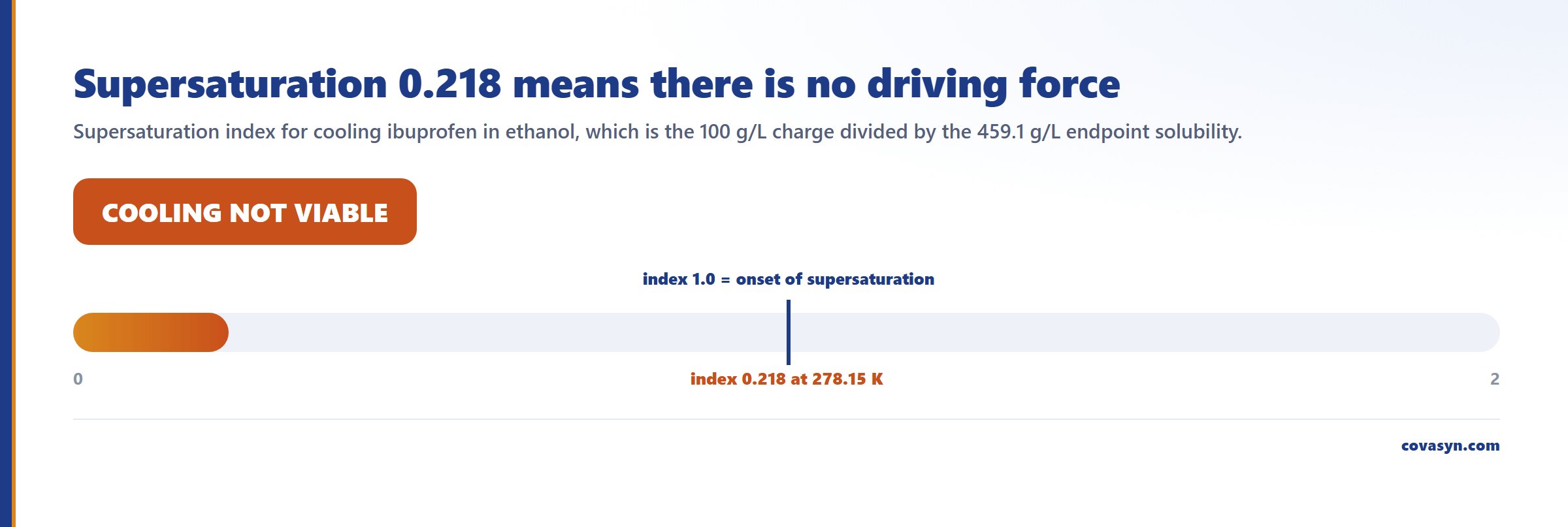
The reason is visible in the table. Even at 5 °C, ethanol still dissolves 459 g/L of ibuprofen. You are carrying 100 g/L. The endpoint solubility is roughly 4.6 times your working concentration, so the cooled liquor is still undersaturated. The computed supersaturation index of 0.218 is exactly 100 g/L divided by 459.1 g/L: it is the ratio of charge to endpoint solubility, and anything below 1.0 means there is no driving force at all. This is a real negative from the calculation, not a hypothetical.
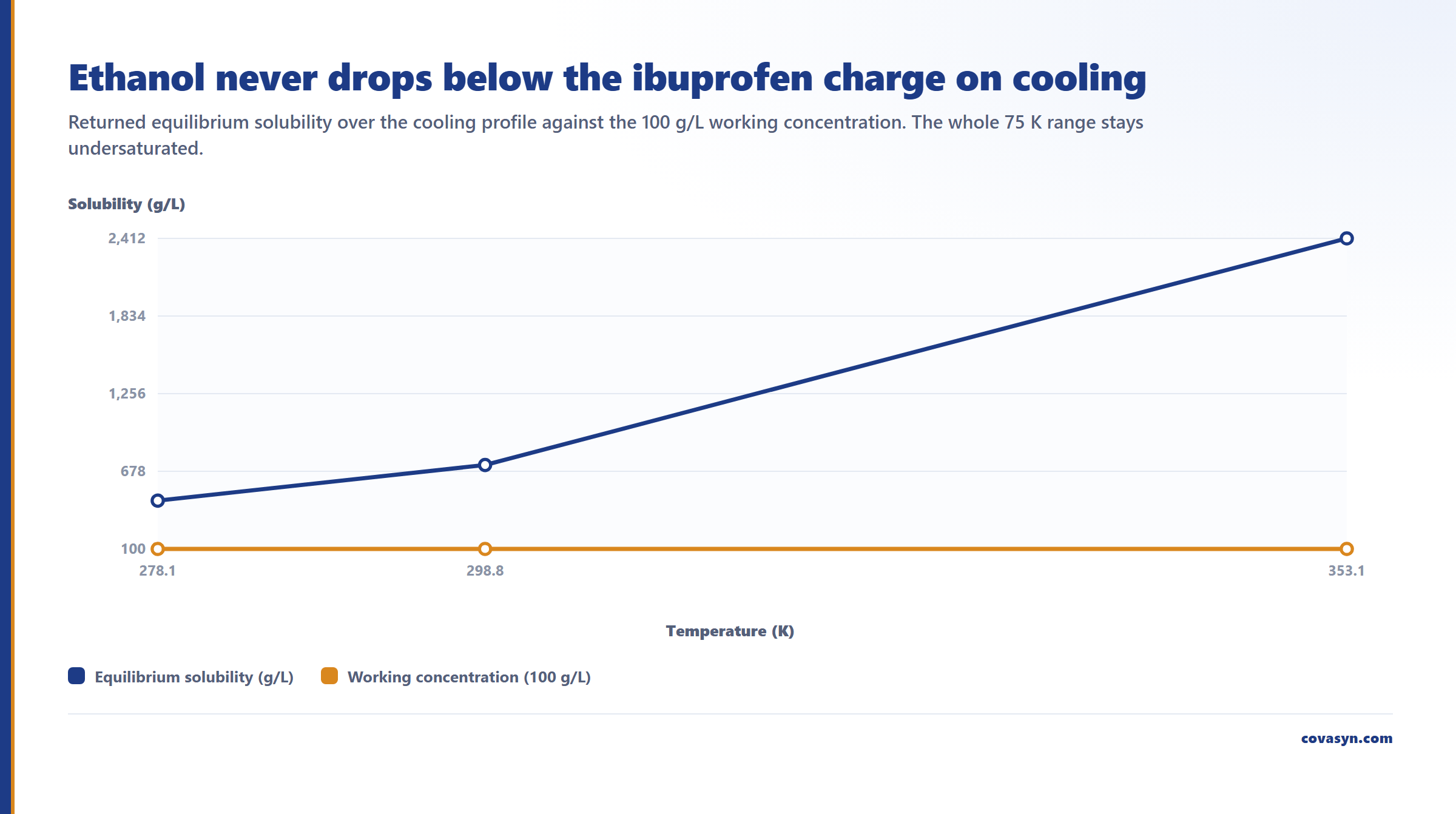
The van't Hoff analysis for the same pair gives a dissolution enthalpy ΔH of 18.12 kJ/mol and a dissolution entropy ΔS of 71.71 J/(mol·K), with an optimal dissolution temperature of 371.1 K. The modest dissolution enthalpy is consistent with the shallow slope: over a 75 K cooling range the solubility only drops by a factor of about 5, and the whole range sits above the charge.
Route B: water as antisolvent
The antisolvent calculation (ibuprofen in ethanol, water as antisolvent, 10 g in 100 mL, 298.15 K) gives:
- optimal antisolvent fraction: 0.90 v/v water
- yield: 9.9961 g of 10 g, 99.96%
The driving force comes from the solvent pair, not the thermometer. The solubility prediction gives ibuprofen at 617 mg/mL in ethanol and 0.02 mg/mL in water at 25 °C: a collapse of roughly four orders of magnitude when water dominates the mixture. Each of those predictions carries a 95% confidence interval and a check of whether the molecule lies within the model's applicability domain.
The counter-case: when cooling is the right answer
Same calculation, different pair. Paracetamol (CC(=O)Nc1ccc(O)cc1) in water gives 93.11% yield with a supersaturation index of 14.52, from 102.8 g/L at 353.15 K to 6.89 g/L at 278.15 K. Charge 100 g/L, endpoint solubility 6.89 g/L, so the index is 14.5 and 9.31 g of the 10 g charge comes out. Cooling works here for exactly the reason it fails for ibuprofen in ethanol: the endpoint solubility sits far below the working concentration.
Metastable zone width, and why the route choice comes first
Supersaturation tells you whether crystals can form. The metastable zone width (MSZW) tells you how the process will behave once they do. It is the gap between the solubility curve and the point where spontaneous nucleation actually starts. Inside that zone the solution is supersaturated but stable, which is where you seed and grow. Push past it and you get uncontrolled primary nucleation: fines, poor filtration, oiling out, and in the worst case the wrong polymorph.
Antisolvent addition is harder here. Local supersaturation at the addition point can be far higher than the bulk average, which is why addition rate, mixing and addition point matter more for antisolvent routes than cooling rate matters for cooling routes. Cooling generates supersaturation slowly and uniformly. That is its real advantage when it works at all.
MSZW is compound-, solvent-, scale- and rate-dependent, and it is measured, not predicted. The crystallization calculation used here provides yield, supersaturation and a cooling profile: it does not give an MSZW value, so treat MSZW as a lab measurement you still owe.
Quick decision list
1. Compute your working concentration: charge divided by solvent volume. 2. Get equilibrium solubility at the coldest practical endpoint. 3. Ratio above roughly 3 to 5? Cooling is viable. Ratio below 1? Cooling is dead: stop there. 4. Cooling dead: look for an antisolvent with a large solubility gap and full miscibility. 5. Ionizable molecule? Check the pH route as well: it is often the cheapest. 6. Rank the shortlist on ICH solvent class, cost and recovery, then take two or three candidates to the lab.
What this does not tell you
- No polymorph prediction. Solubility and yield say nothing about which form crystallizes, or whether the antisolvent route traps a metastable form or a solvate. That is XRPD and DSC work.
- No MSZW, no nucleation kinetics. The computed profile is a thermodynamic path, not an operating recipe. Cooling rate, seeding point, seed load and agitation are lab decisions.
- No particle attributes. Nothing here predicts crystal habit, PSD, filterability, wash efficiency or drying behaviour.
- No oiling-out or gelation warning. A high predicted supersaturation can also mean liquid-liquid phase separation.
- Model predictions, not measurements. These are solubility estimates with confidence intervals; the intervals widen at the hot end of the curve. The computed solubility points are also not perfectly monotonic with temperature: individual points carry prediction noise, so read the trend, not any single value.
- Impurities are ignored. The prediction is for the pure solute. Your real mother liquor contains reaction impurities that shift solubility and can inhibit nucleation.
Use this to eliminate routes and to rank the survivors. The confirmation is still a lab experiment.
Frequently asked questions
When should you use antisolvent crystallization instead of cooling?
Use antisolvent crystallization when the solute stays too soluble in your process solvent even at the lowest practical temperature, so cooling never generates supersaturation. In a worked example, cooling ibuprofen in ethanol gave 0.0% yield because the solubility at 5 °C is 459 g/L against a 100 g/L charge, while water-antisolvent addition to 90% v/v gave 99.96% recovery.
How do you know cooling crystallization will not work?
Compare your working concentration with the equilibrium solubility at your coldest practical endpoint. If the endpoint solubility is higher than the concentration you are carrying, the solution is still undersaturated when cold and yield is zero. A useful screen is the ratio of charge concentration to endpoint solubility: below 1.0 cooling is impossible, and below about 3 it is not worth the vessel time.
What is supersaturation and why does it matter?
Supersaturation is the excess of dissolved solute over the equilibrium solubility at the current conditions. It is the sole thermodynamic driving force for nucleation and crystal growth. Cooling creates it by lowering solubility with temperature, antisolvent addition by lowering solvent power, and pH shift by converting a soluble ionised form to a poorly soluble neutral form. Without it, nothing crystallizes.
What is the metastable zone width?
The metastable zone width is the gap between the solubility curve and the concentration at which spontaneous nucleation actually begins. Inside it a solution is supersaturated yet stable, which is where seeding and controlled growth happen. Cross it and you get uncontrolled primary nucleation, fines and possible polymorph problems. MSZW depends on compound, solvent, cooling rate, scale and agitation, and must be measured experimentally.
Which route gives better control of particle size?
Cooling generally gives better control, because supersaturation is generated slowly and uniformly through the bulk. Antisolvent addition creates high local supersaturation at the addition point, which drives rapid nucleation and typically finer, harder-to-filter particles unless addition rate, addition point and mixing are carefully controlled. Choose antisolvent for yield when cooling cannot work, then engineer the addition.
Can these predictions replace crystallization screening in the lab?
No. They are triage. Solubility and yield predictions eliminate non-viable routes cheaply and rank the survivors, which usually removes most of the screening matrix. They do not predict polymorph, particle size, filterability, oiling out or the effect of process impurities, and they are not a substitute for validated development data or a regulatory filing.
Related reading
Evaluation for this topic
We evaluate this for your lab.
- Solubility, pH, crystallization, antisolvent.