
An impurity shows up at 0.08 percent in a registration batch and someone asks which ICH M7 class it is. The guideline gives you five classes and a two-method assessment and requires a reasoned expert assessment when the results conflict. This article shows what that looks like on five real impurities, including the limits of the computation.
The five ICH M7 classes, in one table
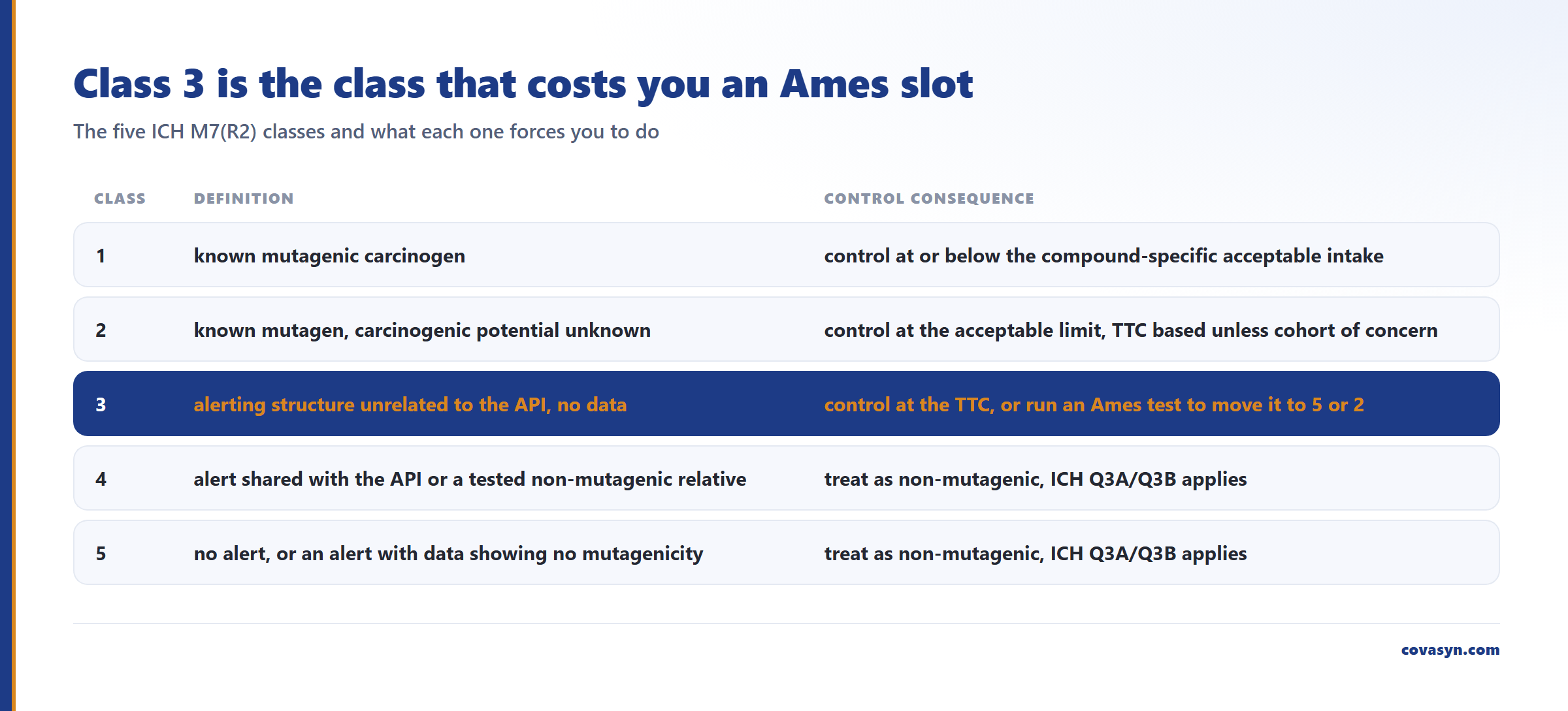
ICH M7(R2) sorts every actual or potential impurity into one of five classes. The class determines the control strategy, not the analytical method.
| Class | Definition | Control consequence |
|---|---|---|
| 1 | Known mutagenic carcinogen | Control at or below the compound-specific acceptable intake |
| 2 | Known mutagen, carcinogenic potential unknown | Control at or below the acceptable limit (TTC based, unless cohort of concern) |
| 3 | Alerting structure, unrelated to the API, no mutagenicity data | Control at the TTC limit, or run a bacterial mutagenicity assay to reclassify to 5 or 2 |
| 4 | Alerting structure shared with the API or with a tested, non-mutagenic relative | Treat as non-mutagenic, ICH Q3A/Q3B applies |
| 5 | No structural alert, or an alert with data showing no mutagenicity | Treat as non-mutagenic, ICH Q3A/Q3B applies |
The practical split is Class 1/2/3 on one side (mutagenic impurity control, typically the 1.5 µg/day TTC for lifetime exposure) and Class 4/5 on the other (ordinary impurity qualification). Class 3 is where most software output lands, and it is the class that costs money, because it means either an Ames test or a tight specification.
The dual assessment: why two methods
ICH M7 asks for two complementary (Q)SAR methodologies for bacterial mutagenicity: one expert rule-based, one statistical. They are not redundant. The rule set encodes mechanism that a model trained on Ames data cannot express defensibly. The statistical model catches structures no rule covers, and it disagrees with the rules often enough to be worth running.
Our assessment runs both methods and reports both results separately, not a merged verdict:
- Expert rule component: structural alerts, each with an evidence level, a named mechanism and a literature reference (Benigni and Bossa 2006, Ashby and Tennant 1988, Toxtree ISS, IARC Monographs).
- Statistical component: an Ames mutagenicity probability with a confidence value.
If both are negative, ICH M7 allows Class 5 with no further testing. If either is positive, you are in expert-review territory.
Five impurities, scored live
All five were assessed on 2026-07-25. The values are reproduced unchanged.
| Impurity (SMILES) | Alert fired | Statistical Ames score | Confidence | Computed assessment |
|---|---|---|---|---|
NDMA CN(C)N=O | nitrosamine (evidence high) | 0.6905 | 0.628 | alert and statistics positive, class 3 without data; with data class 1 (96 ng/day) |
Ethyl methanesulfonate CCOS(=O)(=O)C | alkyl sulfonate ester (high) | 0.7215 | 0.656 | alert and statistics positive, class 3 without data; with data class 1 |
Nitrobenzene O=[N+]([O-])c1ccccc1 | 4 alerts: aromatic_nitro, nitroso, aromatic_nitroso, n_hydroxy_amine | 0.1677 | 0.848 | alert positive, statistics negative, class 3 without data; Ames negative, therefore class 5 |
Aniline Nc1ccccc1 | aromatic amine (high) | 0.1677 | 0.848 | alert positive, statistics negative, class 3 without data; Ames negative, therefore class 5 |
Benzoic acid O=C(O)c1ccccc1 | none | 0.0685 | 0.438 | class 5 |
Read the table by column, not by row. The computation gives the assessment without data; the class only follows from the check against existing mutagenicity and carcinogenicity data.
For NDMA the expert rule and the statistical method agree: both indicate mutagenic potential.
The nitrosamine alert fires with evidence level high and the mechanism CYP2E1 activation to the diazonium ion followed by DNA alkylation, referenced to the IARC Monographs. The statistical model returns 0.6905, positive. Under ICH M7 a prediction alone gives class 3 at most, because classes 1 and 2 require data. NDMA has those data: it is a known mutagenic carcinogen, class 1, with a published limit of 96 ng/day. The computation supports the alert; the class comes from the data check. The same applies to ethyl methanesulfonate, another well-studied mutagenic carcinogen.
For aniline the methods disagree.
The aromatic amine alert fires, mechanism metabolic activation to the nitrenium ion and DNA adduct formation; the statistical model is negative at 0.1677. Without data aniline would stay in class 3 and the conflict would go to expert review. Aniline, however, has negative Ames data, which makes it class 5. This check against existing data is what every assessment has to do before assigning a class.
Nitrobenzene fires four alerts, and that still does not mean higher risk.
Alert count is not risk. Three of the four matches come from overlapping structural patterns on the same nitro group. The statistical model returns 0.1677, negative. Without data this would be class 3, as for aniline; nitrobenzene is Ames negative, however, and therefore class 5.
Benzoic acid is Class 5 on a clean sweep.
No alerts, statistical score 0.0685. That is the "no further testing" outcome ICH M7 permits.
Worked example: a five-impurity batch against an API
The same five impurities, assessed against aspirin (CC(=O)Oc1ccccc1C(=O)O) as the API. The computed result before any data check: two impurities with agreeing positive findings (NDMA, ethyl methanesulfonate), two with conflicting findings (nitrobenzene, aniline), one in class 5. After checking existing data, NDMA and ethyl methanesulfonate are class 1 and the other three class 5. The highest-risk impurity is NDMA. The TTC does not apply to that case, and no numeric limit is returned. Tanimoto similarity to the API is 0.0645 for NDMA, 0.0857 for ethyl methanesulfonate, 0.2121 for nitrobenzene, 0.2069 for aniline and 0.3571 for benzoic acid.
Two things to take from that result.
First, the similarity column is what feeds a Class 4 argument. Class 4 exists for impurities that carry the *same* alert as the API, where the API's own mutagenicity data covers the impurity. None of these five is structurally close to aspirin (highest Tanimoto 0.357), so Class 4 was never available here. If your impurity is a des-methyl or hydroxy analogue of the API, that is where you look.
Second, the TTC note is a trigger, not a limit. No numeric threshold is handed out for an agreeing positive finding. ICH M7 does allow the 1.5 µg/day TTC for most mutagenic impurities without carcinogenicity data at lifetime exposure. But nitrosamines are cohort of concern, where the TTC does not apply and compound-specific limits are required. Setting that number is a human toxicologist's job. The assessment gets you to the point where you know you need one.
How good is the statistical half
The Ames model is the part of the dual assessment that carries a measurable error rate, so here it is.
- Held-out, scaffold-split test set: balanced accuracy 0.736 (n = 1,089). Random split on the same endpoint: 0.848. The scaffold number is the honest one: it holds out entire molecular cores, which is what a novel process impurity looks like.
- Official TDC ADMET split: AUROC 0.847 +/- 0.013 (n = 1,457). Scored by TDC's own evaluator, so it is directly comparable to published entries. Run 2026-05-23.
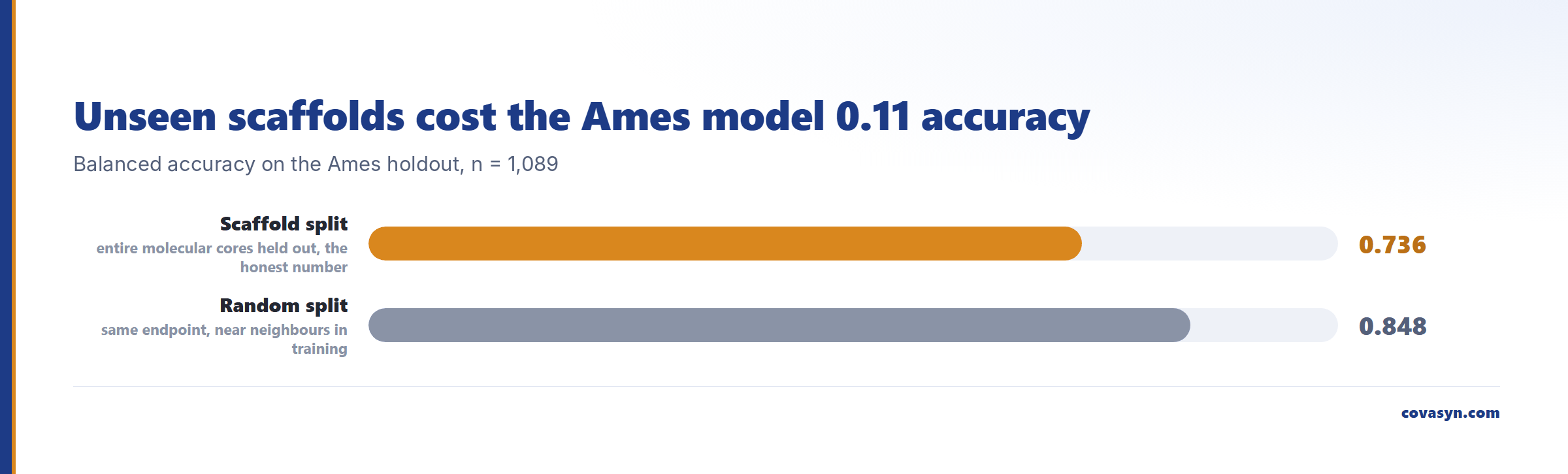
A balanced accuracy of 0.736 on unseen scaffolds is useful for triage. It is not an Ames test.
What this does not tell you
- It is not a regulatory classification. The class is a documented starting point for expert review. ICH M7 requires expert knowledge to be applied on top of the (Q)SAR output, and a filing needs a human-signed rationale.
- It does not set an acceptable intake. No compound-specific AI, no less-than-lifetime adjustment, no cohort-of-concern limit. No number is returned for an agreeing positive finding, deliberately, rather than guessing.
- The statistical score is a probability, not a measurement. Aniline and nitrobenzene both returned exactly 0.1677 with confidence 0.848: two different molecules, the same output. Treat the class and the named alert as the decision unit; do not build an argument on the third decimal.
- Confidence is not calibrated risk. Benzoic acid, the clean Class 5 case, came back with the lowest confidence of the five (0.438). Low confidence on a clean molecule means the model has little to say, not that the molecule is suspect.
- It does not cover Class 1. Class 1 requires known rodent carcinogenicity data. That is a database lookup against IARC, CPDB or a regulatory list, not a prediction.
- Out-of-domain compounds. Check the applicability domain before trusting a score on an unusual scaffold. Outside the training domain, treat the result as "no statistical result available", which under ICH M7 pushes an alerting compound to Class 3 anyway.
Frequently asked questions
What are the five ICH M7 classes?
Class 1 is a known mutagenic carcinogen. Class 2 is a known mutagen with unknown carcinogenic potential. Class 3 has an alerting structure unrelated to the API and no mutagenicity data. Class 4 has an alerting structure shared with the API or with a tested non-mutagenic relative. Class 5 has no alert, or an alert with data showing no mutagenicity. Classes 1 to 3 need mutagenic impurity control; 4 and 5 fall under ICH Q3A/Q3B.
Why does ICH M7 require two (Q)SAR methods?
ICH M7 asks for one expert rule-based and one statistical methodology for bacterial mutagenicity, because they fail differently. Rule sets encode mechanism and give a citable rationale but miss structures no rule covers. Statistical models generalise but cannot explain themselves without extra work. If both are negative, the guideline permits Class 5 with no further testing. If they disagree, expert review decides.
Why do NDMA and aniline differ when both fire an alert?
Both fire a high-evidence structural alert. Computationally the difference is the statistical half: NDMA returns an Ames probability of 0.6905 (positive), rule and model agree; aniline returns 0.1677 (negative), the methods conflict. A prediction alone gives class 3 at most in both cases, because classes 1 and 2 require data. The class follows from existing data: NDMA is a known mutagenic carcinogen and therefore class 1, aniline is Ames negative and therefore class 5.
What TTC applies to a Class 3 impurity?
The default threshold of toxicological concern in ICH M7 is 1.5 µg/day for lifetime exposure, with higher less-than-lifetime values for shorter treatment durations. Class 3 impurities are controlled at that limit, or reclassified by running a bacterial reverse mutation (Ames) test: negative moves it to Class 5, positive moves it to Class 2. Cohort-of-concern compounds such as nitrosamines are excluded from the TTC.
Can a (Q)SAR classification replace an Ames test?
For Class 5 outcomes, ICH M7 accepts two negative complementary (Q)SAR predictions in place of testing, with expert justification. For anything alerting, no. A scaffold-split balanced accuracy of 0.736 on 1089 held-out compounds is triage quality: it tells you which impurities deserve a test slot and which specification to tighten, not what the test will say.
How many impurities can be assessed at once?
A whole impurity profile can be assessed in one pass, with the API alongside as the reference for Tanimoto similarity. The result gives each impurity's class, the class distribution, the highest-risk impurity and a TTC applicability note. Similarity to the API is what supports or rules out a Class 4 argument.
Related reading
Evaluation for this topic
We evaluate this for your lab.
- ICH M7, Tox21, CYP450, structural alerts, ADMET triage.