

A compound comes back from an in-silico screen labelled "Acute 1 (Very Toxic)" and someone in the room says the molecule is a PBT problem. It usually is not. GHS aquatic acute classification and PBT status answer two different questions, use different data, and drive completely different regulatory work. Confusing them either wastes a Phase II ERA budget or lets a real persistence problem through.
This article separates the two, shows the P/B/T criteria as they are actually applied, and works through three real drug molecules using results from CovaSyn's ecotoxicity screen.
The two questions are not the same
GHS aquatic hazard
asks: how much of this substance does it take to kill something in a short test? It is driven by the single most sensitive acute endpoint: fish 96h LC50, Daphnia 48h EC50, or algae 72h ErC50. Acute 1 is anything at or below 1 mg/L. It is a labelling classification.
PBT
asks: does this substance stay around, build up, and cause chronic harm? Toxicity is only one of three gates, and it is the *chronic* gate, not the acute one.
Under the EMA guideline on the environmental risk assessment of medicinal products for human use (EMEA/CHMP/SWP/4447/00 Rev. 1), the PBT screen sits alongside, not inside, the PEC/PNEC risk assessment. A log Kow above 4.5 triggers a PBT assessment regardless of how the exposure calculation comes out. So a molecule can pass the exposure test and still owe you a PBT dossier.
The criteria, as written
The numeric criteria come from REACH Annex XIII and are applied to pharmaceuticals by reference.
| Gate | Criterion (PBT) | Criterion (vPvB) |
|---|---|---|
| P: persistence | half-life > 40 d in fresh water, > 60 d in marine water, > 120 d in freshwater sediment, > 180 d in marine sediment, > 120 d in soil | vP: > 60 d in fresh or marine water, > 180 d in sediment or soil |
| B: bioaccumulation | BCF in aquatic species > 2000 | vB: BCF > 5000 |
| T: toxicity | chronic NOEC or EC10 < 0.01 mg/L, or CMR classification, or endocrine / other chronic evidence | not required |
Two things practitioners get wrong here:
1. PBT needs all three. P and B and T. Two out of three is not a PBT. 2. vPvB needs only two, but both must be the *very* thresholds: vP and vB. A compound can be B and vB while failing vP, which means it is a PBT candidate but not a vPvB.
Worked example: three drugs
All numbers below come from our ecotoxicity screen of 2026-07-25, one evaluation per molecule.
| Diclofenac | Clofazimine | Metformin | |
|---|---|---|---|
| Fish 96h LC50 | 0.0007 mg/L | log −6.10 (~8e-7 mg/L) | 81.7 mg/L |
| Daphnia 48h EC50 | 0.0017 mg/L | log −5.58 | 123.2 mg/L |
| Algae 72h ErC50 | 0.0016 mg/L | log −5.51 | 81.2 mg/L |
| GHS aquatic | Acute 1 (Very Toxic) | Acute 1 (Very Toxic) | Acute 3 (Harmful) |
| BCF | 1022 (log 3.01) | 463799 (log 5.67) | ~0 (log −1.58) |
| B / vB | no / no | yes / yes | no / no |
| Half-life | 39.3 d | 52.1 d | 9.0 d |
| P / vP | no / no | yes / no | no / no |
| Ready biodegradable | not available | No | Yes |
| T gate | yes | yes | no |
| Conclusion | Not PBT/vPvB | PBT | Not PBT/vPvB |
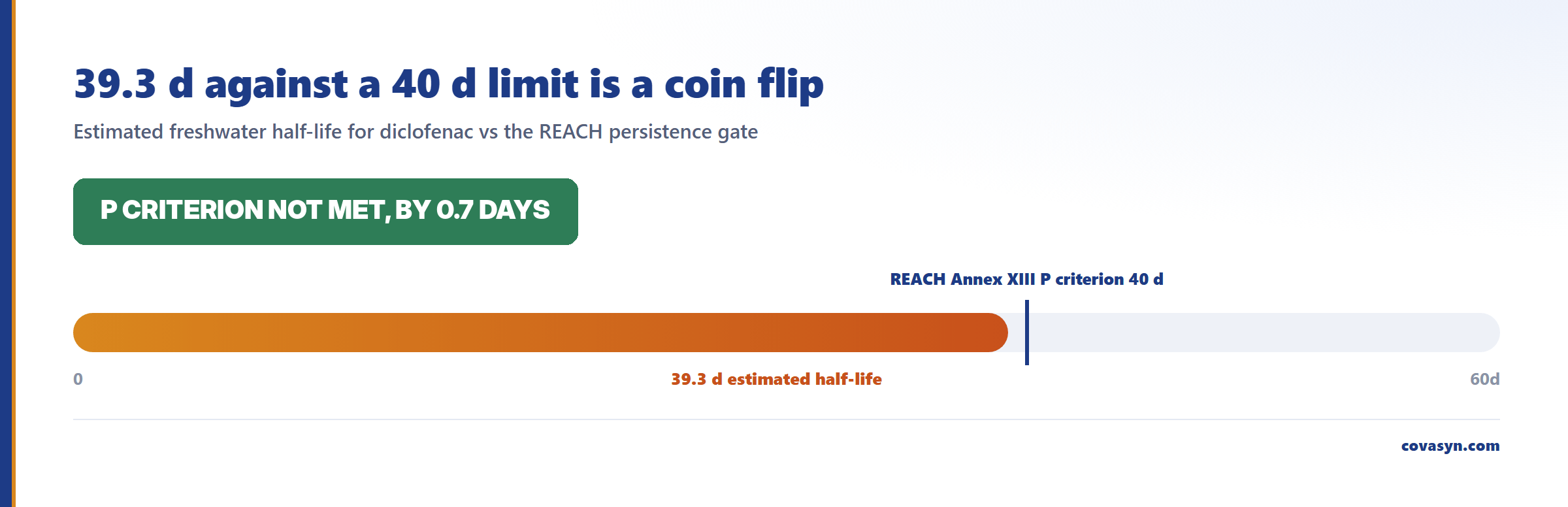
Read the diclofenac column carefully. It is Acute 1. Its most sensitive endpoint is 0.7 µg/L. And it is still not a PBT, because BCF 1022 is under the 2000 B threshold and the estimated 39.3 d half-life is under the 40 d P threshold. "Very toxic" and "PBT" disagree on the same molecule.
Clofazimine is the opposite shape. It clears P (52.1 d > 40 d) and clears B and vB decisively (BCF 463799), so the evaluation gives PBT. But it is not vPvB: 52.1 d does not reach the 60 d vP threshold. That is the correct logic, and it is the kind of distinction that gets lost when people summarise a screen as "flagged".
Metformin fails every gate and lands at Acute 3: the expected answer for a small, highly polar, readily biodegradable molecule, and a useful negative control when validating a screening workflow.
Where these particular numbers stop being usable
This is the part that matters more than the table.
The values in the table are rough estimates, not predictions of trained models.
They derive essentially from lipophilicity. Every number in such a report should make clear whether it was measured, predicted by a validated model, or roughly estimated; that decides its weight.
Lipophilicity-based estimates systematically misfit specifically-acting drugs.
Diclofenac's estimated 0.7 µg/L acute fish LC50 sits far below published acute fish data for the compound, which are orders of magnitude higher. Baseline-narcosis estimates assume non-specific membrane toxicity driven by log Kow; a COX inhibitor does not behave that way acutely. Treat the acute figures as a lipophilicity-driven conservatism ranking, not as an LC50.
Sub-solubility LC50s are not achievable concentrations.
Clofazimine's fish LC50 of ~8e-7 mg/L is below any concentration you could dissolve. Under GHS this is the classic "no acute hazard at saturation" situation. Do not report such an extrapolated number as a measurement.
The thresholds diclofenac "passes" are inside the model error band.
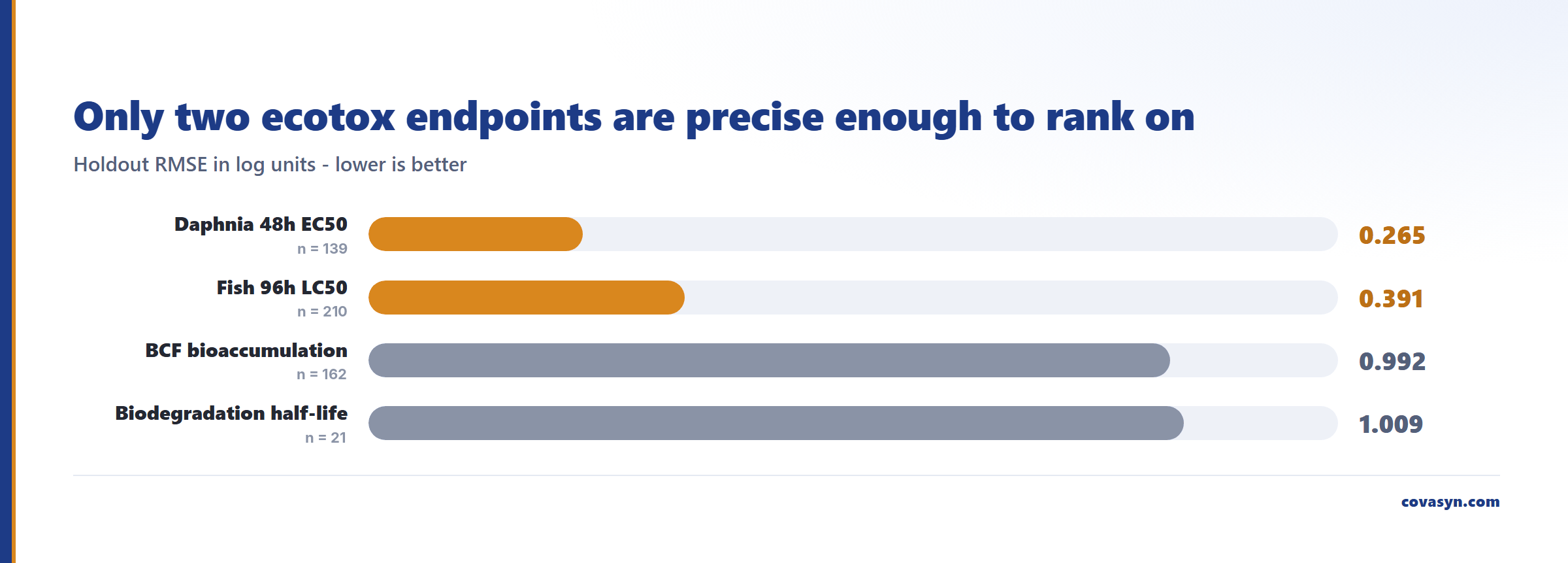
On a held-out test set split by scaffold, our trained BCF model shows RMSE 0.992 log units (n_test = 162) and the biodegradation half-life model RMSE 1.009 log units (n_test = 21, far too small to treat as a firm figure). Roughly an order of magnitude of spread. A BCF estimate of 1022 against a 2000 cut-off, and a 39.3 d half-life against a 40 d cut-off, are both coin flips at that precision. The honest statement is "close to the criterion, needs data", not "not B" and "not P".
For reference, the same test set gives fish LC50 RMSE 0.391 (n_test = 210), Daphnia EC50 RMSE 0.265 (n_test = 139), acute aquatic hazard classification AUC 0.865 (n_test = 193) and ready-biodegradability balanced accuracy 0.713 (n_test = 232). Those are the endpoints worth ranking on. Half-life is not.
The T gate in a screen is not the regulatory T gate.
REACH Annex XIII defines T on *chronic* NOEC/EC10 below 0.01 mg/L, plus CMR and endocrine routes. A screen working from acute estimates is approximating that. Confirming T needs OECD 210/211/201 chronic data or a defensible CMR/ED argument.
How to use a screen like this properly
- Rank, do not classify. Use it to order a portfolio or a set of analogues by likely PBT burden, then spend the OECD 305 and OECD 307/308 money on the top of that list.
- Treat near-threshold as a flag, not a pass. Anything within one log unit of BCF 2000 or the 40/60 d half-life cut-offs is undetermined, not negative.
- Check the provenance of every number. Rough estimates and predictions of validated models deserve different weight in the same report.
- Never put a screening number in a Phase II ERA as a substitute for a guideline study. It is triage input for the study plan.
Frequently asked questions
What is the difference between a "very toxic to aquatic life" classification and a PBT?
GHS Acute 1 ("very toxic to aquatic life") means the most sensitive acute endpoint, whether fish 96h LC50, Daphnia 48h EC50 or algae 72h ErC50, is at or below 1 mg/L. It is a hazard label based on short-term lethality. PBT is a separate screen requiring all three of persistence, bioaccumulation and chronic toxicity. A compound can be Acute 1 and clearly not PBT if it degrades quickly and does not bioaccumulate.
What are the PBT criteria under REACH Annex XIII?
Persistent: half-life above 40 days in fresh water, 60 days in marine water, 120 days in freshwater sediment or soil, 180 days in marine sediment. Bioaccumulative: BCF in aquatic species above 2000. Toxic: chronic NOEC or EC10 below 0.01 mg/L, or a CMR classification, or other chronic/endocrine evidence. All three gates must be met for PBT. vPvB requires only the very-persistent (60 days water) and very-bioaccumulative (BCF above 5000) gates.
When does an EMA environmental risk assessment require a PBT assessment?
Under EMEA/CHMP/SWP/4447/00 Rev. 1, a log Kow above 4.5 triggers a PBT assessment for a human medicinal product, independently of the Phase I exposure calculation. That means a compound can fall below the PEC action limit for a Phase II risk assessment and still owe a PBT evaluation. The PBT screen runs alongside the PEC/PNEC assessment, not inside it.
Can an in-silico screen decide PBT status for a regulatory submission?
No. In-silico ecotoxicity output is triage: it ranks compounds and shapes which guideline studies you commission. PBT conclusions in a dossier need OECD 305 bioaccumulation data, OECD 307/308/309 degradation data and chronic OECD 201/210/211 effects data, or a documented weight-of-evidence argument. Screening estimates near a threshold, within about one log unit, should be reported as undetermined, not negative.
Why does BCF 1022 count as "not bioaccumulative" when that looks high?
The B criterion is a hard cut-off at BCF 2000, so 1022 is formally below it. But even a trained BCF model carries roughly an order of magnitude of uncertainty (RMSE 0.992 log units on a test set split by scaffold, n_test = 162), and the value in the table is only a rough estimate from lipophilicity. A value of 1022 against a 2000 cut-off is not a defensible negative.
Is a short aquatic half-life enough to rule out an environmental concern?
No. Persistence is only one gate, and pharmaceuticals are continuously emitted through wastewater, so a compound with a short half-life can still maintain a steady environmental concentration. Diclofenac is the standard illustration: not PBT by the screening criteria, yet monitored under the EU Water Framework Directive watch list mechanism because of continuous input and chronic effects at low concentrations.
Related reading
Evaluation for this topic
We evaluate this for your lab.
- ICH M7, Tox21, CYP450, structural alerts, ADMET triage.