

Your accelerated arm at 40 °C / 75% RH has come back and the assay is lower than you hoped. The question is not whether the number looks bad. The question is whether it is a "significant change" in the ICH Q1A sense, because that word switches on a different study design, a different shelf-life justification, and a different conversation with the assessor.
This article covers what actually triggers significant change, what it obliges you to do next, and a worked example with real results.
The short answer
Significant change is a defined term, not a judgement call. For a drug product, ICH Q1A(R2) defines it as any one of the following:
| Trigger | What counts |
|---|---|
| Assay | A 5% change from the initial value (or failure to meet the potency acceptance criterion when biological or immunological methods are used) |
| Degradation products | Any degradant exceeding its acceptance criterion |
| Appearance and physical attributes | Failure to meet the acceptance criteria for appearance, physical attributes or functionality (colour, phase separation, resuspendability, caking, hardness, dose delivered per actuation) |
| pH | Failure to meet the pH acceptance criterion, where relevant to the dosage form |
| Dissolution | Failure to meet the dissolution acceptance criteria on 12 dosage units |
Some physical attribute changes (softening of suppositories, melting of creams) are expected at 40 °C and are assessed against the intent of the study rather than treated automatically as a failure.
For a drug substance, the definition is simpler: significant change means failure to meet its specification. There is no 5% assay rule for drug substance.
Two things practitioners get wrong regularly:
- 5% is a change from initial, not a spec failure. A product with a 95.0% lower spec limit that drops from 100.0% to 94.9% has both a spec failure and a significant change. A product that drops from 100.0% to 94.5% but is registered against a 90.0% limit still has a significant change, even though it is comfortably in spec.
- Any single trigger is enough. Assay can be perfect and a single degradant over its limit still fires it.
Worked example: 8.1% assay loss at 40 °C
Take a representative small-molecule stability set: assay as % label claim, arms at 25 °C (long term), 30 °C (intermediate) and 40 °C (accelerated), lower spec limit 95% LC.
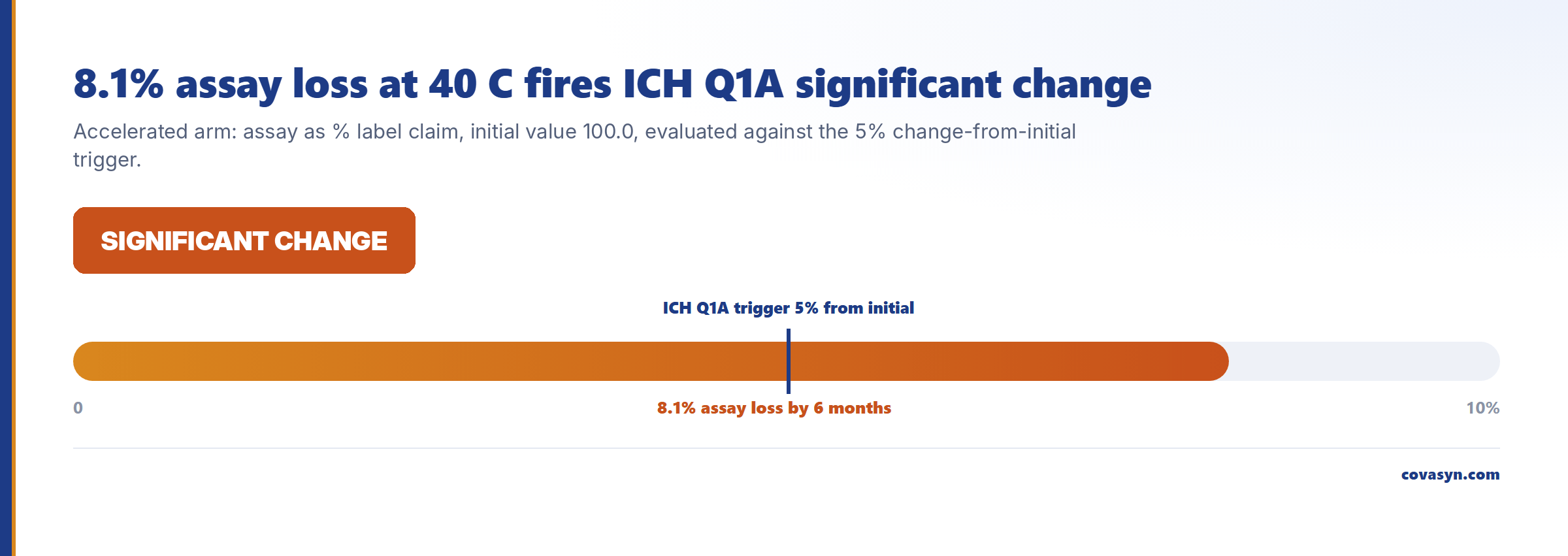
CovaSyn's stability analysis assesses the accelerated arm against the initial value of 100% LC: significant change yes, maximum change 8.1% (value 91.9% against an initial 100.0%).
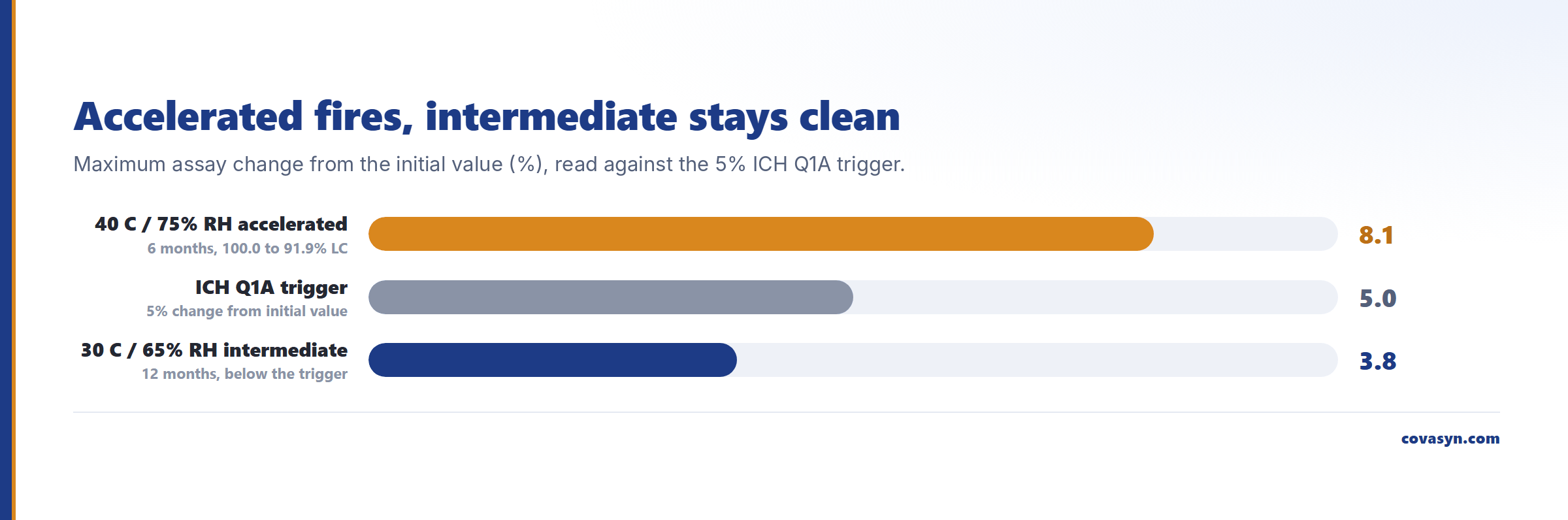
The accelerated assay fell from 100.0% to 91.9% LC by 6 months. That is 8.1 percentage points against a 5% trigger. Significant change, unambiguously.
Now run the same assessment on the intermediate 30 °C arm: significant change no, maximum change 3.8%.
3.8% at 12 months at 30 °C. Below the trigger. That combination, fired at accelerated and clean at intermediate, is the single most common outcome in practice, and it is precisely the case ICH Q1E was written for.
Caveats on those numbers, stated plainly: the input data are a representative dataset, not a client batch; the results are genuine computations on that input. What is assessed here is the assay criterion. Degradant limits, dissolution, pH and physical attributes are separate triggers that you must evaluate against your own registered acceptance criteria: no significant change on assay does not mean the batch is clean overall.
What significant change obliges you to do
Once the accelerated arm fires, the accelerated data stop being a shortcut and start being a warning. The obligations depend on the storage category. For products stored long term at 25 °C with the accelerated arm at 40 °C, as in the example above, the consequence is testing at the intermediate condition (see below). For refrigerated products (long term 5 °C, accelerated 25 °C / 60% RH) it also matters when it fired:
Refrigerated product: significant change between 3 and 6 months at accelerated (25 °C).
The proposed retest period or shelf life is based on the long-term data. You keep running the accelerated study, but you no longer lean on it to extend anything.
Refrigerated product: significant change within the first 3 months at accelerated (25 °C).
You owe a discussion of the effect of short-term excursions outside the label storage condition (shipping, handling), and this can be supported, if appropriate, by further testing on a single batch for a period shorter than 3 months but with more frequent testing than usual. It is not enough to note the failure and move on.
Testing at the intermediate condition.
If your long-term condition is 25 °C / 60% RH and significant change occurs at accelerated, you test at the intermediate condition, normally 30 °C / 65% RH. The expectation for a new submission is a minimum of 6 months data from a 12-month study at intermediate, on at least three primary batches, at a minimum of four timepoints (0, 6, 9, 12).
The exception people miss:
if your long-term storage condition is 30 °C / 65% RH, there is no intermediate condition. There is nothing between 30 and 40. Products already registered for zone IVb, or companies that chose 30 °C long term deliberately to de-risk this, skip the whole intermediate arm.
Extrapolation shrinks.
Under ICH Q1E, how far you can extrapolate beyond the observed long-term data depends on what the accelerated and intermediate arms did. With significant change at accelerated, the permitted extrapolation is materially reduced compared with a clean accelerated arm: work through the Q1E decision trees and Appendix A for your specific case rather than assuming your usual multiplier still applies. If significant change occurs at intermediate as well, extrapolation beyond the long-term data is generally off the table.
The temptation to model your way out
With the same representative dataset, the Arrhenius fit returns Ea 107.45 kJ/mol, Q10 4.08, R² 0.995, and the extrapolation gives 30.4 months at 25 °C; a cross-check via the regression-based shelf-life estimate gives 28.2 months (R² 0.9989, p = 1.3e-8, pooled across batches). That is a well-behaved Arrhenius fit and a coherent shelf-life estimate.
It does not remove the intermediate testing obligation. Kinetic extrapolation is a planning and design tool: it tells you where to put timepoints, whether your degradation is first or second order, and whether 30 °C is likely to fire too. It is not a substitute for the data ICH Q1A requires you to generate. Nobody has ever won that argument with a modelled number.
The useful move is to run the model before the accelerated data land, so that if 40 °C is likely to fire you have already put the intermediate arm on stability rather than starting it 8 months late.
Honest limits
What this analysis does not tell you:
- It does not decide dissolution, degradant, pH or appearance triggers. Those need your registered acceptance criteria and the corresponding analytical results.
- It is assay-criterion arithmetic, not a regulatory opinion. Our analysis flags the 5% threshold and reports the value and the timepoint. Which decision tree applies, and what you write in 3.2.P.8.1, is your call.
- Arrhenius assumes one dominant degradation mechanism across the temperature range. If a new pathway switches on at 40 °C, the 25 °C extrapolation is wrong in a way that R² will not reveal. That is one more reason the intermediate arm exists.
- The example dataset is representative. Absolute months and activation energies are not transferable to your molecule.
Frequently asked questions
What is significant change under ICH Q1A?
For a drug product, significant change is a 5% change in assay from the initial value (or failure of the potency criterion for biological methods), any degradation product exceeding its acceptance criterion, or failure to meet acceptance criteria for appearance, physical attributes, functionality, pH where relevant, or dissolution on 12 dosage units. For a drug substance, significant change simply means failure to meet its specification. Any single trigger is sufficient.
Is 5% a percentage point change or a relative change?
ICH Q1A specifies a 5% change from the initial value. In practice, assay is normally reported as % label claim, and the change is assessed against the initial assay value of that batch, not against the label. In the worked example above, 100.0% falling to 91.9% is an 8.1% change and therefore a significant change.
What do I have to do if significant change occurs at the accelerated condition?
Base the proposed shelf life on long-term data, and test at the intermediate condition (normally 30 °C / 65% RH) if your long-term condition is 25 °C. For a new submission, provide a minimum of 6 months of data from a 12-month intermediate study on three primary batches. The rules on "within the first 3 months" and "between 3 and 6 months" apply instead to refrigerated products with the accelerated arm at 25 °C: if the change occurred there within the first 3 months, discuss short-term excursion effects, supported where appropriate by further testing on a single batch for less than 3 months with more frequent timepoints.
Do I always need an intermediate condition?
No. The intermediate condition only applies when the long-term storage condition is 25 °C / 60% RH. If the product is stored long term at 30 °C / 65% RH, there is no intermediate condition between it and the 40 °C accelerated arm, so significant change at accelerated does not create an intermediate testing obligation.
Can I be in specification and still have a significant change?
Yes, and this trips teams up. The 5% assay criterion is measured against the initial value, independently of your registered limits. A batch starting at 100.0% and reaching 94.0% has a significant change even if the lower spec limit is 90.0%. Conversely, a degradant that exceeds its acceptance criterion triggers significant change even when assay has barely moved.
Can Arrhenius modelling replace intermediate condition testing?
No. Kinetic modelling is decision support for study design and for anticipating whether 30 °C will also fire. ICH Q1A requires generated data at the intermediate condition; a modelled extrapolation, however well fitted, does not discharge that obligation. Use it early to get the intermediate arm on stability on time, not afterwards to argue it away.
Related reading
Evaluation for this topic
We evaluate this for your lab.
- ICH stability, Arrhenius fits, shelf life.