
You have six factors, a limited amount of API and a manager who wants an answer this month. The full factorial is out. The question is which screen to run instead, and what you are giving up when you pick the cheapest one. This article compares fractional factorial, Plackett-Burman and definitive screening designs on the same six-factor problem, using real results from our design-of-experiments analysis.
The test case
A Suzuki-type aryl halide coupling with six factors: temperature (60 to 100 °C), catalyst loading (0.5 to 5 mol%), base equivalents (1 to 3), water fraction (0 to 0.3), time (2 to 16 h) and ArB equivalents (1 to 2). Response: yield.
All numbers below were computed for exactly those factor definitions. Nothing is illustrative.
The comparison, in one table
The design comparison for the screening goal assessed six candidates. The five that matter for a screening decision:
| Design | Runs | Resolution | D-efficiency | G-efficiency | Estimated power |
|---|---|---|---|---|---|
| D-optimal | 19 | VI | 0.990 | 0.826 | 0.979 |
| Definitive screening (DSD) | 13 | VI | 0.799 | 0.933 | 0.850 |
| Full factorial 2^6 | 67 | Full | 0.962 | 0.961 | 1.000 |
| Fractional factorial | 11 | III | 0.761 | 0.757 | 0.702 |
| Plackett-Burman | 8 | III | 1.000 | 1.000 | 0.176 |
For a DSD, "resolution VI" is not a classical term, because a DSD is not a regular fraction; what it means is that main effects are aliased neither with two-factor interactions nor with quadratic effects, while two-factor interactions remain partially correlated with each other.
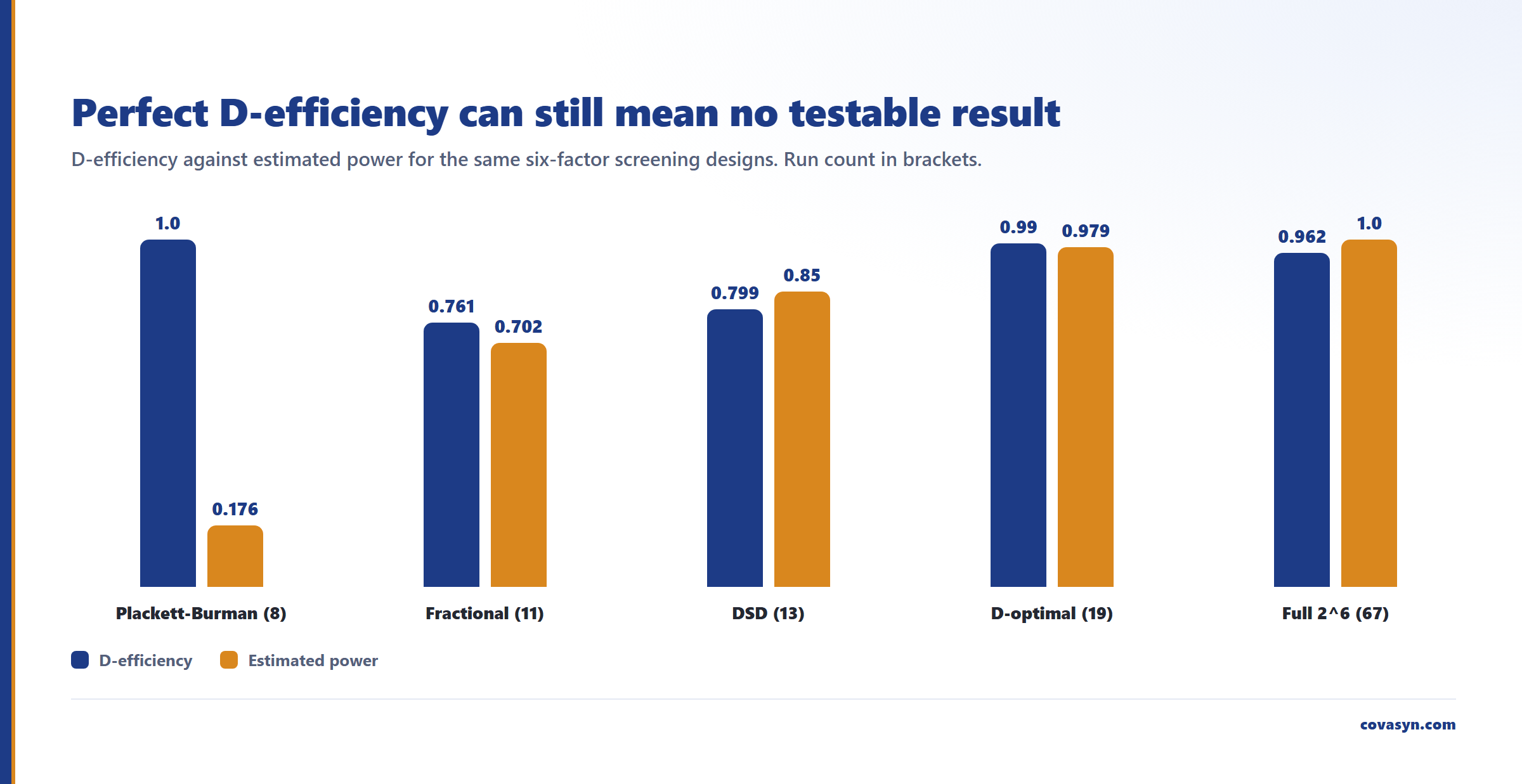
Two things jump out. The full factorial at 67 runs (64 corners plus 3 centre points) buys power 1.0 and every two-factor interaction, at five times the run count of the DSD. And Plackett-Burman has a perfect D-efficiency of 1.000 and a power of 0.176. That is not a contradiction, and it is the most useful thing on the table.
What resolution actually means
Resolution describes which effects are indistinguishable from which. In a fractional design you are running a subset of the full factorial, and the price is that some effects share a column in the model matrix. Those effects are aliased: the data cannot separate them.
- Resolution III: main effects are aliased with two-factor interactions.
- Resolution IV: main effects are clear of two-factor interactions, but two-factor interactions are aliased with each other.
- Resolution V and above: main effects and two-factor interactions are all estimable separately.
The resolution III 2^(6-3) fractional factorial is 8 corner runs with defining relation I = ABD, I = ACE, I = BCF, I = DEF. The alias analysis of that coded matrix returns resolution III and 14 alias chains across 21 terms checked. The main-effect chains are explicit:
| Main effect | aliased with | and with |
|---|---|---|
| Temperature | catalyst × water | base × time |
| Catalyst | temperature × water | base × ArB |
| Base | temperature × time | catalyst × ArB |
| Water | temperature × catalyst | time × ArB |
| Time | temperature × base | water × ArB |
| ArB | catalyst × base | water × time |
Read the first line as a warning. If this screen reports a large temperature effect, that number is temperature plus a catalyst x water interaction plus a base x time interaction. In a coupling reaction where catalyst and water genuinely interact, that is not hypothetical. You cannot untangle it from these 8 runs; you need a fold-over or a different design.
On run counts: the plan itself has 8 corner runs, the comparison above lists 11 because it costs in 3 centre points for a pure-error estimate. Same design, different booking.
Why Plackett-Burman scores 1.000 on efficiency and 0.176 on power
D-efficiency and G-efficiency measure how well a design fills the space it can address. The 8-run Plackett-Burman for 6 factors is a saturated orthogonal array: every column is balanced, every pair is orthogonal, and the information matrix is as good as it gets. Hence 1.000 and 1.000.
Power is a different question: given the residual noise, can you tell a real effect from zero? That depends on degrees of freedom left over after fitting.
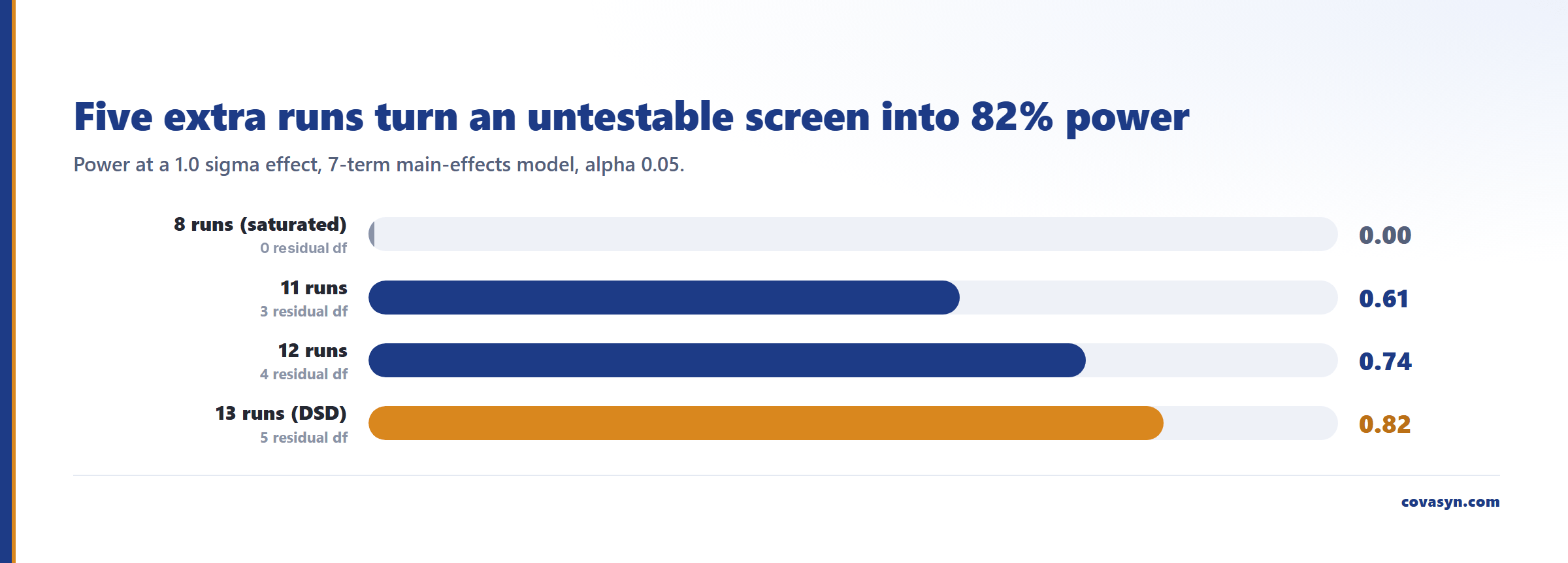
The power analysis at 8 runs with 7 terms and effect size 1.0 sigma gives power 0.0 with 0 residual degrees of freedom: too few runs for the number of terms.
Zero residual degrees of freedom, because the intercept counts on top of the 7 terms: 8 runs minus 7 terms minus intercept gives 0. The model then fits the data exactly, and there is nothing left to estimate the error with. For the model of intercept plus 6 main effects, exactly 1 residual degree of freedom would remain, and a test on a single degree of freedom has hardly any power. A saturated design gives you effect estimates and practically no way to test them.
Compare the same calculation at other run counts, all at 7 terms and 1.0 sigma:
| Runs | Residual df | Power at 1.0 sigma |
|---|---|---|
| 8 (saturated) | 0 | 0.00 (no test possible) |
| 11 | 3 | 0.61 |
| 12 | 4 | 0.74 |
| 13 (DSD) | 5 | 0.82 |
The jump from 8 to 13 runs is five experiments. It takes you from "no test is possible" to "82% chance of catching a one-sigma effect". That is the cheapest statistical purchase in the whole table.
The DSD sweet spot
The definitive screening design for these six factors is 13 runs (labelled resolution VI above, meaning main effects free of two-factor interactions), estimated power 0.850. It detects main and quadratic effects in 13 runs; the classical alternative would be a fractional factorial at 32 runs.
Three levels per factor plus a centre run means DSDs do something the two-level screens cannot: they detect curvature. Main effects are not aliased with two-factor interactions at all, and two-factor interactions are not fully aliased with each other. If a factor has an optimum inside your range rather than at an edge, a two-level screen will report it as a weak linear effect and you will drop it. The DSD will flag it.
Power depends on the effect you are hunting. Power analysis at 13 runs and 7 terms:
| Effect size | Power |
|---|---|
| 0.5 sigma | 0.31 |
| 1.0 sigma | 0.82 |
| 2.0 sigma | 1.00 |
Be honest about this before you run it. A 13-run DSD is not built to find half-sigma effects. If your assay noise is 2% yield and you care about 1% differences, no 13-run design will help you. Reduce the noise or increase the runs.
How to choose
- 6 to 12 factors, want main effects plus curvature, want to move straight into a response surface: definitive screening design. 13 runs here, main effects free of two-factor interactions, power 0.85, and it augments cleanly into a central composite design.
- Many factors, you only need a rank order, effects are large and interactions are genuinely believed negligible: Plackett-Burman. Add centre points or replicates, or you have zero residual df and cannot test anything.
- You need a specific defining relation, blocking, or a fold-over strategy your site already has SOPs for: fractional factorial. Choose resolution IV or higher if any interaction is plausible. Resolution III is for triage only.
- Irregular factor ranges, hard constraints, categorical factors, or a fixed run budget: D-optimal. It reached power 0.979 at 19 runs in this comparison, because it optimises against the model you specify rather than a catalogue design.
- Fewer than 5 factors and runs are cheap: run the full factorial and stop reading comparison articles.
What this comparison does not tell you
- Power figures are model-relative. They assume the 7-term main-effects model, alpha 0.05 and normally distributed residuals. Change the model and the numbers change.
- Effect sizes are in sigma units. "Power 0.82 at 1.0 sigma" is only meaningful once you know your own run-to-run standard deviation. Estimate it from replicates before you trust any of these numbers.
- Efficiency metrics say nothing about chemistry. A design can be D-optimal and still put every run in a region where your catalyst decomposes. Feasibility screening remains your job, not the statistics'.
- Aliasing is not removed by good efficiency values. The resolution III chains above exist regardless of how well the design otherwise performs.
- This is design support, not a validated result. The runs still have to happen in a lab, and nothing here substitutes for confirmation runs or a regulatory filing.
Frequently asked questions
What is the difference between a fractional factorial and a Plackett-Burman design?
Both are two-level screening designs, but a fractional factorial has run counts that are powers of two and a clean defining relation, so the aliasing is explicit and predictable. Plackett-Burman designs come in multiples of four and have complex partial aliasing spread across many interactions. For 6 factors, the result is an 8-run resolution III fraction versus an 8-run Plackett-Burman, both resolution III.
When should I use a definitive screening design instead of a fractional factorial?
Use a DSD when curvature is plausible and you want to move into optimisation without a second screening round. For 6 factors, our comparison returned a 13-run DSD (labelled resolution VI) with power 0.85, versus an 11-run resolution III fraction at power 0.70. Two extra runs buy you unaliased main effects and quadratic detection.
Why does Plackett-Burman show perfect D-efficiency but very low power?
D-efficiency measures how well the design spreads information across the factors, and a saturated orthogonal array scores 1.000. Power measures whether you can distinguish an effect from noise, which needs residual degrees of freedom. At 8 runs with 7 model terms (the intercept counts on top), the power analysis gives power 0.0 with 0 residual df: there are too few runs.
How many runs do I need to screen 6 factors?
It depends on what you want to estimate. Our comparison returned a full factorial at 67 runs (power 1.0), D-optimal at 19 (power 0.98), a definitive screening design at 13 (power 0.85), a resolution III fraction at 11 (power 0.70) and Plackett-Burman at 8 (power 0.18). For most process screens, 13 to 19 runs is the practical range.
What does design resolution III mean in practice?
It means main effects are aliased with two-factor interactions and cannot be separated from them. In the 2^(6-3) fraction above, the alias analysis found 14 alias chains: the temperature estimate is temperature plus catalyst x water plus base x time. If interactions are real, resolution III effect estimates are biased and need a fold-over or an augmented design to resolve.
Can I turn a screening design into a response surface without starting over?
Yes. An existing design can be extended rather than replaced. In our documented example, the 13-run DSD was augmented with 8 further runs (6 axial, 2 centre) to give a 21-run central composite design on the three surviving factors. The screening runs are reused, so only the new runs cost lab time.
Related reading
Evaluation for this topic
We evaluate this for your lab.
- Design of Experiments, RSM, templates.