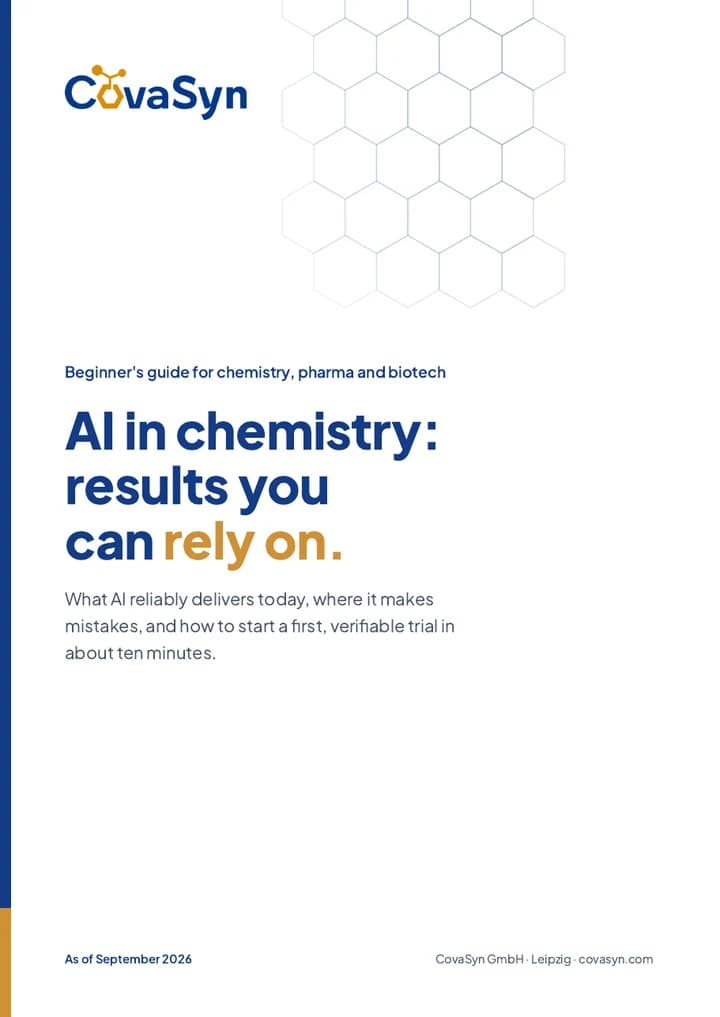
AI in chemistry: results you can rely on
The free guide shows on eight pages when you can trust an AI result in chemistry and how to run a first, verifiable trial in about ten minutes.
PDF, 8 pages, A4, free, by email once you have confirmed your address.
What the guide covers
- 01Model or toolWhich tasks you can leave to a language model and which a chemistry tool should calculate, from literature summaries to stability estimates.
- 02Seven questions to ask of every AI resultWhat to check before a number goes into a report, a protocol or a decision.
- 03Your first trial in about ten minutesStep by step with a molecule whose values you know, in the Sketcher or in your AI client.
- 04Six questions to ask every providerWhat to clarify about data and security as soon as structural or measurement data reach a tool.
Independently measured
AI models alone
14 to 41%
With CovaSyn tools
76 to 92%
14 to 41% without CovaSyn, 76 to 92% with CovaSyn. Measured on MolecularIQ, a benchmark we did not design (arXiv:2601.15279, Klambauer Lab, Institute for Machine Learning, JKU Linz).
Source: Bartmann C., Schimunek J., Ielanskyi M., Seidl P., Klambauer G., Luukkonen S. (2026). MolecularIQ: Characterizing Chemical Reasoning Capabilities Through Symbolic Verification on Molecular Graphs. arXiv:2601.15279. Snapshot: 2026-05-17.
Methodology and dataHow to get the guide
- 1Fill in the formYour name and business email are enough, company and role are optional.
- 2Confirm your addressYou will receive an email with a confirmation link. Only then do we send the guide.
- 3Download the PDFThe download link arrives by email and is also available right after confirmation. It is valid for seven days.
We use your details to send you the guide. No automated sales or newsletter contact follows from this.