
Your API is in solution after the reaction and you need it out as a solid. Two routes are usually on the table: cool the batch, or add an antisolvent. Choosing wrong costs you a campaign's yield and a week of lab time, and the answer is often visible in the solubility data before anyone weighs anything out.
This article shows how to make that call quantitatively, using a worked ibuprofen example from our solubility analysis, and where the numbers stop being trustworthy.
What antisolvent crystallization design actually decides
Four things, in this order:
1. Is antisolvent the right route at all? If cooling generates enough supersaturation, it is usually the simpler and cleaner unit operation. 2. Which antisolvent? It must be miscible with the process solvent, a poor solvent for the API, and acceptable on ICH Q3C and cost grounds. 3. How much? The volume fraction where the solubility drop stops buying you yield. 4. What yield do you get, and what stays in the mother liquor? This sets your mass balance and your recovery loop.
Points 3 and 4 are the ones people guess at. They do not have to be guessed.
The driving force: read the solubility gap first
Antisolvent crystallization works because you are collapsing the solubility of the API by swapping the solvent environment underneath it. So the first number you want is the ratio between the API solubility in the process solvent and in the antisolvent.
For ibuprofen at 25 °C, CovaSyn's solubility prediction returns (analysis of 2026-07-25):
| Solvent | log S (mol/L) | Solubility | 95% CI (log) | Model confidence | In applicability domain |
|---|---|---|---|---|---|
| Ethanol | 0.4756 | 616.7 g/L | 0.320 to 0.632 | 0.987 | yes |
| Water | −3.9446 | 0.0234 g/L | −4.153 to −3.736 | 0.982 | yes |
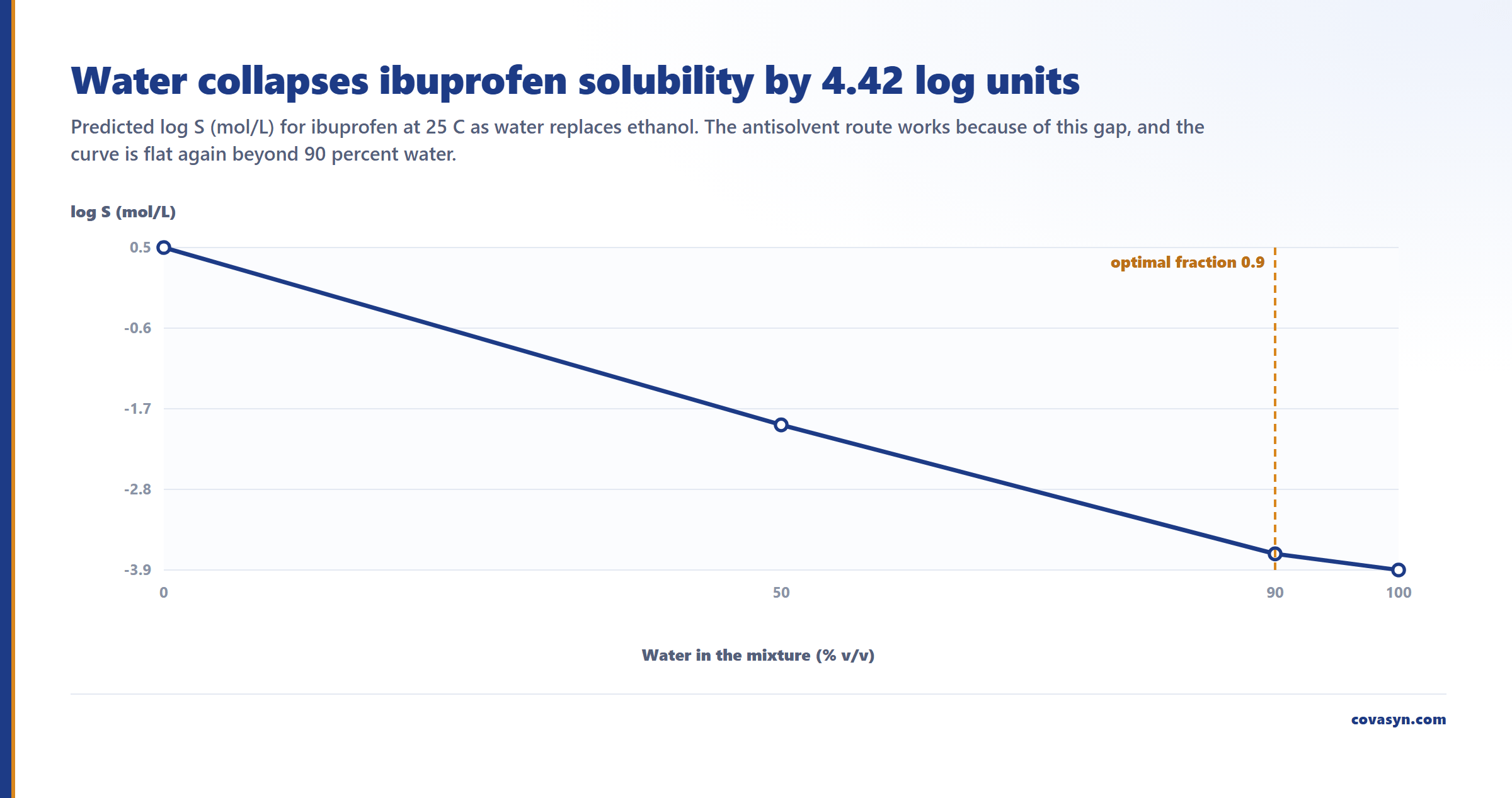
That is 4.42 log units, roughly a 26,000-fold collapse in solubility when water replaces ethanol. Any gap of that size makes water a serious antisolvent candidate before you run a single experiment.
A rule of thumb that holds up: if the process solvent and the candidate antisolvent differ by less than about 1.5 log units of solubility, the antisolvent route will need a lot of volume for modest yield, and you should look harder at cooling, evaporation or a salt form.
Why cooling fails here, in numbers
The honest comparison matters more than the headline. The crystallization calculation for ibuprofen in ethanol returns a yield of 0.0 percent, with a maximum supersaturation of 0.218 over the cooling profile.
Look at the profile it returns and the reason is obvious. The predicted concentration at saturation is 2412 g/L at 353 K and still 459 g/L at 278 K. Ibuprofen is so soluble in ethanol that chilling to 5 °C does not push you past the solubility curve at any sensible charge. Supersaturation stays below 1, so there is no thermodynamic driving force to nucleate. Cooling here is not slow crystallization: it is no crystallization.
This is a real negative result from the calculation, not a strawman. It is exactly the kind of thing you want to find on a Tuesday afternoon in a browser rather than after a jacketed reactor has been chilling overnight.
Worked example: sizing the water addition
Charge: 10 g ibuprofen in 100 mL ethanol, 25 °C. Antisolvent: water.
The antisolvent calculation returns:
- optimal fraction 0.9 (water as volume fraction of the final mixture)
- 9.9961 g recovered of the 10 g charged
- 99.96 percent yield
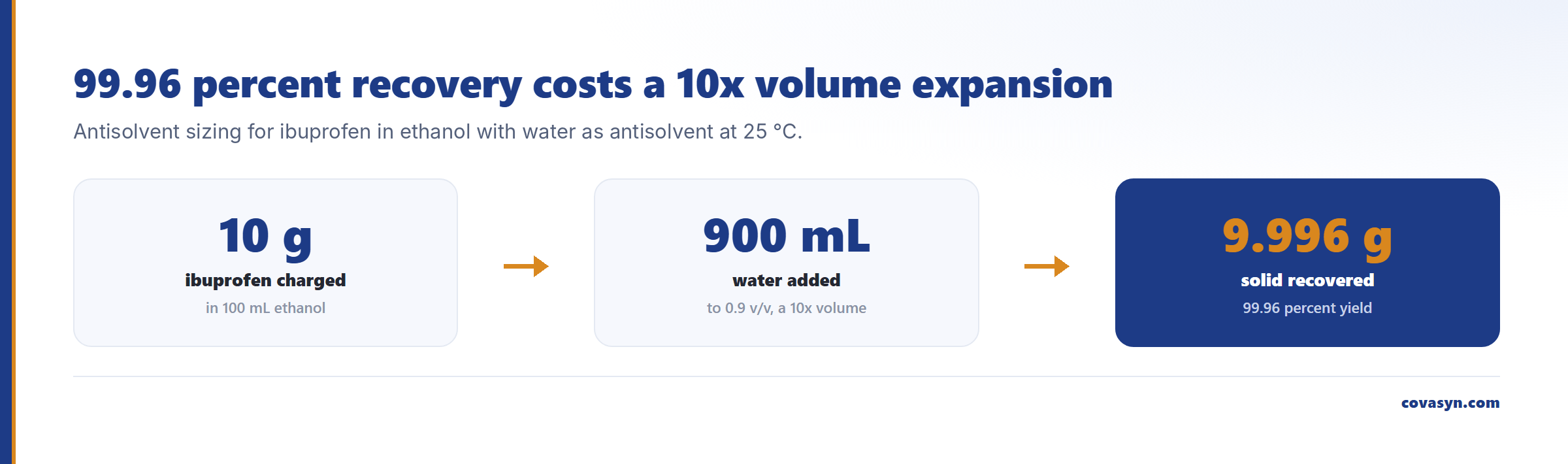
In practice that means adding roughly 900 mL of water to the 100 mL ethanol solution. That is a 10x volume expansion, which is the real cost of this route and needs to be checked against your vessel before anything else.
Cross-checking the mass balance by hand
Do not take a single yield number on trust. Solubility in the mixed solvent can be predicted directly, and gives for ibuprofen at 25 °C:
| Water:ethanol (v/v) | log S (mol/L) | Solubility | 95% CI (log) |
|---|---|---|---|
| 50:50 | −1.956 | 2.29 g/L | −3.92 to +0.004 |
| 90:10 | −3.724 | 0.039 g/L | −5.68 to −1.76 |
At the 90:10 endpoint, 0.039 g/L across roughly 1.0 L of final liquor leaves about 0.039 g dissolved, so about 9.96 g recovered, or 99.6 percent. The 99.96 percent from the antisolvent calculation is close but not identical, because the two routes treat the mixture slightly differently. Both land in the same place: at 90 percent water essentially all of the ibuprofen is out of solution, and the residual in the mother liquor is a rounding error, not a recovery problem.
The 50:50 row is the more useful design number. At half water you still have 2.29 g/L in solution, about 0.46 g in a 200 mL liquor, which is a loss of roughly 5 percent. That is why the calculation pushes to 0.9 rather than stopping at a comfortable 1:1 addition.
What this gives you going into the lab
- A target antisolvent fraction to bracket in the first DoE, say 0.7 / 0.8 / 0.9.
- An expected volume expansion to check against vessel capacity, here 10x.
- A predicted mother liquor loading to compare against your first measured filtrate assay.
- A defensible reason on paper for not running the cooling route.
Honest limits: what these numbers do not tell you
This is decision support for route choice and volume sizing. It is not a crystallization design package, and it will not survive contact with a regulator on its own.
- Thermodynamics only, no kinetics. The calculation returns equilibrium solubility and yield. It says nothing about nucleation rate, metastable zone behaviour under real addition rates, oiling out, or whether you get a filterable crystal or a gel.
- No polymorph or habit prediction. Antisolvent addition is a classic way to isolate a metastable form. Nothing here tells you which form you will get. That is a wet-lab question with XRPD attached.
- Mixture predictions carry much wider intervals. The 50:50 point above has a 95 percent CI spanning close to 4 log units. Treat mixed-solvent solubility as a shape, not a value. The pure-solvent predictions are far tighter (0.31 log wide for ethanol).
- Model accuracy is bounded. On a held-out, scaffold-split test set the solubility prediction reaches R2 about 0.92, RMSE about 0.64 log and roughly 78 percent of predictions within 0.5 log on about 5,315 novel-scaffold rows. On held-out aqueous data specifically: RMSE 0.689, MAE 0.402, R2 0.914, 76.4 percent within 0.5 log. Half a log unit of error is a 3x error in solubility. That is fine for a 26,000x route decision and not fine for a final mass balance.
- No ionization handling unless you ask for it. Ibuprofen is an acid with pKa near 4.9. If your antisolvent is an aqueous buffer rather than pure water, the pH matters enormously and solubility should be assessed pH-dependently rather than with the neutral-water number.
- Nothing about impurity rejection. High yield is not the goal on its own. A 99.96 percent recovery that drags the impurities in with it is a worse outcome than 92 percent clean.
Use the output to pick a route and set the first experiment. Confirm in glassware.
Frequently asked questions
When should I use antisolvent crystallization instead of cooling?
Use antisolvent when the API is too soluble in the process solvent for cooling to generate supersaturation. Compare predicted solubility at your highest and lowest process temperatures. If the difference is small, cooling will not precipitate. For ibuprofen in ethanol, the calculation gives 459 g/L at 5 °C and a maximum supersaturation of 0.218, giving 0 percent cooling yield, so antisolvent is the only viable route.
How do I choose the antisolvent volume fraction?
Pick the fraction where further addition stops reducing dissolved API meaningfully, then check it against vessel capacity. For ibuprofen in ethanol with water, the calculation returns an optimal fraction of 0.9, which recovers 9.996 g of a 10 g charge, or 99.96 percent. At 50 percent water, predicted solubility is still 2.29 g/L, so about 0.46 g of a 10 g charge would stay in a 200 mL mother liquor.
What makes a good antisolvent?
Three requirements: fully miscible with the process solvent at the intended ratio, a poor solvent for the API by at least 1.5 to 2 log units of solubility, and acceptable on ICH Q3C class and cost. Water against an alcohol or acetone process solvent is the standard first choice. Heptane against an ester or ether solvent is the common non-aqueous equivalent.
Can a solubility model predict crystallization yield reliably?
It predicts the equilibrium ceiling, which is the upper bound on yield, not the achieved yield. On a held-out, scaffold-split test set the solubility prediction reaches roughly R2 0.92 and RMSE 0.64 log across about 5,315 novel-scaffold rows. Half a log of error is a 3x solubility error, which is acceptable for route choice and too coarse for a final mass balance. Kinetics, oiling out and filtration losses are not modelled.
Why is the 10x volume expansion a problem?
Because it usually decides feasibility before yield does. Going to 0.9 water on a 100 mL ethanol solution needs 900 mL of water, so a 100 L reactor charge becomes a 1000 L operation. Check vessel capacity, waste volume and downstream solvent recovery first. If the expansion does not fit, reconsider the process solvent so a smaller antisolvent ratio delivers the same drop.
Does antisolvent crystallization affect which polymorph I get?
Frequently, yes. Rapid antisolvent addition creates high local supersaturation and often favours metastable forms, and it can cause oiling out instead of crystallization. No solubility model predicts this. Screen the form experimentally with XRPD and DSC, and control the addition rate and mixing as part of the design space rather than treating the volume fraction as the only variable.
Related reading
Evaluation for this topic
We evaluate this for your lab.
- Solubility, pH, crystallization, antisolvent.