
You have a target-validated antibody and a payload, and now someone has to decide the drug-to-antibody ratio, the conjugation chemistry and the linker. Get it wrong and you find out six months later in a HIC trace, an aggregation shoulder on SEC, or free payload in plasma. Most of the early decisions can be pressure-tested from sequence and SMILES before anyone books conjugation lab time.
This walks through what you can and cannot get from a sequence-level ADC assessment, using a CovaSyn assessment of the trastuzumab heavy chain with MMAE as payload.
The four decisions that define an ADC
1. Payload class. Potency, mechanism, membrane permeability (bystander effect) and hydrophobicity. Auristatins, maytansinoids and camptothecin derivatives behave very differently in all four. 2. Linker. Cleavable (protease, acid, disulfide) versus non-cleavable. Drives systemic stability and whether you get bystander killing. 3. Conjugation site. Interchain cysteine, engineered cysteine, lysine, or enzymatic/glycan site-specific. 4. DAR. Average payloads per antibody, and just as importantly the *distribution* around that average.
They are coupled. A hydrophobic payload plus a high DAR plus stochastic lysine conjugation is the classic route to an aggregation-prone, fast-cleared molecule.
Worked example: trastuzumab heavy chain + MMAE
Basis for the assessment: the trastuzumab IgG1 heavy chain (450 aa, a public therapeutic sequence used here as a realistic test case) and the MMAE SMILES resolved from PubChem CID 11542188. Results for three target DAR values:
| Quantity | DAR 2 | DAR 4 | DAR 8 |
|---|---|---|---|
| Payload mass (Da) | 717.99 | 717.99 | 717.99 |
| Antibody mass (Da, heavy chain only) | 49284.06 | 49284.06 | 49284.06 |
| Estimated ADC mass (Da) | 50720 | 52156 | 55028 |
| Hydrophobicity shift | moderate | significant | significant |
| DAR contribution to hydrophobicity | 0.3 | 0.6 | 1.2 |
| Aggregation risk | low | low | moderate |
| Recommendation | low risk | low risk | acceptable, monitor HIC profile |
Site counts, constant across the DAR range:
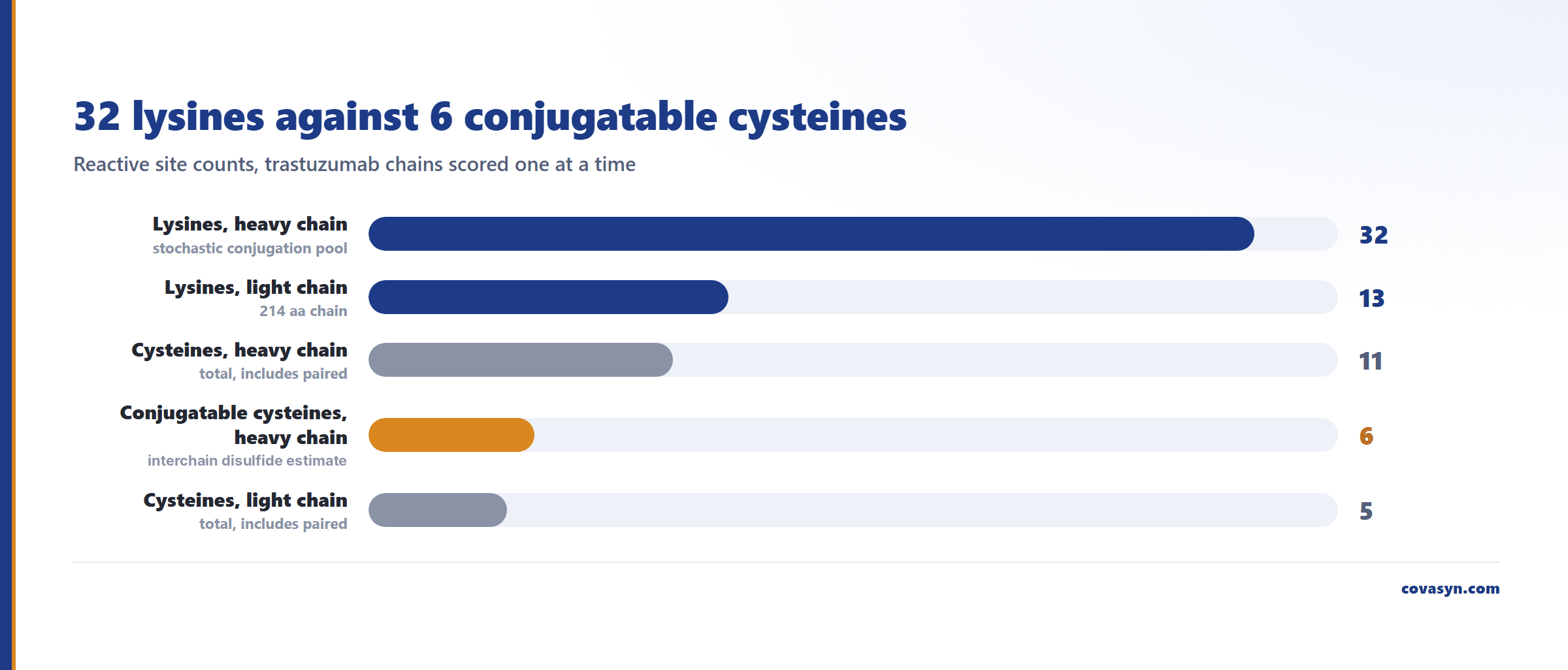
- conjugatable cysteines: 11 total cysteines, 6 estimated conjugatable, derived from the interchain disulfides
- conjugatable lysines: 32
Assessed separately, the light chain (214 aa) gives an antibody mass of 23442.81 Da, 5 cysteines and 13 conjugatable lysines. The assessment covers one sequence at a time, so an intact IgG1 means assessing heavy and light chain separately and adding the chains. The estimated ADC mass is a mass balance of antibody plus n payloads; it does not include linker mass, so treat it as a floor rather than an expected deconvoluted mass.
What the numbers actually tell you
The useful signal is the 32 lysines against 6 conjugatable cysteines on the heavy chain. That is the whole argument for cysteine over lysine conjugation in one line. Stochastic lysine conjugation at DAR 4 draws from a pool of dozens of reactive amines, which is why lysine-conjugated ADCs show broad, heterogeneous species distributions. Reduced-interchain-cysteine conjugation draws from a much smaller, better-defined pool and gives the even-numbered DAR 0/2/4/6/8 ladder you see on HIC.
The second signal is the DAR-dependent aggregation call flipping from low at DAR 2 and 4 to moderate at DAR 8, with the recommendation to monitor the HIC profile. That matches what the field has published: brentuximab vedotin and ado-trastuzumab emtansine both sit at an average DAR in the 3.5 to 4 range, and the DAR 8 subspecies of vc-MMAE conjugates were reported to clear faster and be less tolerable than DAR 2 to 4 species in preclinical work. Higher DAR is only viable when the payload and linker are engineered for it, which is what the DAR 8 topoisomerase-I ADCs did with a much more polar linker-payload.
The payload-class caveat, stated plainly
We ran the same antibody with camptothecin (payload mass 348.36 Da) at DAR 8. The result was identical on the risk quantities: payload hydrophobicity high, DAR contribution 1.2, aggregation risk moderate. The call is dominated by the DAR term, and the payload enters as a coarse class rather than a computed logP-driven delta. So the assessment will tell you that DAR 8 is where you start watching HIC. It will not currently rank an auristatin against a camptothecin derivative for you. If payload-to-payload discrimination is the decision, you need the small-molecule descriptors alongside it.
Conjugation site selection is a liability problem
The site you conjugate is also a site with its own chemistry. On the same trastuzumab heavy chain, the developability assessment returned a composite score of 29/100 ("poor") against 72/100 ("good") for the light chain, with 5 aggregation flags, 3 critical NG deamidation motifs, 4 exposed-Met oxidation sites and an unpaired cysteine. In Kabat numbering, an NG motif sat in CDR-H2 at position 55 and a DG motif in CDR-H3 at position 102. Fc methionine oxidation was flagged at 255, 361 and 431.
Two practical consequences.
Do not engineer a conjugation site into or next to a flagged hotspot.
A THIOMAB-style engineered cysteine placed adjacent to a deamidation motif or in a hydrophobic patch gives you two problems at one position.
The unpaired-cysteine flag matters for conjugation chemistry.
Free thiol content drives both stability and unwanted disulfide scrambling, and it changes what a maleimide will actually react with.
Formulation is coupled too. The viscosity estimate for the same heavy chain returned 18.97 cP at 150 mg/mL, pH 6 ("moderate"), driven by charge asymmetry 0.33 and a hydrophobic patch score of 6, with arginine or proline suggested as viscosity reducers. Adding a hydrophobic payload does not make that better. If you are already at moderate viscosity as a naked antibody, high-DAR hydrophobic conjugation is a formulation risk you should cost in early.
Linker stability: what you have to measure
Linker choice is the one part of this that a sequence-level assessment cannot settle. Practically:
- Cleavable (valine-citrulline, glucuronide, acid-labile hydrazone, disulfide): enables bystander killing, but premature cleavage in circulation is the failure mode. Hydrazones are the least stable of the common set.
- Non-cleavable (thioether, as in ado-trastuzumab emtansine): the released species is payload plus linker plus lysine, which is charged and poorly membrane-permeable. Better plasma stability, no bystander effect.
- Maleimide-thiosuccinimide adducts are subject to retro-Michael exchange with plasma albumin. Hydrolysing the succinimide ring, or using self-hydrolysing maleimides, is the standard mitigation.
You establish this with forced degradation and plasma-stability studies, tracking free payload by LC-MS and DAR drift over time. That is wet-lab work, and no in-silico triage substitutes for it.
Honest limits
- The assessment covers one sequence at a time. Intact IgG numbers require assessing both chains and summing.
- The estimated ADC mass excludes linker mass and assumes a discrete integer payload count. It is not a predicted deconvoluted mass.
- The conjugatable cysteine count is derived heuristically from the interchain disulfides, not from a structure-based solvent-accessibility calculation.
- The aggregation risk call is driven primarily by DAR, with a coarse payload hydrophobicity class. It does not discriminate between payload chemotypes at equal DAR, as our camptothecin control showed.
- Nothing here predicts DAR distribution width, HIC retention, plasma linker stability, potency, or ADCC/target-binding retention after conjugation. Those are measurements.
- All of it is triage to rank options and prioritise experiments, not a substitute for validated analytics or anything you would put in a filing.
Frequently asked questions
What is DAR in ADC design?
DAR is the drug-to-antibody ratio: the average number of payload molecules conjugated per antibody. It is reported as an average, but the distribution around it matters more. Cysteine conjugation gives a discrete 0/2/4/6/8 ladder; lysine conjugation gives a broad continuum. Most approved auristatin and maytansinoid ADCs sit near an average DAR of 3.5 to 4.
Why does high DAR cause aggregation?
Each conjugated payload adds hydrophobic surface to a protein that evolved to stay soluble. Above roughly DAR 6 to 8 with a hydrophobic payload, exposed hydrophobic patches promote self-association, which shows up as late-eluting HIC species, SEC high-molecular-weight peaks and faster clearance. Assessing DAR 2, 4 and 8 on trastuzumab heavy chain plus MMAE moved the risk call from low to moderate at DAR 8.
Cysteine or lysine conjugation?
On the trastuzumab heavy chain, the assessment counted 32 conjugatable lysines against 11 total cysteines with 6 estimated conjugatable. That ratio is the argument: lysine chemistry draws from a much larger pool and produces heterogeneous, hard-to-characterise mixtures, while reduced interchain cysteine conjugation is more controlled. Engineered-cysteine and enzymatic site-specific methods narrow the distribution further at the cost of more construct engineering.
Cleavable or non-cleavable linker?
Cleavable linkers such as valine-citrulline release free, membrane-permeable payload and enable bystander killing of antigen-negative neighbouring cells. Non-cleavable thioether linkers release a charged payload-linker-lysine adduct that stays inside the target cell, giving better plasma stability but no bystander effect. Choose on tumour antigen heterogeneity and on how much systemic payload release you can tolerate.
Can an in-silico assessment predict ADC aggregation?
It can rank and flag, not predict. The assessment gives a DAR-driven risk level and a payload hydrophobicity class, and flags aggregation-prone patches, deamidation and oxidation hotspots in the sequence. None of this replaces HIC, SEC, DLS or an accelerated stability study. Use it to choose which two constructs to make instead of six.
What sequence should I submit?
Submit the mature amino acid sequence of one chain, heavy or light, without signal peptide. Non-amino-acid characters are rejected. For an intact IgG1, assess both chains and combine, remembering that an IgG contains two of each.
Related reading
Computed with CovaSyn
The numbers in this article come from our tools.
- Antibodies, peptides, mRNA, siRNA, ADCs.