Software
Your AI sounds sure about chemistry. Our software makes it check.
Draw or paste a structure, then analyse it in the Sketcher or ask in Claude, ChatGPT and Cursor. Every number comes from a deterministic tool, from 1H NMR prediction to ICH Q1E shelf life. Same input, same result, version logged.
Free plan, nothing to install. Prefer to see it first? In a demo call we walk you through the Sketcher for 30 minutes on a molecule from your daily work.
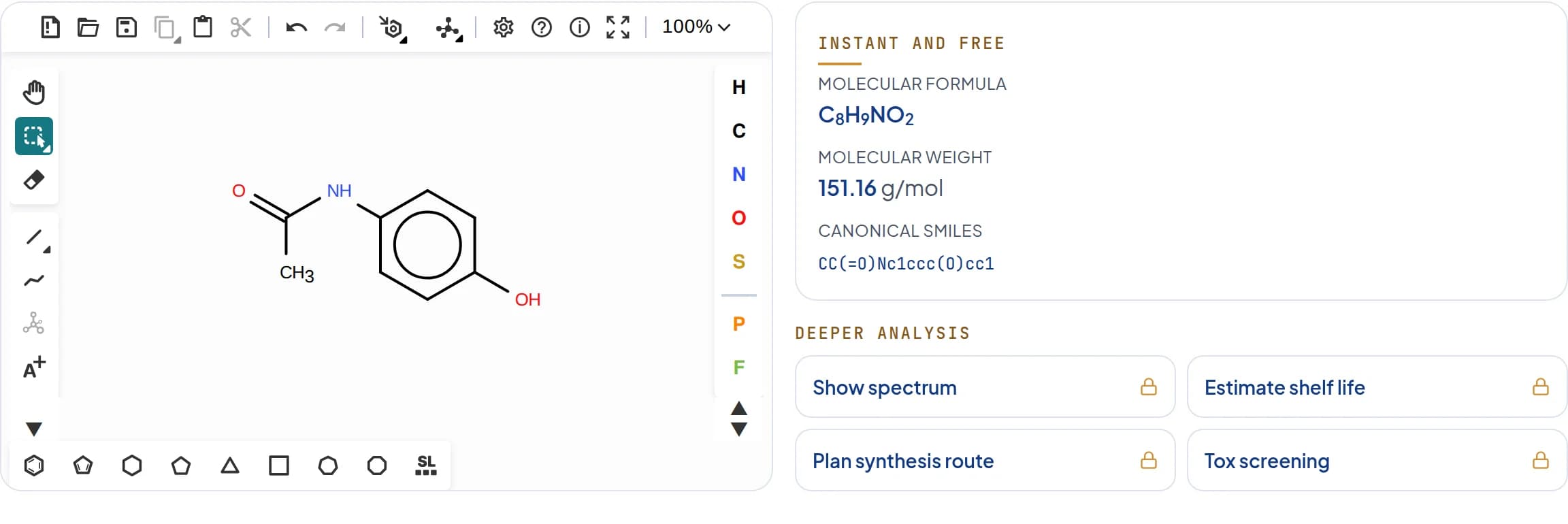
Draw a molecule. The values appear instantly.
The preview computes formula, molecular weight and canonical SMILES right in your browser.
- No sign-in
- Real computation
- Under 1 minute
New at CovaSyn
All systems operational26.10.10Clearly set out what happens to your dataLive
27 October 2026
A dedicated page now sets out how we handle your data: it serves only your assignment, is stored in Germany and is deleted on request. For your quality assurance we offer an agreement, a questionnaire and an audit on request.
- Your data used only for your assignment, stored in Germany, deleted on request
- Data handover through a dedicated upload link per assignment
- Quality agreement, supplier questionnaire and audit on request
Ask in your AI. Check in the sketcher.
Without tools, a language model miscounts atoms and invents shifts that look plausible. With CovaSyn MCP it calls a tool for every number, and you see which one. Or draw in the sketcher and analyse with a right-click, no chat needed.
Paracetamol, CC(=O)Nc1ccc(O)cc1: formula, molar mass, and which 1H NMR signals should I expect in DMSO-d6?
CovaSyn MCPCheck structure0.3 s
CovaSyn MCPNMR prediction1.1 s
C8H9NO2, 151.16 g/mol. Expected in DMSO-d6, five signals:
- δ 9.6 s 1H NH
- δ 9.1 s 1H OH
- δ 7.3 d 2H Ar-H, J ≈ 8.9 Hz
- δ 6.7 d 2H Ar-H, J ≈ 8.9 Hz
- δ 2.0 s 3H CH3
Example conversation, shortened.
Ready in a few minutes
Create an account, start in the browser, or add CovaSyn MCP once as a connector in your AI. Sign-in runs through your account, no key to copy.
Sign up free
Create an account with your email address. Nothing to install, no IT involved.
Draw or ask
Right-click in the sketcher, or ask Claude and ChatGPT in your own words.
Connector URL in Claude or ChatGPT:
https://mcp.covasyn.com/mcp
Use the result
Numbers, charts and the tool version, traceable for colleagues and QA.
The checks that usually cost you an afternoon
Does the spectrum fit the structure? Does the impurity carry a mutagenicity alert? Is there a route through building blocks you can buy? Every answer runs on the same molecule, deterministic and with the tool version.
- Check the structure
- Valence, stereochemistry, tautomers and properties of the structure you drew, reusable as an unambiguous SMILES.
- Interpret spectra
- Match NMR, MS and IR against the structure, assign signals, see what does not fit. UV/Vis for assay and dissolution.
- Estimate stability
- Assign degradation pathways from stress studies, shelf life per ICH Q1E from your long-term data, Arrhenius estimates from accelerated data for planning, catch OOT trends early.
- Plan a route
- Retrosynthesis down to building blocks from a catalogue of commercial compounds, several routes ranked by model likelihood. Conditions and availability are yours to check.
- Screen toxicology
- Mutagenicity alerts for impurities and intermediates from two complementary (Q)SAR methods, as ICH M7 requires, with a class proposal for your expert review. Plus predicted tox endpoints.
- Solubility and crystallisation
- Solubility at any temperature with a 90 % interval, solvent shortlists filtered by ICH Q3C and miscibility, cooling and antisolvent yield with a proposed charge.
Without our tools 14 to 41 %, with them 76 to 92 %.
On MolecularIQ, a public peer-reviewed chemistry benchmark presented at ICLR 2026, frontier models answered 14 to 41 % of tasks correctly without our tools and 76 to 92 % with them.
Model alone
14 to 41 %
answered correctly
With our tools
76 to 92 %
answered correctly
Source: MolecularIQ, arXiv:2601.15279, dataset and code public.
For everyone who needs an answer about a molecule
- Analytical and QC
- Check a spectrum against its structure, place unknown peaks, prepare methods before the instrument is free.
- Medicinal chemistry
- Rank candidates by predicted ADMET properties, tox alerts and synthetic effort before anyone spends a week on a synthesis.
- Process development
- Shortlist solvents, design a cooling crystallisation with charge and yield, set up a design of experiments. Your first experiments run on systems that physically work.
- CMC and regulatory
- Assign degradation pathways early, prepare an ICH M7 class proposal for impurities, evaluate shelf life per ICH Q1E from your long-term data. With the tool version for your records.
Try it now, no account needed
Each calculator runs the same calculation as the full version. Enter values, see the result. With a free account you keep going on the molecule you drew.
ICH M7 quick classification
Expert rules and a statistical model in one pass, with class proposal, mechanism and confidence. Your expert review confirms the classification.
Open calculatorMolecular formula from exact mass
Candidate formulas for a measured m/z, with mass error in ppm, RDBE and a plausibility score.
Open calculatorDrug-likeness: Lipinski, Veber, QED
Molecular weight, LogP, hydrogen bond donors and acceptors, TPSA, plus Lipinski, Veber, Ghose, QED and synthetic accessibility.
Open calculatorIsotope pattern from molecular formula
Theoretical isotope pattern with relative intensities, the cross-check for every formula assignment.
Open calculatorHPLC starting method
Column, eluents, gradient and flow as a starting point for the first injection.
Open calculatorStart free, grow when it fits
Free, Pro and Max with a weekly allowance, cancel monthly. When the allowance runs out, nothing is charged automatically. Licences for teams and companies on request.
What happens to your data
Your inputs are processed only for your request, not stored permanently and never used for training.
- Servers in the EU
- Hosted at Hetzner in Nuremberg, data kept in the EU.
- No training
- Your data feeds no training, neither ours nor that of service providers we use. This is set out in the data processing agreement, not just on this page. The computing tools are deterministic: same input, same result.
- Deletion on request
- On request we delete your data within 30 days, backups included. Rights to inputs and results remain yours.
Computed, explained, verifiable
Practical articles on design of experiments, prediction models, docking and formulation, each with real numbers.
Solubility prediction benchmarked: what the numbers say, and what they do not
On the public FastSolv benchmark our solubility model reaches an RMSE of 0.70 (SolProp) and 0.87 (Leeds) log units for compounds not in the training data. Every prediction carries a 90 % interval. What that means for solvent screening, and where a measurement still has to decide.
Read articleResponse Surface Methodology, End to End
A response surface methodology tutorial with a worked example: 18-run CCD, quadratic fit R2 0.9988, optimum with CIs, design space and residual.
Read articleHigh Concentration Antibody Viscosity: Predict It Early
High concentration antibody viscosity decides whether your mAb can be a subcutaneous injection. Predict it from sequence before formulation work begins.
Read articleFrequently asked questions
What does the Sketcher cost?
The free plan costs nothing and includes a weekly allowance of analyses. Pro and Max are booked monthly inside the app and can be cancelled at the end of any month. All prices are on the pricing page.
Do I need to install anything or involve IT?
No. The sketcher runs in the browser. For Claude, ChatGPT, Cursor or VS Code you add CovaSyn MCP once as a connector; the docs walk you through it.
Is an AI doing the maths, or a tool?
The numbers come from deterministic tools: structure checks, NMR prediction, ICH Q1E regression, (Q)SAR models. Your AI picks the tool and words the answer. Which tool and version produced each number is shown in the conversation. Review the AI's wording like any draft; the number underneath does not change.
What happens to my structures and data?
Your inputs are processed only for your request, not stored permanently and never used for training. Your data feeds no training, neither ours nor that of service providers we use. This is set out in the data processing agreement, not just on this page. The computing tools are deterministic: same input, same result. When you ask in Claude or ChatGPT, your question also passes through that AI client; its terms and your settings there apply. For unpublished structures, use the right-click analysis in the sketcher or your company's AI account.
How traceable are the results?
Every call is logged in the audit trail with timestamp, tool and version, without content. Same input, same result. In a GMP context it is a supporting calculation; assessment and release stay with your experts, for example the ICH M7 expert review.
Is it available for whole teams?
Yes. The team licence starts at 5 users, with a shared allowance, invoicing, a DPA and SSO, and a 3-month onboarding phase. From January 2027 it also runs on your own servers. We settle the price in the intro call.
Your next molecule, checked today.
Create an account, draw a molecule, see your first analysis. Upgrade to Pro or Max later, inside the app, when you need more. Or let us show you the Sketcher in a demo call first.