

You have a monoclonal antibody that works, and a clinical plan that says subcutaneous. That plan quietly commits you to a dose concentration somewhere north of 100 mg/mL, and at that concentration a solution that behaved like water at 20 mg/mL can turn into something that will not go through a 27G needle. The question worth answering at candidate selection, not at the tech-transfer meeting, is: which of my candidates will do that?
Why subcutaneous forces high concentration
The arithmetic is unforgiving. A typical mAb dose is in the hundreds of milligrams. A subcutaneous bolus into the abdomen or thigh is conventionally held to about 1 to 2 mL, because larger volumes hurt and back-pressure rises. Divide a 300 to 600 mg dose by 1 to 2 mL and you land at 150 to 300 mg/mL.
There are only three exits from that box, and each has a cost:
- Reduce the dose. Usually not available: the dose was set by efficacy.
- Increase the volume. Needs a delivery workaround. Herceptin Hylecta, for instance, delivers 600 mg trastuzumab in 5 mL by co-formulating recombinant human hyaluronidase, which is 120 mg/mL (product label). That is a real answer, but it adds a second active component and its own regulatory and supply chain burden.
- Make the protein tolerate the concentration. Formulation, or engineering, or both.
The third exit is the one that pays back, and it is also the one you can start assessing from sequence long before you have material to put in a rheometer.
What viscosity actually does to syringeability
Injection force through a needle scales roughly linearly with dynamic viscosity for a given needle geometry and flow rate, and inversely with the fourth power of the needle radius. Two consequences follow:
1. Viscosity is the lever you have. Needle gauge is mostly fixed by patient tolerability. 2. The problem is non-linear in concentration. Viscosity of a concentrated mAb solution typically rises exponentially, not linearly, with protein concentration, so a candidate that is fine at 100 mg/mL can be out of specification at 150 mg/mL.
Formulation groups commonly work to a rule of thumb of roughly 20 cP or below for a hand-held syringe or autoinjector at refrigerated-to-room temperature. Treat that as a working heuristic, not a specification: the real limit depends on your device, needle, plunger speed, spring force, and the temperature at which the patient actually injects.
Worked example: trastuzumab heavy chain at 150 mg/mL
We applied CovaSyn's sequence-based viscosity prediction to the public trastuzumab heavy chain sequence. Nothing here is hand-picked: these are the results as returned.
At the default subcutaneous condition, 150 mg/mL and pH 6.0:
- Estimated viscosity: 18.97 cP
- Risk level: moderate
- Named drivers: moderate charge-patch asymmetry (symmetry 0.33) and a large hydrophobic patch (length 6 residues)
- Note: viscosity may challenge syringeability. Excipient screening with arginine and proline, or a lower concentration, are the options.
Read that as: right at the edge of the rule of thumb, with two named reasons and a specific experiment to run next.
The concentration ladder
Same sequence, same pH 6.0, four concentrations, all from the same prediction:
| Concentration | Estimated viscosity | Risk level |
|---|---|---|
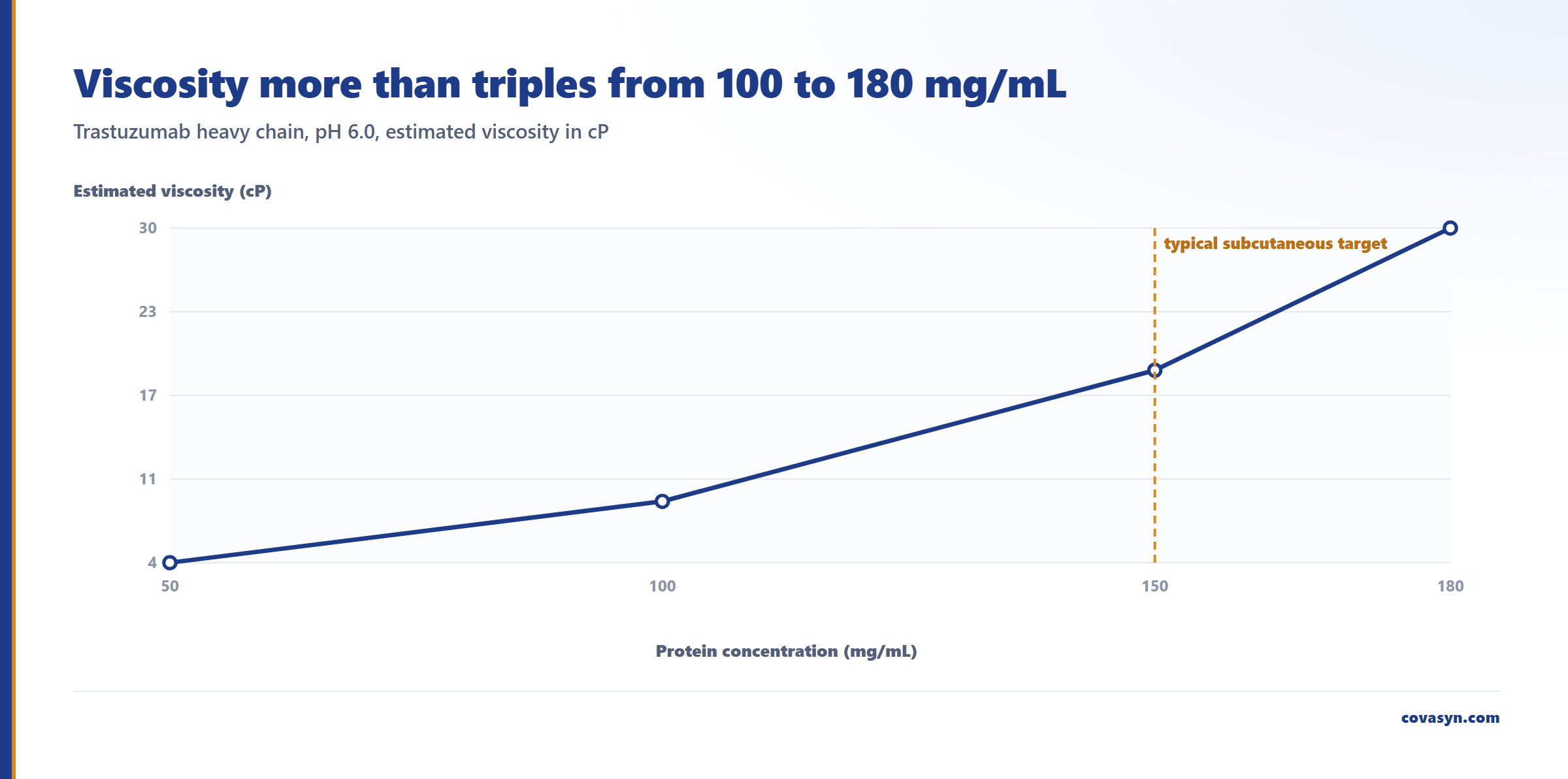
| 50 mg/mL | 4.16 cP | low |
| 100 mg/mL | 8.88 cP | low |
| 150 mg/mL | 18.97 cP | moderate |
| 180 mg/mL | 29.92 cP | moderate |
This is the shape of the problem in one table. Between 100 and 180 mg/mL the estimate more than triples. If your dose calculation moves you from 100 to 150 mg/mL late in development, the model says you are not making a small formulation adjustment: you are changing the problem.
The pH lever, and its honest limit
Same sequence, 150 mg/mL, pH varied:
| pH | Estimated viscosity | delta(pH, pI) | pI-proximity risk flag |
|---|---|---|---|
| 5.0 | 18.97 cP | 3.02 | low |
| 6.0 | 18.97 cP | 2.02 | low |
| 7.4 | 24.67 cP | 0.62 | high |
At pH 7.4 a third driver appears, proximity to the pI at a distance of 0.6 pH units, and the estimate rises about 30 percent. That is the model recognising that near the isoelectric point net charge collapses, electrostatic repulsion between molecules falls away, and self-association goes up.
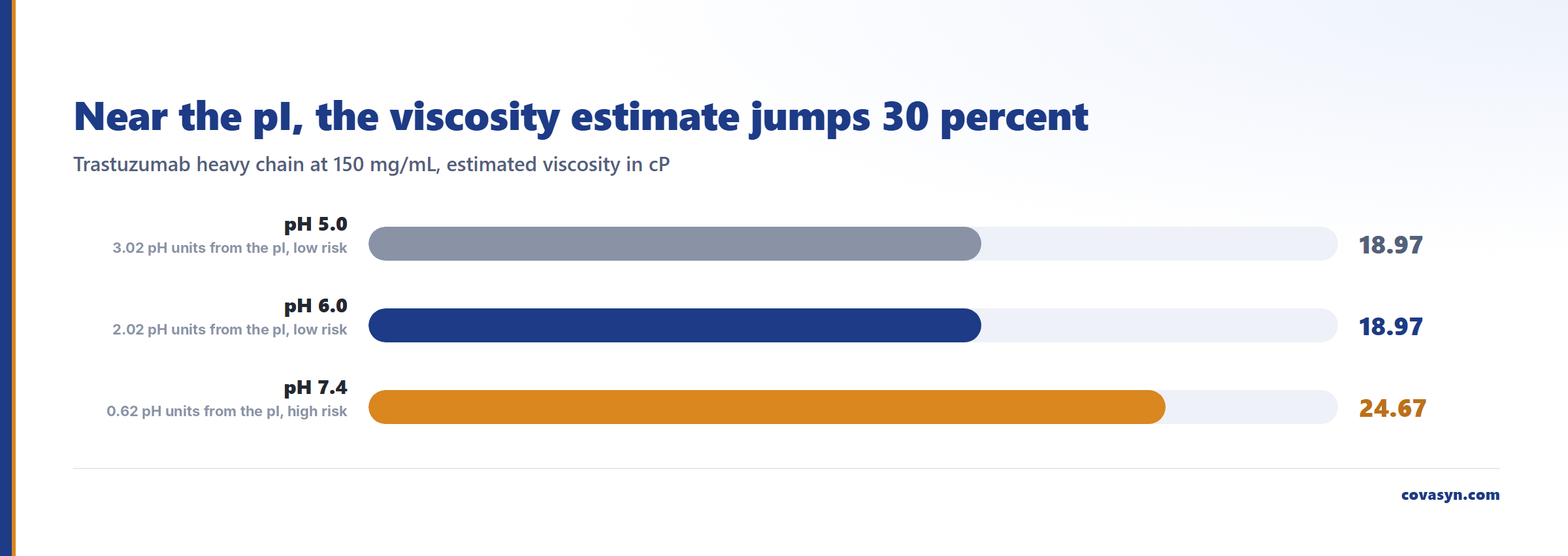
Note also what the table shows about the model itself: pH 5.0 and pH 6.0 return the identical value. The pI-proximity term is a threshold, not a continuous function. Below the threshold, moving pH does nothing in this model. Do not use it to fine-tune a buffer pH: use it to tell you whether you are formulating dangerously close to the pI.
The named drivers
The mechanistic detail block is where the triage value sits:
| Descriptor | Value | Why it matters |
|---|---|---|
| Charge symmetry | 0.3333 (2 positive patches, 4 negative patches) | Asymmetric surface charge drives dipole-like head-to-tail self-association, a well-described viscosity mechanism for IgGs |
| Max hydrophobic patch length | 6 residues (11 patches total, surface hydrophobicity 0.017) | Exposed hydrophobic patches promote reversible self-association |
| Estimated pI | 8.02 | Sets the safe formulation pH window |
Charge-patch asymmetry of 0.33 and a length-6 hydrophobic patch are the two things a protein engineer can act on. If you have freedom to mutate, that is where to look. If you do not, it is a formulation problem, and the note to screen arginine and proline is the standard first move, because both act on the electrostatic and hydrophobic self-association pathways this model is flagging.
How to use this in a real programme
A workable sequence for a lead panel:
1. Predict viscosity for every candidate at the intended clinical concentration, not at a convenient one. The ladder above shows why. 2. Run it again at your intended formulation pH and at pH 7.4. If the pI-proximity flag turns high anywhere in your intended range, that is a formulation constraint, not a nuance. 3. Rank the panel. Use the estimate to decide which two or three candidates get scarce material for real rheology, not to declare a winner. 4. Pair it with the rest of the developability panel. Viscosity almost never travels alone: the same hydrophobic patches that raise viscosity tend to show up as aggregation flags in the developability assessment. 5. Measure. A cone-and-plate or microfluidic viscometer reading on 100 to 200 microlitres of real material settles the question. The model exists to decide who gets that material.
What this does not tell you
Being explicit, because this is a heuristic model and it should be used as one:
- It is an estimate, not a measurement. Underneath it is a heuristic sequence-descriptor correlation, not a physical simulation and not a fit to your molecule. Treat the absolute cP value as a rank-ordering signal with an uncertainty of the same order as the rule-of-thumb limit it is being compared to.
- It sees sequence, not formulation. Ionic strength, buffer species, sugars, surfactant, and the actual excipients you will use are not inputs. It cannot tell you how much arginine to add, only that arginine is the right thing to screen.
- We ran it on the heavy chain sequence alone. It is a single-chain model. A real IgG is two heavy and two light chains, glycosylated, with a paired Fv. Interpret it as a heavy-chain-driven risk signal for the molecule, not as the assembled antibody.
- The pI is estimated, and estimators disagree. The viscosity prediction reports pI 8.02 for this sequence, while a general protein profile reports 8.49 for the same sequence using a different pKa set. Neither is a measured cIEF value. The safe formulation window should be drawn with that spread in mind.
- No temperature dependence. Viscosity is strongly temperature-dependent, and patients inject product that has been out of the fridge for an unknown time. The model gives you one number, not a curve.
- It is triage, not a filing. This is decision support to prioritise wet-lab work. It is not a substitute for measured viscosity data and it does not go into a submission.
Frequently asked questions
What is a high concentration antibody formulation?
In practice, any monoclonal antibody solution at or above roughly 100 mg/mL. Subcutaneous delivery drives this: a 1 to 2 mL injection volume combined with a dose of several hundred milligrams forces concentrations of 150 mg/mL or more. Above about 100 mg/mL, viscosity, reversible self-association, opalescence, and aggregation risk all rise sharply and non-linearly with concentration.
What viscosity is too high for subcutaneous injection?
Formulation groups commonly work to a rule of thumb of about 20 cP or below for a hand-held syringe or autoinjector. This is a heuristic, not a specification. The real limit depends on needle gauge and length, plunger force, injection time, device spring characteristics, and the temperature at which the patient injects. Any candidate near 20 cP needs measured injection-force data, not a model.
Can you predict antibody viscosity from sequence alone?
Partly. Sequence-derived descriptors (charge-patch asymmetry, exposed hydrophobic patch size, and the distance between formulation pH and pI) correlate with high-concentration viscosity and are enough for rank-ordering a candidate panel. Our viscosity prediction returns an estimate plus these named drivers. It is a heuristic model, so use it to decide which candidates get scarce material for measurement, not to replace measurement.
Why does viscosity rise near the isoelectric point?
At pH near the pI, the antibody carries little net charge, so the electrostatic repulsion that keeps molecules apart is weakest. Molecules self-associate reversibly into transient clusters, and those clusters raise the effective hydrodynamic volume and therefore the viscosity. In the worked example, moving from pH 6.0 to pH 7.4 with an estimated pI of 8.02 raised the estimate from 18.97 to 24.67 cP.
Do arginine and proline actually reduce antibody viscosity?
They are the standard first-line excipients to screen, and are widely used in marketed high-concentration biologics. Arginine is thought to disrupt both electrostatic and hydrophobic self-association contacts; proline acts similarly as a weak chaotrope-like cosolute. Effect size is molecule-specific and can range from negligible to a several-fold reduction, so the outcome has to be measured on your molecule in a small excipient screen.
When in development should viscosity be assessed?
At candidate selection, from sequence, before material is committed. Viscosity is a molecular property that formulation can moderate but not eliminate. Discovering at 150 mg/mL that your lead is unformulable costs a programme far more than screening the panel in silico first. The in-silico step decides which two or three molecules get the real rheology run.
Related reading
Computed with CovaSyn
The numbers in this article come from our tools.
- Antibodies, peptides, mRNA, siRNA, ADCs.