
AlphaFold3 Alternatives in 2026: An Honest Comparison
AlphaFold3 alternatives compared: OpenDDE, ESMFold2, Protenix, OpenFold3, Boltz-1 and Chai-1 on a published antibody-antigen benchmark, plus our own.
Oliver Kraft
CovaSyn

You need a structure prediction engine, and the field now has at least seven credible options. Most comparison posts either quote a single leaderboard number or quote a monomer confidence score and call it accuracy. Those are different quantities, and mixing them is how teams end up trusting a model on exactly the task it is worst at.
This article keeps two sources of evidence strictly apart: a benchmark that OpenDDE published, and folds we ran ourselves through covafold_fold and covafold_cofold. We tell you which is which every time.
The short answer
For monomers, almost everything modern is good enough. The ranking barely matters for a well-behaved globular protein with deep homology - you will get a usable backbone from ESMFold, AlphaFold3, Boltz or OpenDDE.
For complexes, and antibody-antigen complexes in particular, the spread between engines is large. That is where the choice actually costs you something.
The published benchmark: antibody-antigen complexes
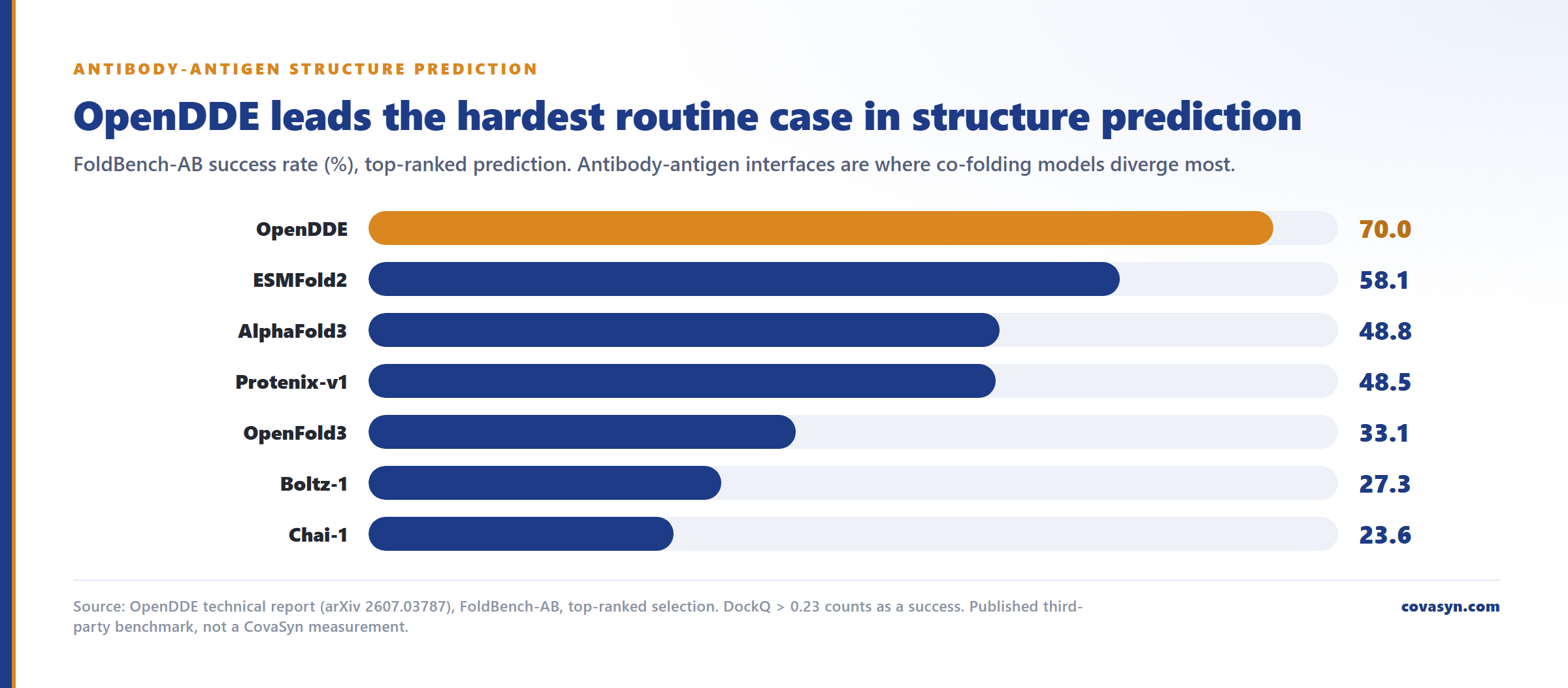
The numbers below are OpenDDE's own published FoldBench-AB result, not a CovaSyn measurement. We reproduce them because they are the most directly relevant public comparison for biologics work, and we label them as what they are: a vendor-published benchmark on their own model.
| Engine | Antibody-antigen success rate (%) |
|---|---|
| OpenDDE | 70.0 |
| ESMFold2 | 58.1 |
| AlphaFold3 | 48.8 |
| Protenix-v1 | 48.5 |
| OpenFold3 | 33.1 |
| Boltz-1 | 27.3 |
| Chai-1 | 23.6 |
Source: OpenDDE, FoldBench-AB antibody-antigen subset. Not independently reproduced by CovaSyn.
Read this with the usual caution you would apply to any benchmark published by the party that wins it. Self-reported results tend to sit at the optimistic end: the authors chose the benchmark, the subset, the success threshold and the inference settings. The ordering of the trailing engines is probably more robust than the exact gap at the top.
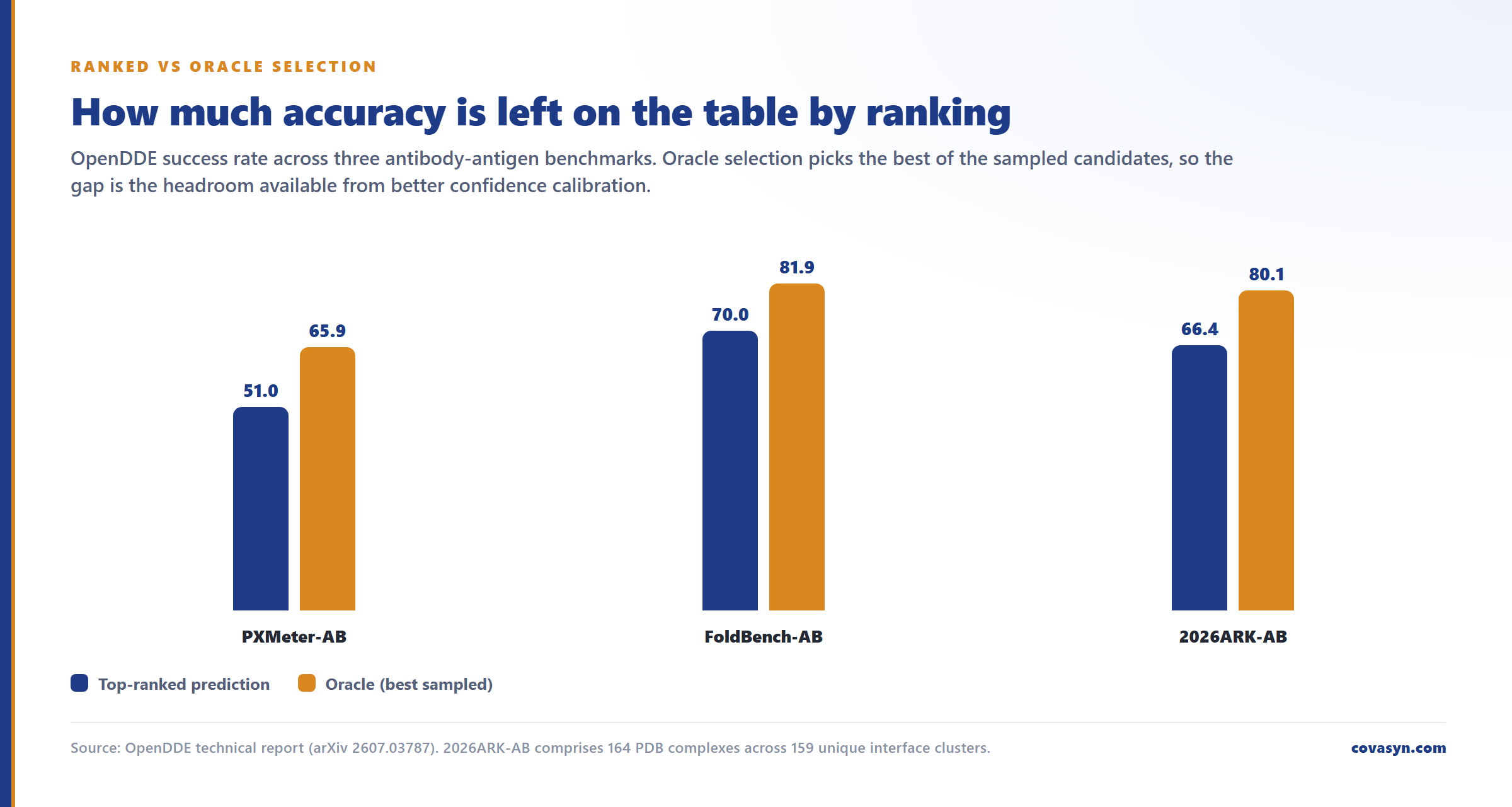
What is worth taking from the table regardless of who published it: antibody-antigen is still hard for everyone. Even the best number here means roughly three in ten predictions are not usable. If your workflow assumes a correct epitope from the model, that assumption fails often enough to matter.
Our own runs: what CovaFold actually returns
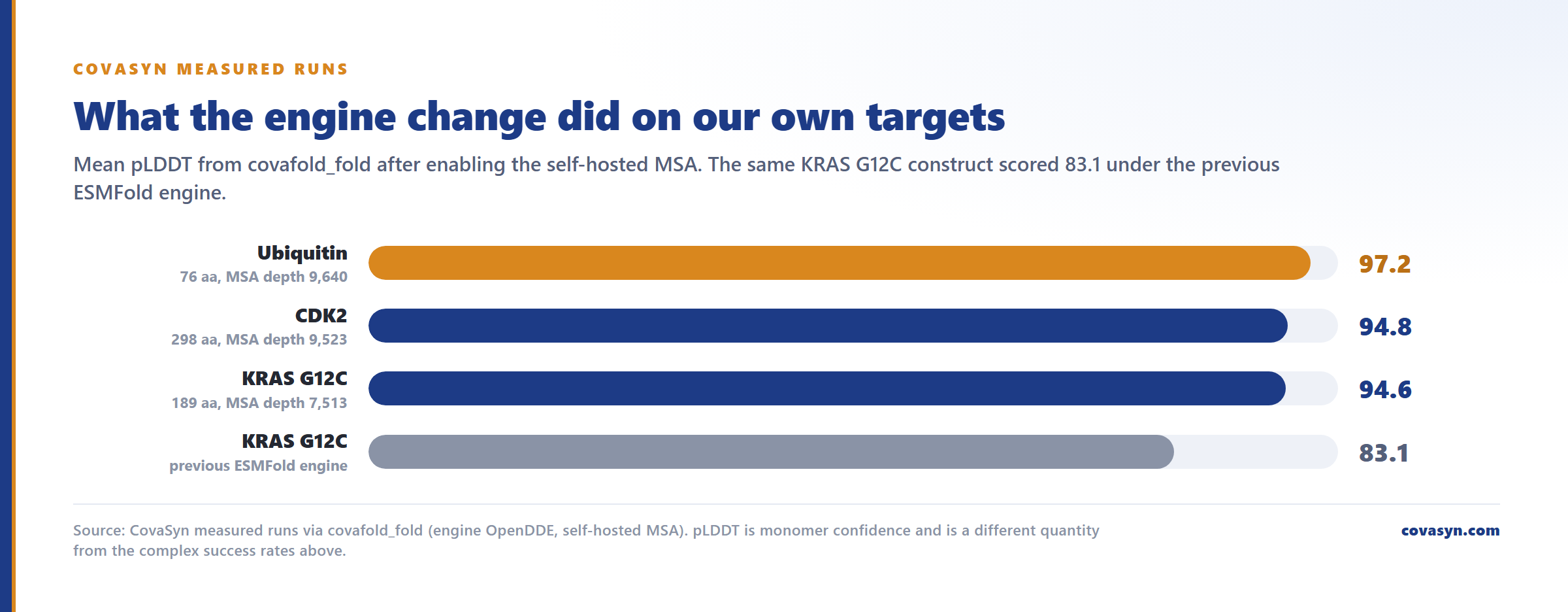
CovaFold moved its folding engine from ESMFold to OpenDDE. The numbers below are CovaSyn measurements on our own infrastructure, post-MSA-enable, via covafold_fold (monomer) and covafold_cofold (complex).
| Target | Length (aa) | fold pLDDT | cofold ipTM | MSA depth |
|---|---|---|---|---|
| Ubiquitin | 76 | 97.19 | 0.63 | 9,640 |
| KRAS G12C | 189 | 94.61 | 0.99 | 7,513 |
| CDK2 | 298 | 94.79 | 0.97 | 9,523 |
For a before/after on the same construct: the identical KRAS G12C sequence scored 83.1 pLDDT under the previous ESMFold engine and 94.61 under OpenDDE. Same input, same pipeline, different engine.
Three things to be precise about:
1. pLDDT is not accuracy. It is the model's own per-residue confidence, calibrated against a training distribution. High pLDDT on a well-represented fold like ubiquitin is close to a tautology. It tells you the model is not confused; it does not tell you the structure is right. 2. These are monomers. The FoldBench-AB table above measures complexes. A 97.19 monomer pLDDT and a 70.0 antibody-antigen success rate are not the same claim and cannot be averaged, compared or presented as one story. 3. The ipTM column is the complex number, and it moves independently. Ubiquitin scored 97.19 as a monomer but only 0.63 ipTM as a complex - the model is confident about the chain and unconfident about the interface. That single row is the whole argument for reading the two metrics separately.
The cost nobody puts on the slide: MSA time
Accuracy is the number people compare. Latency is the number that decides whether the tool gets used.
Measured on our runs:
- Cold MSA for a new target: roughly 2,500-2,900 seconds (about 42-49 minutes). Ubiquitin ~2,491 s, KRAS G12C ~2,500 s, CDK2 ~2,934 s.
- Cached MSA: 0.2-0.5 seconds.
That is a four-orders-of-magnitude difference and it drives your architecture. A screening loop over a fixed target family runs effectively instantly after the first pass. A loop over novel sequences pays ~45 minutes each, every time.
One honest caveat we hit ourselves: the MSA cache did not appear to hit for a point mutant. A re-fold of KRAS G12C was submitted and polled for about 60 minutes without completing, which is consistent with G12C keying differently from wild-type P01116 and taking the cold path. We are reporting that as an open operational issue, not as a resolved one.
How to choose
Pick by the task, not the leaderboard.
- Monomer, well-studied family, you need a backbone for docking prep: any modern engine works. Optimise for latency and cost. ESMFold-class single-sequence models skip MSA entirely, which is the whole point of them.
- Antibody-antigen or any protein-protein interface: this is where engine choice is load-bearing, and where you should expect a meaningful failure rate whatever you pick. Predict multiple seeds, look at ipTM and not pLDDT, and treat a low-ipTM interface as "no answer" rather than "weak answer".
- Licensing and deployment: several of these models carry non-commercial or copyleft terms. Check the licence before you build a product on one. This is frequently the deciding factor, not the benchmark.
- Reproducibility: if the structure feeds anything regulated, you need the model version, the MSA database snapshot and the seed pinned. A number without those three is not reproducible.
What these numbers do not tell you
- Nothing here is experimental validation. No crystal structure, no cryo-EM map, no SPR. Predicted structures are a triage and hypothesis-generation layer.
- A benchmark success rate is not your success rate. Benchmark sets skew towards targets with homologs in the PDB. A genuinely novel scaffold, a heavily engineered binder or a disordered region will do worse than the table suggests.
- pLDDT and ipTM are model self-reports. They are useful for ranking your own predictions against each other. They are not comparable across engines as if they were a common scale.
- Low confidence is often correct. A disordered loop *should* score low. Discarding a prediction because part of it has low pLDDT can mean discarding the right answer.
- We did not independently re-run the FoldBench-AB benchmark. Our re-verification attempt in-session was inconclusive (the job did not complete within the polling window). That is absence of evidence, not confirmation.
Frequently asked questions
What are the main AlphaFold3 alternatives in 2026?
The practical alternatives are OpenDDE, ESMFold2, Protenix-v1, OpenFold3, Boltz-1 and Chai-1. They differ mainly in complex prediction quality, whether they require a multiple sequence alignment, and licensing terms. For monomer folds of well-studied proteins the differences are small. For protein-protein and antibody-antigen complexes the gap between engines is large enough to change project outcomes.
How do OpenDDE and AlphaFold3 compare on antibody-antigen complexes?
On OpenDDE's published FoldBench-AB antibody-antigen subset, OpenDDE reports 70.0 percent success versus 48.8 percent for AlphaFold3, with ESMFold2 at 58.1, Protenix-v1 at 48.5, OpenFold3 at 33.1, Boltz-1 at 27.3 and Chai-1 at 23.6. This is a vendor-published benchmark from the winning party, not an independent reproduction, and should be read with that bias in mind.
Is pLDDT the same thing as prediction accuracy?
No. pLDDT is the model's own per-residue confidence estimate, calibrated on its training distribution, not a measurement against an experimental structure. High pLDDT means the model is internally certain; it can be certain and wrong, particularly on novel folds. For complexes, use ipTM instead - in our CovaFold runs, ubiquitin scored 97.19 pLDDT as a monomer but only 0.63 ipTM as a complex.
How long does a structure prediction actually take?
The model inference is fast; the multiple sequence alignment is not. In CovaSyn's own covafold_fold runs, a cold MSA for a new target took roughly 2,491 to 2,934 seconds - about 45 minutes. Once cached, the same target returned in 0.2 to 0.5 seconds. Plan your pipeline around the cold path, because that is what a novel sequence will cost you.
Did switching engines actually improve results?
On one directly comparable construct, yes. The same KRAS G12C sequence scored 83.1 pLDDT under the previous ESMFold engine and 94.61 pLDDT under OpenDDE in CovaFold. That is a single-target, single-metric comparison of model confidence, not a validated accuracy gain across a test set, and it should not be generalised to your target without checking.
Can I use a predicted structure for a regulatory filing?
Not on its own. A predicted structure is decision support: it helps you prioritise constructs, plan mutagenesis and set up docking. Anything that goes into a filing needs experimental structural or functional evidence. If a prediction supports a regulated decision at all, pin the model version, MSA database snapshot and random seed so the run is reproducible.
Related reading
Structure prediction is on the CovaSyn free tier - fold a target you already have a crystal structure for and see how the confidence scores line up before you trust them on a novel one. - Binding Site Druggability Prediction, Honestly Read - pLDDT Explained: When to Trust a Predicted Structure
Tools for this topic
Use these in your AI agent right away.
- CovafoldProtein folding and structure prediction.